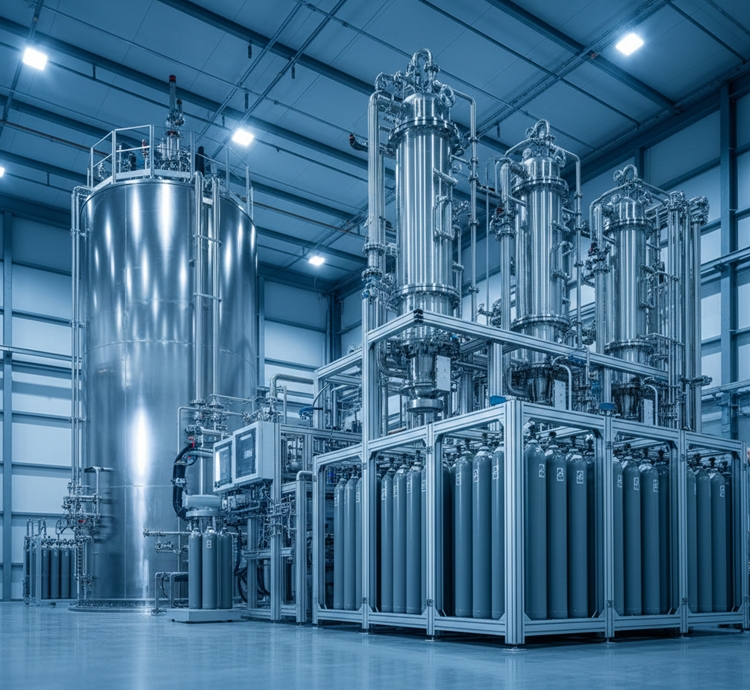
For decades, helium was treated as an industrial constant - essential, yes, but predictable. It cooled superconducting magnets, stabilized research equipment, and quietly supported laboratories where temperature precision mattered more than public attention. Then quantum computing shifted the conversation.
Quantum systems don’t just require low temperatures; they demand environments where microscopic instability becomes a system-level threat. A fluctuation that would be meaningless in conventional cryogenics can disrupt qubit coherence. At that scale, helium isn’t simply coolant - it becomes part of the operational architecture.
Ultra-clean cryogenic environments now act as the invisible scaffolding of quantum processors. Any trace impurity can influence thermal transfer behavior, introduce micro-vibrations, or degrade long-duration system stability. Engineers aren’t chasing theoretical perfection; they’re protecting fragile quantum states that depend on consistency measured in fractions of a degree.
This is where helium stops being a background material and becomes a precision instrument. Companies specializing in cryogenic refinement - including Cryoin Engineering - operate at the intersection of purification science and quantum infrastructure, where helium quality directly influences computational reliability. The shift is subtle but decisive: helium purity is no longer a maintenance detail. It’s a performance parameter.
The implication is straightforward. As quantum hardware scales, helium purity requirements scale with it. Systems that once tolerated minor contamination now require near-absolute stability. And that expectation reshapes how purification, storage, and circulation are engineered.
Cryogenic stability and the physics of quantum environments
Quantum processors live in conditions that border on the extreme. Dilution refrigerators operate millikelvin above absolute zero, where thermal noise becomes an existential threat to qubit fidelity. Maintaining that environment isn’t just about reaching temperature - it’s about preserving uniformity.
Helium plays a central role in this balancing act. Its thermodynamic behavior enables controlled cooling cycles, but only when purity remains intact. Even minimal contamination alters phase transitions and thermal conductivity, introducing variability where precision is mandatory.
Engineers designing cryogenic platforms must account for helium’s interaction with system materials, pressure gradients, and circulation loops. Stability isn’t static - it’s maintained through continuous monitoring and adjustment. When purity drifts, performance drifts with it.
Modern quantum facilities therefore treat helium handling as a dynamic discipline. Purification cycles are integrated directly into cryogenic workflows, ensuring that helium entering the cooling system meets strict tolerances. This isn’t redundancy - it’s structural insurance against instability.
Helium as infrastructure, not consumable
Traditional cryogenic systems treated helium as a resource to be supplied, used, and replenished. Quantum computing reverses that logic. Helium becomes persistent infrastructure - circulating through recovery loops, purification stages, and storage systems designed for minimal loss and maximal consistency.
This infrastructure mindset changes engineering priorities. Recovery efficiency becomes critical. Storage vessels incorporate conditioning mechanisms that preserve gas integrity over time. Monitoring systems track purity continuously, preventing drift before it reaches operational thresholds.
Facilities working at the edge of quantum performance increasingly design helium ecosystems rather than isolated cooling setups, aligning with cryoin helium quantum computing principles that emphasize system-wide stability. Every transfer, compression stage, and purification pass is part of a closed environment optimized for repeatability, ensuring consistent thermal behavior across advanced quantum platforms.
The benefit isn’t only stability. It’s predictability. When helium behaves consistently, quantum hardware can operate closer to theoretical limits. Performance tuning becomes a matter of design rather than compensation.
Engineering challenges in maintaining ultra-high purity
Maintaining ultra high purity helium isn’t simply a matter of filtering contaminants. At quantum scale, purity must survive compression, storage, circulation, and temperature cycling without degradation. Each transition introduces opportunities for micro-contamination or molecular imbalance.
Materials compatibility becomes critical. Surface interactions inside pipelines and valves can introduce trace particles. Thermal cycling stresses seals and joints, potentially allowing atmospheric intrusion. Even vibration control matters - mechanical disturbances can influence cryogenic flow behavior.
Purification systems must therefore operate as continuous guardians rather than periodic maintenance tools. Multi-stage cryogenic separation, adsorption refinement, and spectral monitoring combine to create purification architectures that function in real time. Helium doesn’t wait to be cleaned - it is kept clean.
These challenges expand further when helium interacts with broader research ecosystems. Facilities engaged in rare gases quantum fusion research often require synchronized cryogenic handling across multiple gas types. Maintaining cross-system purity demands precision engineering that anticipates contamination pathways before they appear.
The result is an evolving discipline where cryogenic purification is inseparable from system design. Ultra-high purity helium isn’t achieved once - it’s maintained through engineered vigilance.
Advanced purification architectures built for quantum environments
Once helium purity becomes a performance variable rather than a background requirement, purification architecture has to evolve. Traditional batch purification - clean, store, deploy - simply isn’t fast or stable enough for quantum systems operating at millikelvin precision. What replaces it is continuous architecture: purification embedded directly into circulation.
Modern systems combine cryogenic separation, adsorption layers, and real-time spectral monitoring into closed purification loops. Helium is constantly evaluated and conditioned while moving through the cooling ecosystem. The design philosophy is simple but demanding - contamination should never accumulate long enough to influence thermal behavior.
In high-performance quantum labs, purification isn’t a side module. It’s structural infrastructure. Pressure transitions, compression stages, and storage reservoirs are designed with integrated impurity interception zones that prevent micro-contamination from propagating. This reduces oscillations in cooling performance and stabilizes long-duration experiments.
Engineering firms working in this space-among themCryoin Engineering-focus on purification architectures designed to remain stable under continuous load. Their systems aren’t built around occasional cleanup; they assume helium is always in motion and always at risk. The result is a cryogenic environment that actively resists drift instead of reacting to it.
That shift is subtle but transformative. Instead of treating purity as a checkpoint, facilities treat it as a condition that must be preserved moment by moment.
Integration with rare gas ecosystems and fusion research
Quantum computing doesn’t exist in isolation. Many research facilities operate multi-gas cryogenic infrastructures where helium interacts with neon, xenon, and other specialty gases supporting adjacent experiments. When helium purity becomes mission-critical, integration across these ecosystems becomes an engineering challenge of its own.
Facilities engaged in rare gases quantum fusion research push cryogenic systems to extreme operational boundaries. Shared pipelines, thermal exchange zones, and compression stages must maintain gas segregation while preserving ultra-clean conditions. Even microscopic crossover risks destabilizing precision experiments.
Integrated purification frameworks address this by synchronizing gas-specific conditioning modules. Each rare gas moves through tailored refinement stages that prevent cross-contamination without disrupting cryogenic balance. Monitoring networks oversee the entire ecosystem, allowing operators to detect anomalies before they influence system stability.
This integrated approach changes how facilities are designed. Instead of independent gas silos, engineers build coordinated cryogenic environments where purification logic extends across systems. Helium purity isn’t protected in isolation - it’s reinforced by the architecture around it.
Specialists like Cryoin Engineering contribute to this layered ecosystem thinking, designing purification systems that anticipate interaction rather than merely responding to contamination. Their focus reflects a growing recognition that helium stability depends as much on surrounding infrastructure as on the gas itself.
Reliability, storage, and continuous purification loops
Quantum hardware demands uptime measured not just in hours, but in experimental continuity. A purity interruption isn’t a minor inconvenience - it can invalidate long research cycles or destabilize sensitive qubit arrays. Reliability therefore becomes inseparable from purification strategy.
Modern helium ecosystems embed continuous purification loops into storage and recovery stages. Rather than storing gas passively, facilities maintain gentle circulation that preserves molecular balance and removes impurities before they accumulate. Storage vessels effectively become active components of the cryogenic network.
Recovery systems add another resilience layer. Helium captured during cooldown transitions or maintenance cycles is immediately reconditioned, ensuring that reclaimed gas meets operational thresholds before reintegration. This closed-loop model minimizes loss while protecting consistency.
The benefit isn’t just efficiency - it’s operational confidence. Engineers know that helium entering the quantum cooling chain behaves identically to the helium that left it. Variability shrinks. Predictability grows. Experiments can run longer without interruption.
These reliability-focused architectures represent a philosophical shift: helium isn’t a consumable asset to be managed intermittently. It’s a circulating medium whose purity must remain stable across every transition.
The future of helium precision in quantum technologies
Quantum systems are scaling - more qubits, longer coherence windows, tighter thermal tolerances. As hardware advances, the cryogenic infrastructure supporting it must evolve in parallel. Helium purity standards will not plateau; they will sharpen.
Future purification architectures are trending toward predictive operation. Integrated sensors and analytics will anticipate contamination patterns, adjusting cryogenic conditions before instability emerges. Purity management becomes proactive rather than corrective.
This evolution aligns with a broader transformation in quantum engineering: treating environmental stability as part of computational design. Cooling infrastructure, purification logic, and gas management systems merge into a unified framework where helium precision directly influences processing capability.
Organizations such as Cryoin Engineeringexemplify this trajectory by advancing cryogenic systems that treat purity as a continuous engineering objective. Their work signals where the industry is heading - toward helium ecosystems designed not just for compliance, but for performance.
As quantum technology matures, helium will increasingly function as a precision medium rather than a background resource. The distinction matters. When cryogenic stability becomes computational infrastructure, purification stops being support work and becomes foundational engineering.
Ultra-high purity helium is no longer a peripheral concern in quantum computing - it is structural. Continuous purification, ecosystem integration, and reliability engineering now define how cryogenic environments are built.
Quantum performance depends on stability measured in microscopic margins. Maintaining those margins requires helium systems engineered for vigilance, not convenience.
And as quantum technology accelerates, the quiet science of helium purification will continue shaping how far - and how reliably - those systems can go.
Media Contact
Company Name: Cryoin Engineering Ltd.
Contact Person: Oleksandr
Email: Send Email
Country: Ukraine
Website: https://cryoin.com/