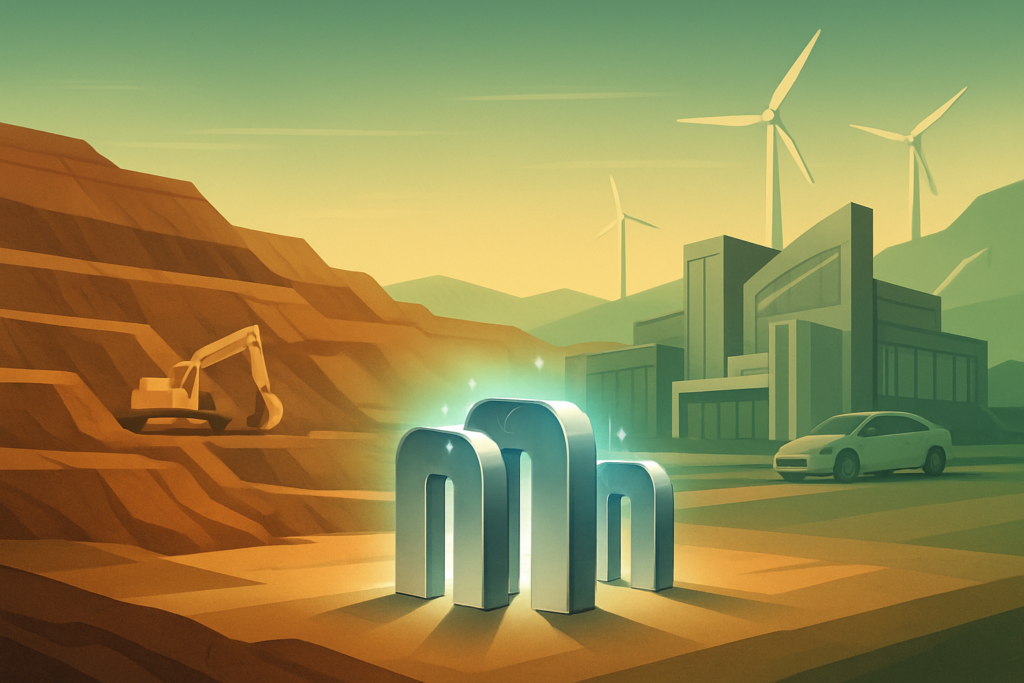
As of January 26, 2026, the global race for mineral sovereignty has reached a fever pitch, and no company finds itself more squarely at the center of this geopolitical storm than USA Rare Earth, Inc. (Nasdaq: USAR). Once a speculative venture aiming to revive the American "mine-to-magnet" supply chain, USAR has evolved into a strategic national asset. Today's landmark announcement of a $1.6 billion U.S. government investment package—comprised of direct grants and senior secured loans—marks the largest federal intervention in the critical minerals sector since the Second World War.
This capital infusion is not merely a corporate milestone; it is a decisive move by the U.S. Department of Commerce to break a decades-long Chinese monopoly on the rare earth elements (REEs) essential for electric vehicles (EVs), wind turbines, and advanced defense systems. With its flagship Round Top project in Texas and a newly commissioned magnet facility in Oklahoma, USA Rare Earth is attempting a feat of vertical integration that has eluded Western companies for thirty years. This feature explores the company's trajectory, its financial standing, and whether it can truly become the "Exxon of the Green Revolution."
Historical Background
The story of USA Rare Earth began with a recognition of the strategic vulnerability inherent in the global supply chain. Founded as a private entity, the company’s foundational move was the acquisition of an 80% interest in the Round Top Heavy Rare Earth and Critical Minerals Project in Sierra Blanca, Texas, in partnership with Texas Mineral Resources Corp (OTCQB: TMRC).
Throughout the early 2020s, USAR focused on a "mine-to-magnet" philosophy, realizing that simply mining ore was insufficient if the processing and manufacturing capabilities remained in China. In 2020, the company purchased the equipment from the only neodymium-iron-boron (NdFeB) magnet plant in the U.S., which had been shuttered years prior, and began planning its revival.
The company’s transformation accelerated in March 2025, when it successfully went public on the Nasdaq through a merger with Inflection Point Acquisition Corp. This IPO provided the necessary "dry powder" to scale its processing technologies and finalize the acquisition of Less Common Metals (LCM) in the UK and France, cementing USAR’s presence on both sides of the Atlantic.
Business Model
USA Rare Earth operates a uniquely vertically integrated business model designed to capture value at every stage of the REE lifecycle. Unlike traditional miners that sell raw concentrate to third-party refiners (often in China), USAR’s model is built on four pillars:
- Extraction: The Round Top deposit in Texas provides a massive, 130-year resource of heavy rare earths (Dysprosium, Terbium) and lithium.
- Processing & Separation: Utilizing proprietary Continuous Ion Exchange (CIX) technology, the company separates mixed rare earth oxides into high-purity individual elements at its Colorado facility.
- Metal & Alloy Production: Through its subsidiary LCM, the company converts these oxides into specialized metals and alloys.
- Magnet Manufacturing: The final and most lucrative stage occurs at its Stillwater, Oklahoma plant, where metals are transformed into sintered NdFeB magnets for industrial and automotive customers.
By controlling the entire chain, USAR aims to eliminate "midstream leak" where domestic ore is shipped abroad for processing, thereby securing higher margins and ensuring supply chain transparency for Tier 1 OEMs.
Stock Performance Overview
Since its public debut in March 2025 at an initial price of $10.00 per share, USAR has experienced significant volatility, typical of the "Critical Mineral 2.0" era.
- 1-Year Performance: In the past 12 months, the stock has risen 85%, buoyed by the completion of its Stillwater facility and today’s $1.6 billion government announcement.
- Post-IPO Trajectory: After hitting a low of $7.50 in mid-2025 amid concerns over permitting delays, the stock staged a massive rally in late 2025 as the U.S. government intensified its "De-risking" policy toward China.
- Current Valuation: As of January 26, 2026, USAR trades at approximately $18.40 per share, with a market capitalization of $3.3 billion. While the company is still pre-revenue from its mining operations, the market is pricing in the strategic "floor" provided by the U.S. government’s 16% potential equity stake.
Financial Performance
USAR’s balance sheet underwent a radical transformation today. Prior to the government deal, the company was burning approximately $45 million per quarter on capital expenditures and R&D.
Key Financial Metrics (Estimated Jan 2026):
- Cash Position: Post-investment, the company sits on roughly $1.9 billion in liquidity (including the $1.3 billion loan facility).
- Government Stake: The U.S. government has secured warrants for up to 17.6 million shares, effectively making the taxpayer a major partner in the enterprise.
- Projected Revenue: Analysts expect the first significant revenue from magnet sales to commence in H2 2026, with a massive ramp-up in 2028 when the Round Top mine comes online.
- Debt-to-Equity: The $1.3 billion senior secured loan increases the company's leverage significantly, but the 15-year term and subsidized interest rates provide a manageable runway.
Leadership and Management
The leadership of USA Rare Earth was "industrialized" in late 2025 to prepare for the massive scale-up.
- Barbara Humpton (CEO): The former CEO of Siemens USA (OTC: SIEGY) took the helm in October 2025. Her deep ties to the Department of Defense and Department of Energy were instrumental in securing the $1.6 billion federal package.
- Thayer Smith (President): A veteran of the company’s early years, Smith remains the architect of the operational strategy. His focus is on the "technical de-risking" of the CIX separation technology and the mine build-out.
- Board of Directors: The board includes former high-ranking officials from the U.S. Geological Survey and veterans from the automotive and defense sectors, reflecting the company’s dual role as a commercial entity and a national security asset.
Products, Services, and Innovations
The crown jewel of USAR’s innovation is its Continuous Ion Exchange (CIX) processing. Traditional solvent extraction is chemically intensive and environmentally taxing. CIX allows for the separation of rare earths with a much smaller footprint and lower water consumption, a critical factor for the arid West Texas climate.
In Stillwater, Oklahoma, the company’s magnet facility utilizes advanced sintering techniques to produce magnets with high coercivity—meaning they can operate at the high temperatures required for EV motors without losing their magnetic properties. Furthermore, USAR is developing a "circular" magnet recycling program, allowing it to recover REEs from end-of-life electronics and reintroduce them into the manufacturing stream.
Competitive Landscape
USAR operates in a landscape dominated by three major forces:
- China (State-Owned Enterprises): China still controls over 85% of global rare earth processing. Their ability to flood the market and crash prices remains the primary external threat to USAR.
- MP Materials (NYSE: MP): The current domestic leader. While MP Materials has a head start in mining at Mountain Pass, USAR’s focus on heavy rare earths (Dysprosium/Terbium) differentiates it, as MP primarily produces light rare earths (Neodymium/Praseodymium).
- Lynas Rare Earths (ASX: LYC): The largest producer outside of China. USAR competes with Lynas for non-Chinese off-take agreements with European and American automakers.
Industry and Market Trends
The "Great Re-Shoring" is the dominant trend of 2026. As Western governments realize that the energy transition is impossible without REEs, industrial policy has replaced pure free-market dynamics.
- EV Proliferation: Despite a plateau in some regions, the transition to permanent magnet motors in EVs continues to drive a 12% CAGR in NdFeB demand.
- Geopolitical Bifurcation: The world is splitting into two mineral blocs. USAR is the flagship of the "Mineral Security Partnership" (MSP), an alliance of 14 countries aiming to build supply chains independent of Beijing.
Risks and Challenges
Investing in USAR is not without significant peril:
- Execution Risk: Building a multi-billion-dollar mine and processing plant simultaneously is a Herculean task. Any delays at Round Top could starve the Oklahoma magnet plant of domestic feedstock.
- Price Volatility: Rare earth prices are notoriously opaque and volatile. A sudden drop in prices orchestrated by Chinese state-owned firms could hurt USAR’s margins.
- Regulatory Hurdles: Despite federal support, the Round Top project must navigate a complex web of environmental assessments and local permitting in Texas.
Opportunities and Catalysts
The primary catalyst is the Accelerated Mine Plan, which aims to bring Round Top into commercial production by 2028.
- Defense Contracts: With the U.S. military moving toward a "China-free" supply chain for its F-35 fighter jets and Virginia-class submarines, USAR is perfectly positioned to secure high-margin defense off-take agreements.
- Strategic Stockpiling: The U.S. government’s move to create a National Defense Stockpile of permanent magnets provides a guaranteed "buyer of last resort" for USAR’s production.
Investor Sentiment and Analyst Coverage
Wall Street sentiment has shifted from "skeptical" to "strategic." Goldman Sachs and Morgan Stanley have recently initiated coverage on USAR, with "Buy" ratings predicated on the company’s unique position as a government-backed monopoly-challenger.
Institutional ownership has surged to 45%, with major positions held by BlackRock and the Vanguard Group. On retail forums, USAR is often discussed as a "generational hold," with investors betting on the long-term inevitability of mineral de-coupling from China.
Regulatory, Policy, and Geopolitical Factors
The $1.6 billion investment is part of a broader suite of policies including the Inflation Reduction Act (IRA) and the CHIPS and Science Act. These laws provide production tax credits (Section 45X) that essentially subsidize the manufacturing of magnets on U.S. soil.
Geopolitically, the U.S. has signaled that it will use the "Defense Production Act Title III" to ensure that companies like USAR remain solvent even during periods of market manipulation. This "sovereign backstop" is perhaps the company’s greatest competitive advantage.
Conclusion
As of January 26, 2026, USA Rare Earth (Nasdaq: USAR) stands as a bold experiment in industrial policy. The $1.6 billion U.S. government investment has effectively "de-risked" the company’s capital structure, providing a bridge to 2028 when its domestic mining operations are slated to begin.
For investors, USAR represents a high-stakes bet on the future of the American energy transition. While operational and geopolitical risks remain substantial, the company’s "mine-to-magnet" vertical integration and unprecedented federal backing make it the most significant player in the Western quest for mineral independence. Investors should closely watch the commissioning of the Stillwater plant in Q1 2026 and the progress of environmental permitting at Round Top as the next major indicators of success.
This content is intended for informational purposes only and is not financial advice.