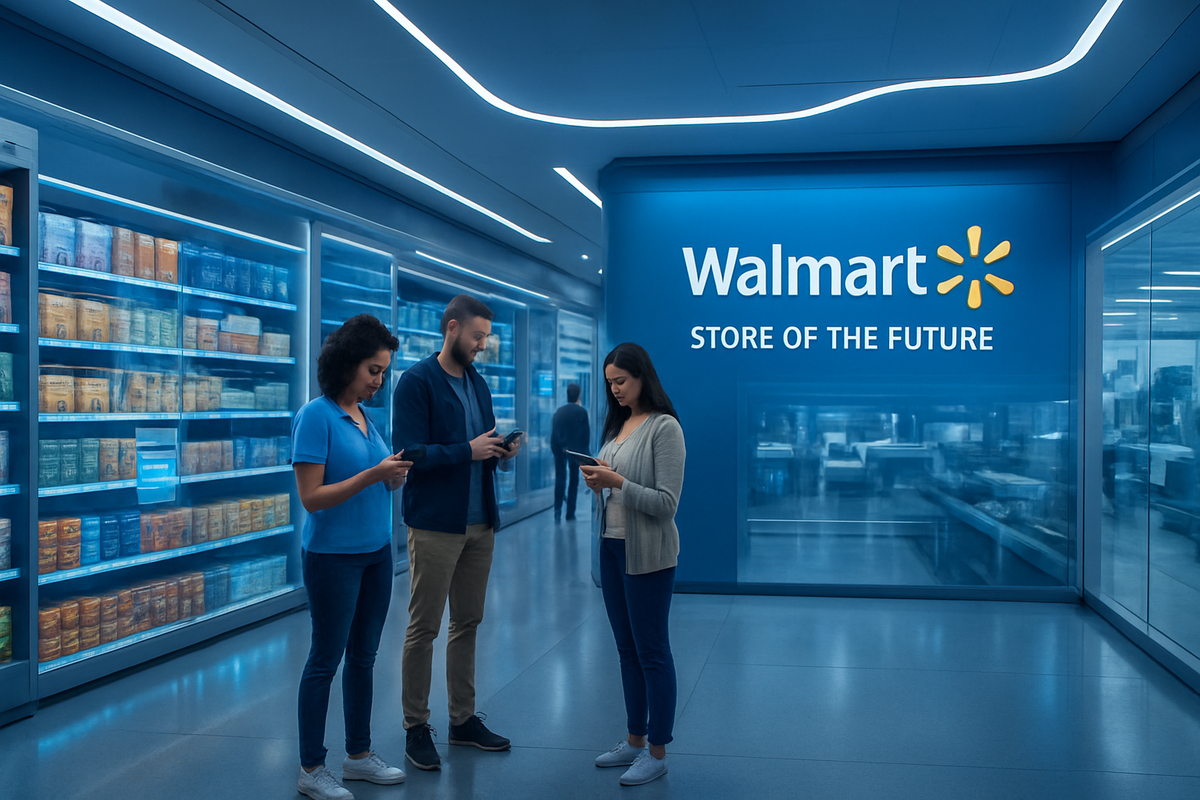
As the sun sets on 2025, the retail landscape has been irrevocably altered not by a new startup, but by a 63-year-old incumbent. Walmart (NYSE: WMT) enters the final week of the year not merely as the world’s largest grocer, but as a sophisticated technology ecosystem that has successfully fused physical dominance with digital agility. By leveraging generative AI, automated logistics, and a high-margin data business, Walmart has effectively built a defensive moat that its competitors are finding increasingly difficult to bridge.
The immediate implications are clear: Walmart has moved beyond the "bricks-and-mortar" versus "e-commerce" debate. Instead, it has created an "adaptive retail" model where the store is a fulfillment node, the customer’s home is a replenishment zone, and data is the primary currency. With its U.S. e-commerce division finally turning a consistent profit in late 2025, the company has silenced critics who doubted its ability to match the digital efficiency of pure-play tech giants.
The Automation of the American Pantry
The journey to this moment was accelerated by a multi-year, multi-billion-dollar investment strategy that reached its zenith in 2025. Throughout the year, Walmart aggressively scaled its partnership with Symbotic (NASDAQ: SYM), implementing AI-powered robotics across its regional distribution centers. By December 2025, approximately 65% of Walmart’s 4,700 U.S. stores are serviced by some form of automation, and 55% of fulfillment center volume moves through automated systems. This technological backbone has allowed Walmart to slash unit-delivery costs by nearly 20%, a margin improvement that has been reinvested into maintaining low prices amidst fluctuating inflation.
A critical milestone occurred in mid-2025 with the full-scale rollout of "Wallaby," Walmart’s proprietary suite of retail-specific Large Language Models (LLMs). Unlike generic AI, Wallaby is trained on decades of the company’s own transaction and supply chain data. This has powered "Sparky," a generative AI shopping assistant that doesn't just suggest products but understands the context of a customer’s life—planning a week’s worth of meals based on dietary restrictions and budget, then automatically adding the ingredients to a digital cart for same-day delivery. This shift from "search" to "solution" has redefined the customer journey as we head into 2026.
Winners and Losers in the New Retail Order
The primary winner in this evolution is undoubtedly Walmart (NYSE: WMT) itself. The company’s stock has seen a robust 2025, trading near record highs as investors revalue the firm as a tech-retail hybrid. Furthermore, the integration of VIZIO (formerly NYSE: VZIO), acquired to bolster the Walmart Connect advertising arm, has turned millions of living rooms into shoppable interfaces. This has created a "closed-loop" ecosystem where Walmart can track a consumer from seeing an ad on their smart TV to purchasing the item in-store or online.
Conversely, traditional grocery chains like Kroger (NYSE: KR) and Albertsons find themselves in a precarious position. While they have attempted to scale their own digital offerings, they lack the massive capital required to match Walmart’s automation scale. Even Amazon (NASDAQ: AMZN), the long-time king of e-commerce, is feeling the pressure. While Amazon remains the leader in general merchandise, Walmart’s 21.2% share of the U.S. grocery market—bolstered by its ability to offer fresh food for pickup within minutes—has forced Amazon to aggressively expand its physical "fresh" footprint to keep pace. Smaller regional retailers who cannot afford the "AI tax" are the biggest losers, facing a future where they may become mere niche players or acquisition targets.
A Paradigm Shift: From Selling Goods to Selling Insights
Walmart’s transformation fits into a broader industry trend where retail is becoming a service rather than a transaction. The company’s "Walmart Luminate" data-as-a-service platform has become an essential tool for suppliers like Procter & Gamble (NYSE: PG) and PepsiCo (NASDAQ: PEP). By charging suppliers for real-time insights into consumer behavior, Walmart has created a high-margin revenue stream that subsidizes the lower margins of its grocery business. This "retail media" and "data monetization" flywheel is a strategy now being mimicked by competitors like Target (NYSE: TGT) and Costco (NASDAQ: COST), but Walmart’s sheer scale gives it a data advantage that is nearly impossible to replicate.
The regulatory implications of this dominance are also coming into focus. As Walmart becomes a central clearinghouse for consumer data and a dominant force in digital advertising, it may face increased scrutiny from the Federal Trade Commission (FTC). The "closed-loop" nature of its ecosystem—owning the store, the delivery network, the data platform, and the advertising screen—raises questions about market fairness and data privacy that will likely be debated in Congress throughout 2026.
The Road Ahead: Autonomous Replenishment and Leadership Transitions
Looking toward 2026, the next frontier for Walmart is "autonomous replenishment." The company is currently testing systems that use AI and IoT sensors to monitor a customer’s pantry levels, automatically shipping essentials before the consumer even realizes they are low. This move toward a "subscription to life" model aims to lock in customer loyalty more effectively than any discount program ever could. Strategically, the company must also navigate a significant leadership change; on January 31, 2026, John Furner is slated to succeed Doug McMillon as CEO. Furner, the architect of the U.S. division’s tech pivot, is expected to double down on the company’s identity as a technology leader.
The challenges remaining are not insignificant. Maintaining the "Everyday Low Price" promise while funding massive tech expenditures requires surgical precision. Additionally, as the company automates more of its workforce, it faces the social and logistical challenge of upskilling its 2.1 million global associates. The "My Assistant" GenAI tool, now in the hands of almost every associate, is a first step toward turning manual laborers into "tech-augmented service providers," but the long-term success of this cultural shift remains to be seen.
Final Thoughts: The Flywheel in Motion
Walmart’s evolution into a tech-powered ecosystem is perhaps the most significant corporate transformation of the decade. By the end of 2025, the company has proven that size is not an impediment to speed if the right technological investments are made. For investors, the key takeaway is the diversification of Walmart’s profit pools; the company is no longer solely dependent on the thin margins of retail, but is increasingly fueled by the high-octane growth of advertising and data.
As we move into 2026, the market should watch for the continued growth of Walmart Connect and the success of the CEO transition. If Walmart can continue to leverage its physical proximity to 95% of the U.S. population as a high-tech fulfillment network, it won't just be the world's largest grocer—it will be the indispensable operating system of the American household.
This content is intended for informational purposes only and is not financial advice.