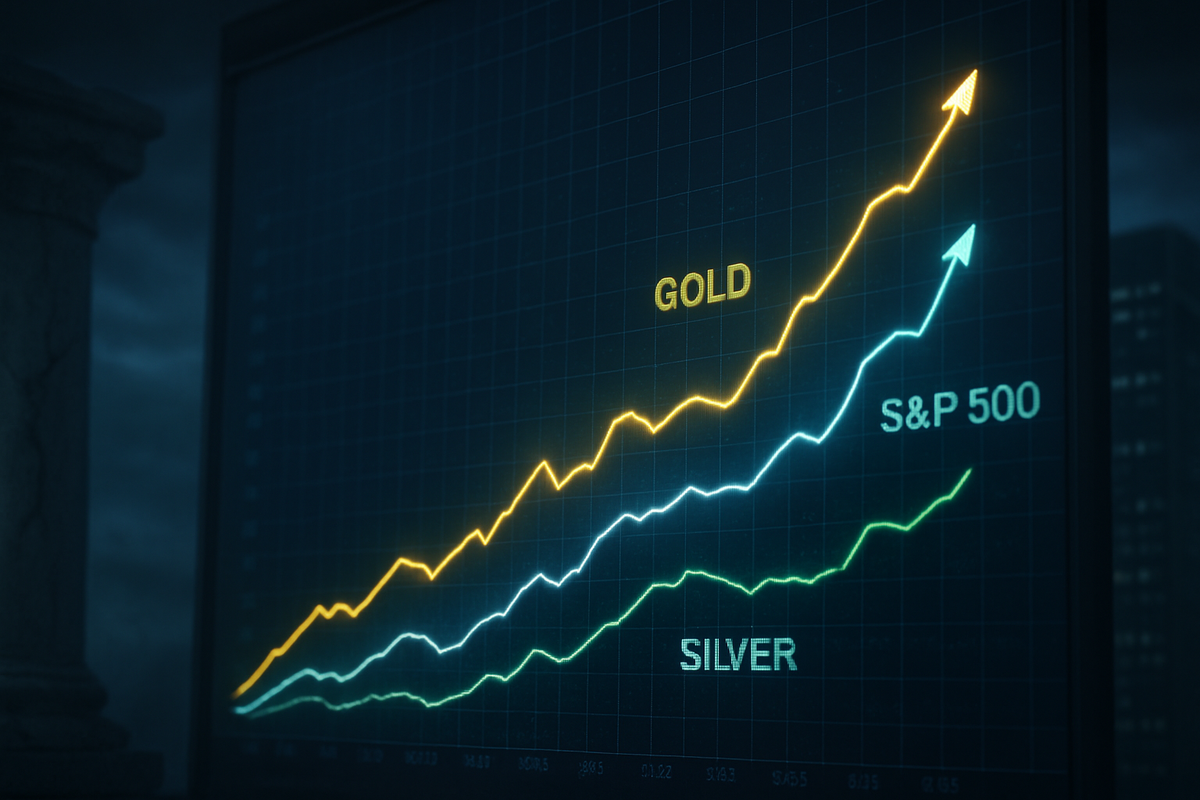
As the final trading days of 2025 draw to a close, the global financial markets find themselves in the grip of a phenomenon that has left traditional economists baffled and portfolio managers on edge. Dubbed the "Dangerous Consensus," this rare market regime has seen the S&P 500, gold, and silver all surge to record highs simultaneously, shattering the long-held rules of asset correlation. In a typical year, a rally in high-risk technology stocks would be met with a cooling of safe-haven assets like gold; however, as of December 25, 2025, the market is no longer choosing between growth and safety—it is frantically buying both.
The immediate implications are profound for the average investor. The S&P 500 (INDEXSP:.INX) recently crossed the 6,900 mark, while gold has shattered psychological barriers to trade at $4,525 per ounce, and silver has skyrocketed to $72 per ounce. This "everything rally" suggests a fundamental breakdown in the traditional 60/40 portfolio, as the inverse relationship between equities and "hard money" has effectively collapsed. While the gains are staggering, the underlying message is one of deep-seated anxiety: a consensus that the current monetary system is under such strain that investors must own both the engines of future growth (AI) and the ultimate insurance policies (precious metals).
The Path to the Triple Peak: A Timeline of the 2025 Surge
The roots of this "Dangerous Consensus" can be traced back to the second half of 2024, but the catalyst was the Federal Reserve’s decisive pivot in mid-2025. After maintaining a "higher for longer" interest rate stance to combat post-pandemic inflation, the Fed executed three consecutive rate cuts in late 2025, bringing the federal funds rate down to a range of 3.50%–3.75%. This move was intended to support a "soft landing" for the economy, which saw a robust Q3 GDP growth of 4.3%. However, the liquidity injection backfired in a way the Fed did not anticipate: instead of just boosting stocks, it ignited a massive "debasement trade."
Throughout 2025, the U.S. fiscal deficit ballooned to a staggering $1.78 trillion, fueling fears that government debt—now exceeding $34 trillion—is becoming unmanageable. Key stakeholders, including major central banks in the Global South, responded by diversifying away from the U.S. Dollar at a record pace. In 2025 alone, official institutions acquired over 850 tons of gold. This institutional flight from fiat currency collided with the retail "AI mania," creating a market where the S&P 500 and gold prices moved in a positive correlation for the first time in decades. By November, silver’s inclusion on the U.S. Critical Minerals list further supercharged the rally, as industrial demand for AI infrastructure and solar energy met a tightening physical supply.
Initial market reactions were celebratory, as year-to-date returns for gold (70%) and silver (140%) reached levels not seen since the late 1970s. However, the tone among institutional strategists has turned somber. Analysts at Goldman Sachs (NYSE: GS) and other major firms have warned that this consensus is "dangerous" because it signals a total lack of confidence in the underlying currency. If the Fed is forced to raise rates again to combat the inflationary pressures of $70 silver and $4,500 gold, the resulting "liquidity vacuum" could lead to a catastrophic revaluation of all assets simultaneously.
Winners and Losers in the Age of Hard Assets
The primary winners of this regime have been the producers of the very assets the market is chasing. In the mining sector, Agnico Eagle Mines (NYSE: AEM) has emerged as a standout, hitting a 52-week high of $187.50 in December. The company’s Q3 earnings report showed a massive 32.6% net margin, as the cost of pulling gold out of the ground remained relatively stable while the selling price soared. Similarly, Newmont Corporation (NYSE: NEM) reported record quarterly free cash flow of $1.6 billion, with its stock price more than doubling over the course of the year. In the silver space, First Majestic Silver (NYSE: AG) and Pan American Silver (NASDAQ: PAAS) have seen their valuations triple, driven by the dual tailwinds of monetary demand and silver's new status as a critical industrial mineral for the AI revolution.
In the technology sector, the winners are those providing the physical backbone for AI. While Nvidia (NASDAQ: NVDA) remains a pillar of the equity rally, its 32% year-to-date return has actually lagged behind gold. The real "hyper-winners" have been networking firms like Ciena (NYSE: CIEN), which jumped 147% in 2025 as it benefited from the "Private AI" trend. Broadcom (NASDAQ: AVGO) also outperformed its peers, reporting $20 billion in AI-specific semiconductor revenue. These companies are viewed as "productive assets" that can outpace inflation, making them a core part of the Dangerous Consensus alongside gold and silver.
However, the "Dangerous Consensus" has created a new class of losers. Tesla (NASDAQ: TSLA), once the darling of the growth trade, has seen its hardware margins come under severe pressure due to the skyrocketing cost of silver and copper required for electric vehicle electronics. In the digital asset space, MicroStrategy (NASDAQ: MSTR) and Coinbase (NASDAQ: COIN) have struggled as capital rotated out of "digital gold" (Bitcoin) and back into physical metals. Furthermore, traditional advertising giants like WPP (NYSE: WPP) have seen their stocks crater by 60% as AI-driven automation disrupts their business models, proving that even in an "everything rally," companies without a clear "hard asset" or "AI-essential" narrative are being left behind.
Historical Precedents and the "Crack-up Boom"
The current market environment bears a striking, albeit more volatile, resemblance to the "stagflation" era of the late 1970s. During that period, gold and equities occasionally rose together as investors fled a weakening dollar. However, the 2025 version is amplified by the sheer scale of global debt and the speed of the AI technological shift. Economists are increasingly using the term "crack-up boom"—a concept from the Austrian School of Economics describing a period where the public’s expectation of a currency’s collapse leads to a frantic flight into any and all real goods, causing prices to spiral upward regardless of economic fundamentals.
The wider significance of this event lies in the erosion of the U.S. dollar’s role as the world’s primary reserve currency. As the Dollar Index (DXY) fell by roughly 10% in 2025, the "debasement trade" became a self-fulfilling prophecy. This has massive regulatory implications; for the first time, Western governments are facing a scenario where they may need to implement "financial repression" tactics—such as capping bond yields or introducing new taxes on "windfall" mining profits—to keep the system from overheating. The ripple effects are also being felt in emerging markets like India, where the record high price of silver has led to a 14% decline in jewelry demand, potentially destabilizing local economies that rely on precious metals for social security.
The Looming Liquidity Vacuum: What Comes Next?
In the short term, the momentum behind the Dangerous Consensus appears unstoppable. With the Federal Reserve signaling a preference for growth over price stability, the "path of least resistance" for gold and the S&P 500 remains upward. However, a strategic pivot may be required as we enter 2026. The most significant risk is a "policy shock" where the Fed, alarmed by the inflationary signals of $5,000 gold, is forced to abruptly reverse its rate cuts. Such a move would create a liquidity vacuum, potentially causing a synchronized crash in both stocks and metals as investors scramble for cash to cover margin calls.
Investors should also watch for the potential emergence of "commodity-backed" digital currencies or new trade blocs that bypass the dollar entirely. If the Dangerous Consensus holds through the first half of 2026, we may see a fundamental shift in how corporations manage their balance sheets, with more companies following the lead of early adopters and holding physical gold or silver as a reserve asset. The challenge for the market will be navigating the transition from a "flight to safety" to a "flight from the dollar" without triggering a systemic collapse of the credit markets.
Final Thoughts: Navigating the End of Diversification
The "Dangerous Consensus" of late 2025 marks a turning point in modern financial history. The fact that gold, silver, and equities are all hitting record highs simultaneously is a clear signal that the traditional rules of diversification are no longer functioning. For decades, investors relied on the fact that when one asset class fell, another would rise. Today, that safety net is gone, replaced by a singular, massive bet on the continued debasement of fiat currency and the relentless growth of AI.
Moving forward, the market will likely be characterized by extreme volatility and "all-or-nothing" price movements. Investors should watch the U.S. Treasury auctions and the consumer price index (CPI) data in early 2026 with intense scrutiny; any sign that inflation is re-accelerating could be the pin that pops this multi-asset bubble. While the gains of 2025 have been historic, they come with a warning: when everything is rising at once, there is nowhere left to hide when the tide finally turns.
This content is intended for informational purposes only and is not financial advice