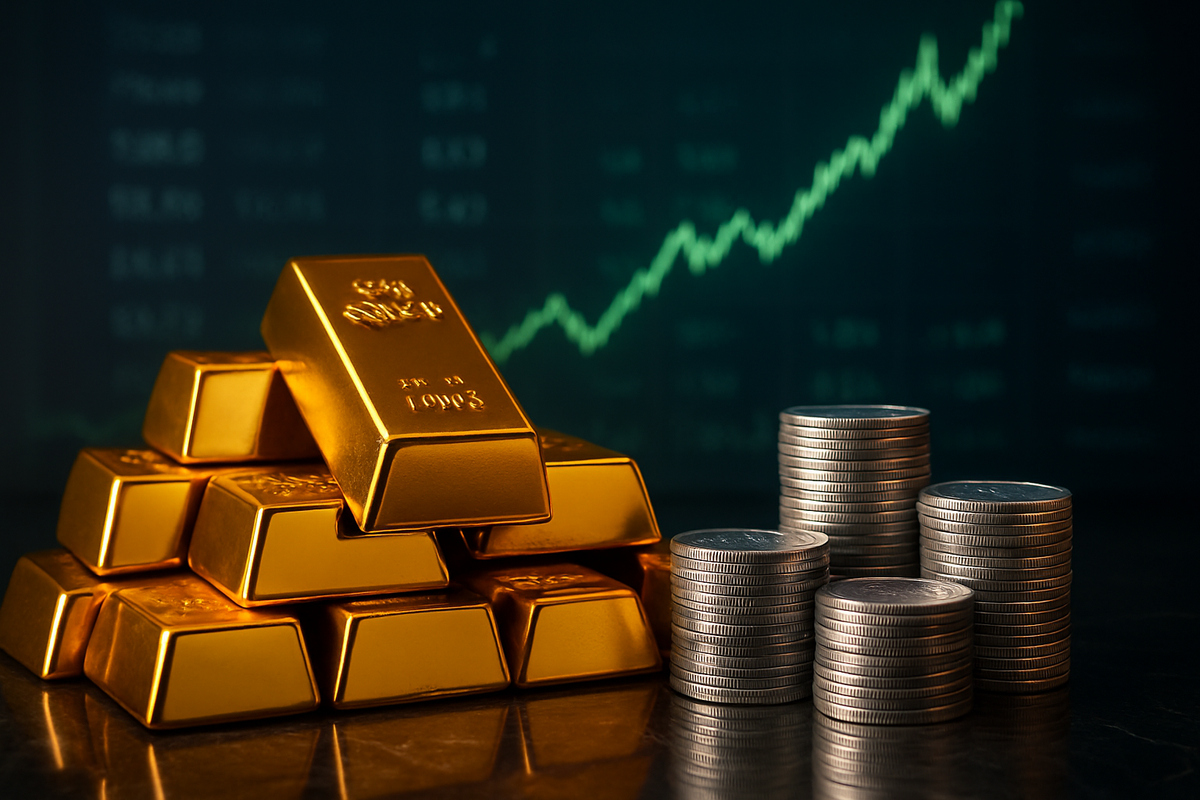
As of late December 2025, the global financial landscape is witnessing a historic realignment of value. Gold has officially breached the psychological $4,500 per ounce threshold, while silver has staged a meteoric "catch-up" rally, trading between $72 and $75 per ounce—a staggering 150% increase since the beginning of the year. This surge in precious metals is not occurring in a vacuum; it is happening alongside record highs in the equity markets, creating a rare and unsettling "Dangerous Consensus" where investors are simultaneously betting on aggressive growth and catastrophic systemic risk.
The immediate implications are profound. The traditional inverse correlation between "risk-on" assets like stocks and "safe-haven" assets like gold has effectively evaporated. As the S&P 500 pushes toward the 7,000 mark, the rush into hard assets suggests that the rally is fueled less by economic optimism and more by a desperate search for a hedge against fiat currency debasement. With the U.S. dollar weakening under the weight of a recent Federal Reserve pivot and mounting sovereign debt, the flight to bullion represents a fundamental lack of confidence in the long-term stability of the global monetary order.
The Perfect Storm: A Timeline of the 2025 Precious Metals Surge
The journey to these record highs began in earnest during the second half of 2025, following a pivotal shift in Federal Reserve policy. After maintaining a "higher for longer" interest rate stance for nearly two years, the Fed executed three consecutive rate cuts starting in September, bringing the federal funds rate down to a range of 3.50%–3.75%. This move, aimed at cooling a labor market that saw unemployment tick up to 4.6%, lowered the opportunity cost of holding non-yielding assets and sent the U.S. Dollar Index (DXY) into a tailspin.
Simultaneously, geopolitical tensions reached a boiling point. A U.S.-led oil blockade on Venezuela and military disruptions in Nigerian production zones created a "fear premium" that hasn't subsided. However, the most significant driver was the structural shift in global reserves. Central banks, particularly within the BRICS+ bloc, purchased over 1,000 tonnes of gold this year. The formal introduction of "The Unit"—a gold-backed settlement currency designed to bypass the SWIFT system—provided a new, practical utility for physical gold that extended beyond mere speculation.
Silver’s ascent has been even more dramatic, fueled by its reclassification as a "U.S. Critical Mineral." As AI data centers, solar infrastructure, and the electric vehicle sector reached new heights of consumption, the silver market entered its fifth consecutive year of supply deficits. By December, the gold-to-silver ratio, which sat at a bloated 104:1 in early 2024, had compressed to roughly 64:1, signaling that the "poor man’s gold" is now the primary target for industrial and retail investors alike.
Mining Titans and Streaming Giants: Winners of the New Bull Market
The historic price action has transformed the balance sheets of the world’s largest miners. Newmont Corporation (NYSE: NEM) has emerged as a primary beneficiary, with its stock surging over 160% year-to-date. Having successfully integrated its Newcrest acquisition, Newmont reported a record $4.5 billion in free cash flow by the third quarter of 2025. The company’s ability to scale production while gold prices soared allowed it to expand its quarterly dividend to $0.25, making it a darling for yield-hungry investors who previously shunned the volatile mining sector.
Barrick Gold Corporation (NYSE: GOLD) has also seen its valuation skyrocket, up 181% this year, though its path has been more turbulent. Undergoing a strategic rebranding to "Barrick Mining Corporation," the firm has pivoted heavily toward copper-gold porphyry projects like Reko Diq to capitalize on the green energy transition. Despite its massive profits, Barrick has faced significant operational headwinds, including the suspension of its Loulo-Gounkoto complex in Mali due to local political disputes. This highlights the "resource nationalism" risk that continues to haunt even the most profitable miners in this high-price environment.
Perhaps the cleanest winner in this cycle is Wheaton Precious Metals Corp. (NYSE: WPM). As a streaming company, Wheaton avoids the direct impact of mining inflation—such as rising diesel and labor costs—that can eat into the margins of traditional miners. By maintaining a fixed-cost structure while capturing the full upside of $75 silver, Wheaton reported a net profit margin of 54.7% in Q3. This "efficiency play" has made streaming companies the preferred vehicle for institutional investors looking for exposure to the metals without the operational headaches of digging them out of the ground.
Macroeconomic Sentiment and the 'Data Fog' of 2025
The record-breaking run in gold and silver fits into a broader trend of "economic bifurcation" in the United States. While headline GDP growth remained resilient at 4.3% in Q3, consumer sentiment has plummeted to a five-month low of 89.1. This disconnect is largely attributed to the "catch-up" inflation resulting from double-digit tariffs on imported goods and the lingering psychological effects of the 43-day government shutdown that ended in mid-November. The shutdown created a "data fog," leaving markets blind to key economic indicators for weeks and driving a frantic move into the transparency of physical assets.
Historically, this dual rally in stocks and gold mirrors the inflationary environment of the late 1970s, but with a modern twist: the "AI Premium." Investors are essentially long on the future of technology (buying the S&P 500) and short on the future of the currency used to price that technology (buying gold). This suggests a transition toward a "multi-polar" financial system where the U.S. dollar no longer enjoys undisputed hegemony, and "hard money" returns to the center of the global trade architecture.
The policy implications are equally significant. With silver now a critical mineral, we are seeing the first signs of government-mandated stockpiling. This could lead to export restrictions from major producers like Mexico and Peru, further tightening the squeeze on industrial users. For the Federal Reserve, the surge in metals is a flashing red light; it suggests that inflation expectations are becoming unanchored, potentially forcing a "U-turn" back to higher rates if the dollar’s slide becomes disorderly.
The Road Ahead: Scenarios for 2026
In the short term, the market is bracing for a potential "blow-off top." With silver up 150%, a technical correction is almost inevitable, yet the structural supply deficits suggest that any dip will be aggressively bought by industrial giants and central banks. The strategic pivot for many companies in 2026 will involve securing physical supply chains. We may see tech giants like Apple (NASDAQ: AAPL) or Tesla (NASDAQ: TSLA) directly investing in silver mines or signing long-term "off-take" agreements to ensure their AI and EV ambitions aren't derailed by $100 silver.
Long-term, the sustainability of this rally depends on the trajectory of U.S. sovereign debt. If the debt-to-GDP ratio continues its current climb, gold at $5,000 and silver at $100 are not just possibilities—they are mathematical probabilities. The primary challenge for the market will be liquidity; as more physical metal is locked away in central bank vaults and industrial stockpiles, the "paper" markets (Comex and LBMA) may face unprecedented delivery demands, potentially leading to a decoupling of physical and paper prices.
A New Era for Hard Assets
The events of late 2025 mark the definitive end of the "low inflation, low volatility" era that defined the previous decade. The surge in gold and silver is a clear signal from the market that the era of fiat dominance is facing its sternest test yet. For investors, the takeaway is clear: precious metals are no longer just "disaster insurance"; they have become core components of a diversified portfolio in a world where "risk-free" government bonds no longer feel risk-free.
Moving forward, the market will be characterized by extreme volatility and a continued focus on tangible value. The "Dangerous Consensus" of rising stocks and rising gold cannot last forever; eventually, one side of the trade must give way. Investors should watch the gold-to-silver ratio and the DXY closely in the coming months. If the dollar continues to weaken despite high interest rates, it will be a sign that the "Great Debasement" is accelerating, and the record highs of 2025 may only be the beginning.
This content is intended for informational purposes only and is not financial advice.