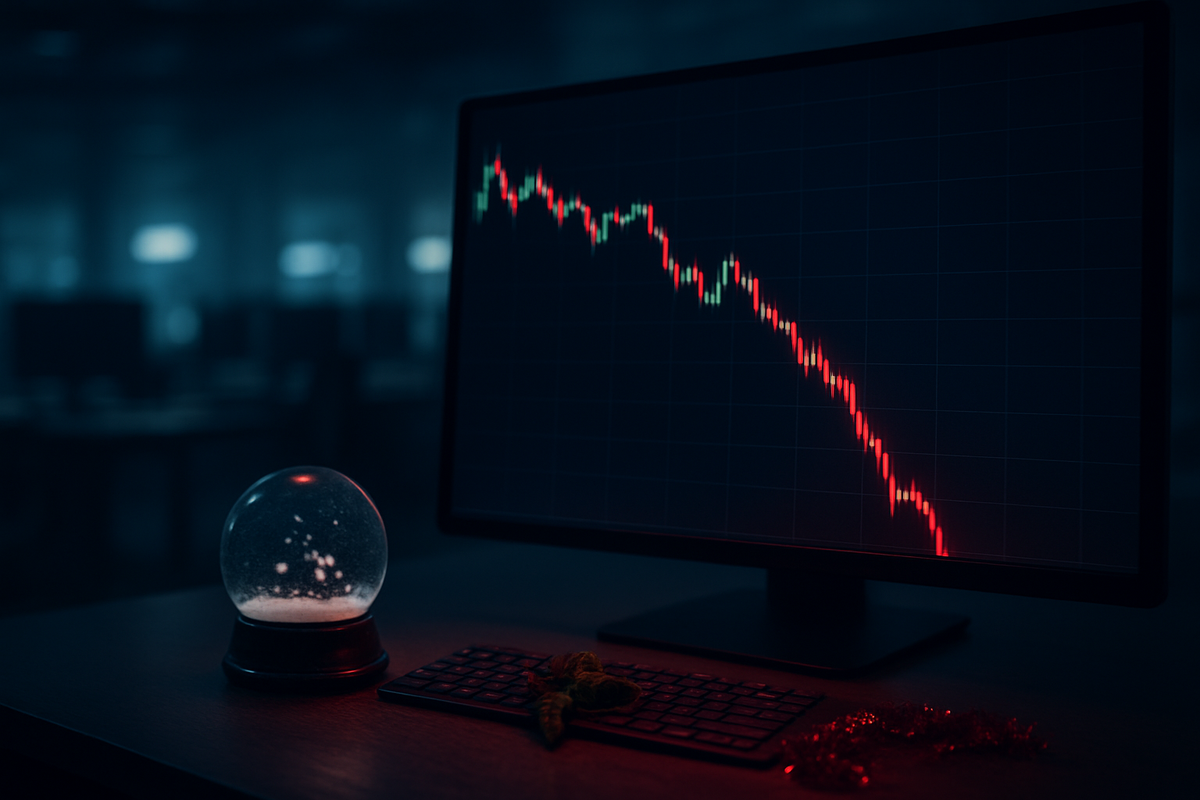
As of today, December 29, 2025, the traditional "Santa Claus Rally"—a seasonal phenomenon where stocks typically rise in the final five trading days of December and the first two of January—has officially fizzled. What began as a hopeful mid-month surge following a Federal Reserve interest rate cut has turned into a late-December rout, as major U.S. indexes have erased all their recent gains in a matter of days. The S&P 500 and the tech-heavy Nasdaq Composite are currently trading lower than their December 1st levels, catching investors off guard during what is historically the most bullish week of the year.
The immediate implications are sobering for a market that was "priced for perfection" heading into 2026. The sudden reversal has been triggered by a combination of "sticky" inflation data, the lingering economic hangover from a historic 43-day government shutdown that ended in November, and the cumulative weight of the "Liberation Day" tariffs implemented earlier this year. With the S&P 500 P/E ratio hovering at a lofty 20.5x, the year-end sell-off suggests that the market’s patience for speculative growth is wearing thin, as institutional investors move to lock in profits before a highly uncertain new year.
The Shutdown Hangover and the Fed's Failed Pivot
The timeline of this year's failed rally began with a sense of triumph. On December 17, the Federal Reserve announced a 25-basis-point interest rate cut, bringing the federal funds rate to a range of 3.5%–3.75%. This third consecutive cut in the latter half of 2025 initially sent the Dow Jones Industrial Average to a record high, as traders bet on a "soft landing" for the economy. However, the optimism was short-lived. By the start of the final week of December, new data revealed that PCE inflation remained stubbornly lodged between 2.4% and 2.9%, largely due to the retaliatory trade cycles sparked by the universal 10% tariffs introduced in April 2025.
The situation worsened as the "shutdown hangover" became more apparent. The 43-day federal government shutdown, which paralyzed Washington through much of October and November, has resulted in a significant "blind spot" for economic forecasting. As delayed reports finally hit the desks of analysts this week, the reality of a 1.5% hit to Q4 GDP growth became undeniable. Key stakeholders, including major hedge fund managers and pension fund advisors, began a rapid rotation out of high-flying tech names and into defensive havens, effectively killing the Santa Claus Rally before it could gain momentum.
Initial market reactions on Monday and Tuesday saw the Nasdaq plummet by over 3%, led by a sharp correction in the semiconductor sector. The realization that a global memory chip shortage is now squeezing the margins of even the most dominant AI players has turned the usual year-end "window dressing"—where fund managers buy winning stocks to improve their year-end reports—into a "window exit." By mid-week, the gains from the Fed’s mid-month pivot had been entirely surrendered.
Tech Giants Tumble While Defensive Anchors Hold Fast
The primary victims of this year-end reversal are the "Magnificent Seven" and other high-growth technology leaders. Nvidia (NASDAQ: NVDA), which reached a staggering $4.6 trillion market cap earlier this year, has seen its stock correct by roughly 11% from its October peak as investors question the sustainability of massive AI infrastructure spending. Similarly, Microsoft (NASDAQ: MSFT) has faced pressure as rising capital expenditures—projected to hit $85 billion for the fiscal year—begin to weigh on its once-impenetrable margins. Apple (NASDAQ: AAPL) has also struggled, with supply constraints on the iPhone 17 and rising production costs due to the memory chip shortage limiting its Q4 revenue potential.
Conversely, the "fizzle" has highlighted a select group of winners that have shown remarkable resilience. Walmart (NYSE: WMT) has emerged as the retail standout of late 2025, reaching new highs as consumers across all income levels "trade down" to combat persistent inflation. In the energy sector, ExxonMobil (NYSE: XOM) has remained a pillar of stability; despite lower crude prices, its acquisition of Pioneer Natural Resources has unlocked billions in synergies, allowing it to maintain strong shareholder returns.
Defensive sectors like Utilities have also acted as a unique hybrid play. Companies such as NRG Energy (NYSE: NRG) and Constellation Energy (NASDAQ: CEG) have outperformed the broader market throughout 2025, driven by the insatiable demand for power from AI data centers. While even these stocks saw a slight "cooling" in the final week of December due to stretched valuations, they remain the preferred destination for capital fleeing the volatility of the tech sector.
A Shift from AI Dreams to Tangible ROI
The failure of the 2025 Santa Claus Rally is not just a seasonal anomaly; it is a signal that the market is shifting its focus from AI "dreams" to tangible ROI. For the past two years, investors have been willing to overlook high valuations in exchange for the promise of an AI-driven productivity boom. However, as 2025 draws to a close, the "pricing for perfection" era appears to be ending. This event fits into a broader trend of "K-shaped" economic divergence, where high-end consumers and tech-integrated firms thrive, while the rest of the market—the "other 493" stocks in the S&P 500—struggles to find growth.
The ripple effects are likely to be felt in the regulatory and policy spheres. The "Liberation Day" tariffs of 2025 have proven to be a double-edged sword, protecting some domestic industries while fueling the "sticky" inflation that now prevents the Fed from being more aggressive with rate cuts. This policy friction is creating a "frozen" environment for international supply chains, particularly in the semiconductor and automotive sectors.
Historical comparisons are already being drawn to the late-December sell-offs of 2018 and 2022. In both instances, year-end volatility served as a precursor to a major shift in Federal Reserve policy or a broader economic slowdown. With some analysts now predicting a 93% chance of a recession in 2026, the current market retreat suggests that the "smart money" is already positioning itself for a period of contraction rather than continued expansion.
Navigating the January Indicator and Beyond
Looking ahead to the first quarter of 2026, the market faces a challenging path. In the short term, the absence of a Santa Claus Rally often correlates with a weak January, a phenomenon known as the "January Indicator." If the first five days of the new year do not show a meaningful recovery, investors may need to prepare for a prolonged period of rangebound or downward trading. Strategic pivots will be required; companies that cannot demonstrate a clear path to profitability amidst higher input costs and tariff-related friction will likely see their valuations further compressed.
However, challenges often create new market opportunities. The current correction may finally bring valuations for mid-cap and value stocks down to attractive levels, potentially ending the extreme concentration of the market in a handful of tech giants. We may see a "great rebalancing" in early 2026, where capital flows back into overlooked sectors like healthcare and traditional manufacturing, provided they can navigate the new trade landscape.
The most critical scenario to watch will be the Federal Reserve's first meeting of 2026. If the Fed remains in its "wait-and-see" stance due to persistent inflation, the market may lose its primary catalyst for growth. Conversely, if the year-end sell-off turns into a broader panic, the central bank may be forced to accelerate rate cuts, even if inflation remains above its 2% target—a move that would carry its own set of long-term risks for the U.S. dollar.
Summary: A Cold Winter for Wall Street
The fizzling of the 2025 Santa Claus Rally serves as a stark reminder that seasonal trends are never guaranteed, especially in an era of high fiscal and trade volatility. The key takeaway for investors is that the "AI premium" is no longer a blanket protection against macroeconomic headwinds. As the gains of mid-December vanish, the market is entering 2026 with a renewed focus on balance sheet strength, margin resilience, and the ability to navigate a world of persistent inflation and trade barriers.
Moving forward, the market will likely remain volatile as it digests the full impact of the 2025 government shutdown and the evolving tariff landscape. The era of "easy gains" driven by low rates and speculative hype appears to be in the rearview mirror. Investors should watch closely for the Q4 earnings season starting in January, which will provide the first concrete evidence of how the "shutdown hangover" and memory chip shortages have truly affected corporate bottom lines.
As we close out a tumultuous 2025, the message from the trading floor is clear: caution is the new watchword. While the holiday season may be ending on a somber note for portfolios, the current reset may ultimately provide a healthier, more sustainable foundation for the market—if, and only if, the economy can avoid the recession that many now fear is looming on the horizon.
This content is intended for informational purposes only and is not financial advice