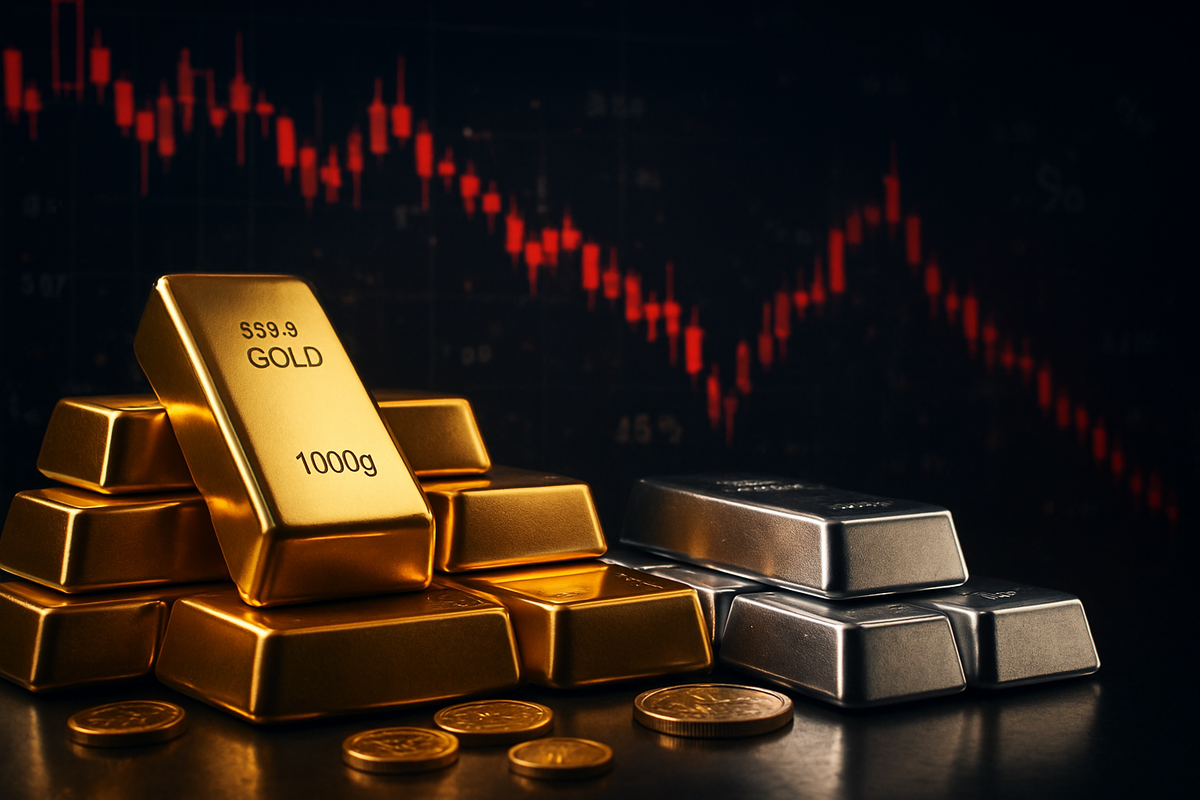
As the curtain closes on 2025, the financial landscape is witnessing a dramatic rotation of capital. Gold and silver prices have embarked on a historic rally, reaching unprecedented heights in late December as investors flee a volatile U.S. stock market. While the broader indices grapple with "AI fatigue" and year-end liquidity thinness, precious metals have reasserted their status as the ultimate safe-haven assets, driven by a confluence of geopolitical instability, central bank diversification, and a shifting interest rate environment.
The immediate implications of this surge are profound. The traditional "60/40" portfolio is being reconsidered in favor of hard assets, and mining equities are experiencing a renaissance. However, the rapid ascent has not been without friction; a sharp late-month correction, triggered by margin hikes and profit-taking, has introduced a new layer of complexity for traders heading into the new year. As of December 30, 2025, the market is caught between the momentum of a generational bull run and the gravity of overextended technicals.
The Perfect Storm: A Timeline of the 2025 Precious Metals Rally
The rally that defined the final quarter of 2025 was the culmination of a "perfect storm" of fundamental drivers. Gold reached a staggering record high of $4,549.71 per ounce on December 26, before settling near $4,332 per ounce by year-end. Silver’s performance was even more parabolic, peaking near $84.00 per ounce—a triple-digit percentage gain for the year—before a sharp liquidity-driven pullback to the $72.00 range. This movement was catalyzed by the Federal Reserve’s pivot toward more aggressive interest rate cuts in the autumn, which significantly weakened the U.S. Dollar and reduced the opportunity cost of holding non-yielding bullion.
Leading up to this moment, global central banks acted as the primary floor for the market, with total 2025 acquisitions projected to hit 850 tons. This aggressive diversification away from dollar-based reserves, led by emerging market economies, created a supply-demand imbalance that was further exacerbated by geopolitical flares in Eastern Europe and the Middle East. By the time December arrived, the "Santa Claus rally" usually reserved for equities had shifted entirely into the metals complex, as institutional investors deployed an estimated $82 billion into gold-backed ETFs throughout the year.
The volatility peaked in the final week of December when the CME Group (CME) implemented a series of margin requirement hikes for precious metals futures. This move was designed to curb excessive speculation but instead triggered a "liquidity shock," forcing some leveraged players to liquidate positions. This spillover effect contributed to the modest rise in the CBOE Volatility Index (VIX), which climbed toward 14.20, reflecting a growing unease that the decade-long dominance of growth stocks might be facing a structural challenge from hard assets.
Winners and Losers: Mining Giants and Tech Heavyweights
The primary beneficiaries of this rally have been the senior mining companies, which have seen their profit margins expand exponentially. Newmont (NYSE: NEM) and Barrick Gold (NYSE: GOLD) have emerged as the standard-bearers for the sector, with their stock prices reflecting the massive operational leverage gained from $4,500 gold. For these companies, the high price environment has turned marginal projects into cash-flow machines, allowing for record dividend payouts and aggressive debt reduction. Similarly, silver-focused producers like Pan American Silver (NYSE: PAAS) and First Majestic Silver (NYSE: AG) have outperformed the physical metal, with the iShares MSCI Global Silver and Metals Miners ETF (BATS: SLVP) posting gains of over 210% for the year.
Conversely, the rally in metals has coincided with a cooling period for the technology sector, which dominated the first half of 2025. Mega-cap names like Nvidia (NASDAQ: NVDA) and Tesla (NASDAQ: TSLA) have faced selling pressure as investors question the immediate return on investment for massive AI infrastructure spending. The Nasdaq Composite (INDEXNASDAQ: .IXIC), while still up for the year, has lagged behind the VanEck Gold Miners ETF (NYSEARCA: GDX) in the fourth quarter. The industrial sector has seen a mixed bag; while Freeport-McMoRan (NYSE: FCX) has benefited from the copper and gold surge, manufacturers facing higher input costs for silver—essential in high-end electronics and solar panels—are seeing their margins squeezed.
Diversified mining conglomerates such as BHP Group (NYSE: BHP) and Rio Tinto (NYSE: RIO) have also found favor, though their exposure to iron ore and base metals has made their gains more tempered compared to the pure-play precious metals miners. The shift suggests a broader market transition where "value" is no longer just a descriptor for low P/E stocks, but a flight toward tangible, industrial-essential commodities.
Beyond the Glitter: Broader Trends and Historical Context
The 2025 precious metals surge is more than a temporary spike; it represents a significant shift in the global monetary order. Historically, gold rallies of this magnitude have signaled deep-seated concerns about currency debasement and sovereign debt levels. With the U.S. national debt continuing its upward trajectory and trade-war rhetoric intensifying due to new tariff proposals, gold is once again being viewed as the "neutral" reserve asset. This mirrors the inflationary cycles of the late 1970s, though the current rally is uniquely supported by the "green energy" transition, which has turned silver into a strategic industrial metal rather than just a monetary one.
The industrial demand for silver in 2025 reached record levels, driven by the massive expansion of photovoltaic (PV) solar capacity and the hardware requirements of the AI revolution. China’s decision in late 2025 to restrict certain silver exports added fuel to the fire, highlighting the vulnerability of Western supply chains. This "weaponization of commodities" is a trend that market analysts expect to persist, forcing Western nations to reconsider mining regulations and domestic production incentives.
Furthermore, the rally fits into a broader trend of "de-dollarization" that has moved from a theoretical risk to a tangible market force. As central banks in the "Global South" increase their gold holdings, the historical inverse correlation between the U.S. Dollar and gold has begun to decouple. We are entering an era where both the dollar and gold can rise simultaneously during periods of high geopolitical tension, a phenomenon rarely seen in previous decades.
The Road Ahead: Navigating Post-Peak Volatility
Looking into the first quarter of 2026, the primary question for investors is whether the late-December pullback is a healthy correction or the start of a deeper bear phase. Short-term, the market is likely to see continued volatility as thin year-end liquidity gives way to the rebalancing of institutional portfolios in January. If the Federal Reserve continues its path of interest rate normalization, the tailwinds for gold remain intact. However, a "higher-for-longer" surprise on the inflation front could temporarily strengthen the dollar and put a ceiling on further metal gains.
Strategic pivots are already underway. Many hedge funds are moving away from pure equity plays and into "commodity-equity" hybrids, seeking companies with strong balance sheets and high exposure to the metals complex. The challenge for the mining industry will be to manage this windfall responsibly; historical precedents show that periods of high prices often lead to ill-advised acquisitions and cost overruns. Investors will be watching for disciplined capital allocation from the likes of Newmont and Barrick Gold to ensure that the current boom translates into long-term shareholder value.
Potential scenarios for 2026 include a "consolidation phase" where gold trades between $4,000 and $4,200, allowing the market to digest its 70% annual gain. Alternatively, if geopolitical tensions escalate further or if the U.S. stock market faces a more severe "AI bubble" burst, a second leg of the rally could push gold toward the $5,000 milestone.
Summary of the 2025 Market Shift
The 2025 rally in gold and silver marks a definitive moment in financial history, signaling a transition from a decade of digital-asset dominance back to the security of tangible wealth. The surge to record highs was driven by a rare alignment of central bank buying, industrial scarcity, and a cooling tech sector. While the late-December volatility has provided a reality check for speculators, the fundamental case for precious metals remains the strongest it has been in a generation.
Moving forward, the market will be characterized by heightened sensitivity to Federal Reserve policy and geopolitical headlines. Investors should closely monitor the VIX (INDEXCBOE: VIX) and the gold-silver ratio, which has compressed significantly, indicating that silver may continue to lead in a high-growth, high-inflation environment. The lesson of 2025 is clear: in an era of uncertainty, the oldest form of money still holds the greatest allure.
This content is intended for informational purposes only and is not financial advice.