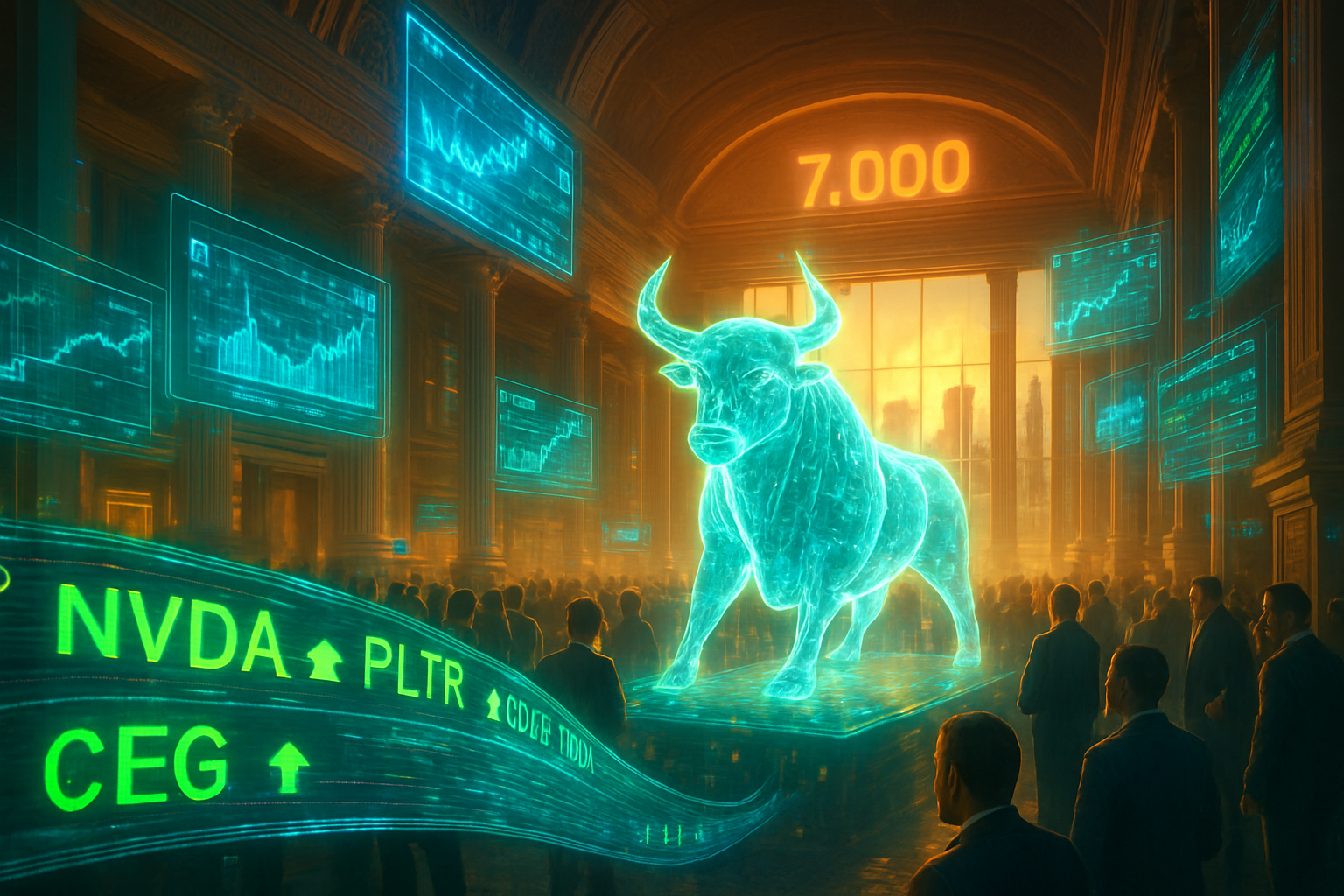
The U.S. stock market stands as a testament to unexpected endurance. What began as a tentative recovery from the depths of the 2022 bear market on October 12, 2022, has matured into a powerful, multi-year secular bull run. As of December 30, 2025, the S&P 500 (INDEXSP: .INX) is hovering near the historic 7,000 milestone—a staggering doubling of its value in just over three years—defying the skepticism of analysts who predicted that high interest rates and geopolitical friction would have derailed the rally long ago.
The immediate implications of this longevity are profound. By successfully navigating its third year and entering its fourth, this bull market has officially outlasted the historical average duration of approximately 1,011 days. For investors, the transition from a "hope-driven" rally to one supported by the "Inference Phase" of Artificial Intelligence (AI) and a pivot toward Federal Reserve easing has shifted the strategy from defensive positioning to aggressive sector rotation. However, the market’s age also brings a new set of anxieties, as historical precedents suggest that "Year 4" of a bull run often demands even higher earnings growth to justify increasingly stretched valuations.
The Long Road to 7,000: A Timeline of Resilience
The current market cycle was born in the shadow of 40-year high inflation and the Federal Reserve’s most aggressive hiking cycle in decades. From the October 2022 lows, the market climbed a "wall of worry," initially led by a handful of tech giants. By late 2024, the narrative shifted from "if" the Fed would cut rates to "when," providing a secondary tailwind that allowed the rally to broaden. The defining moment of the third year came in early 2025, during the "April Tariff Storm," when a sudden shift in trade policy triggered a sharp 10.5% correction in 48 hours. Yet, the market’s ability to absorb a $5 trillion wipeout and recover within three months signaled an underlying structural strength fueled by massive corporate buybacks and AI-driven productivity gains.
Key players have been instrumental in maintaining this momentum. Federal Reserve Chair Jerome Powell, once the market’s primary antagonist, became a stabilizing force in 2025 by implementing three tactical 25-basis-point rate cuts, bringing the federal funds rate to a range of 3.50%–3.75%. This "soft landing" was coupled with the July 4th passage of the "One Big Beautiful Bill Act," a legislative package that made corporate tax cuts permanent, further incentivizing capital expenditure. The reaction from the industry has been one of cautious optimism; while the "Magnificent Seven" continue to lead, the latter half of 2025 saw significant capital flow into mid-cap and industrial sectors, suggesting a healthier, more diverse market participation than seen in previous years.
The Winners and Losers of the 2025 Expansion
The third year of this bull run has been a story of radical divergence between those who own the "picks and shovels" of the new economy and those tethered to traditional consumer models. NVIDIA (NASDAQ: NVDA) remains the undisputed king of the cycle, becoming the first company to reach a $5 trillion market capitalization in October 2025. However, the "Inference Phase" of AI has minted new winners like Palantir Technologies (NYSE: PLTR), which saw its stock surge 150% as its AI Operating System became the standard for enterprise efficiency. In the energy sector, nuclear power providers like Constellation Energy (NASDAQ: CEG) and Vistra Corp (NYSE: VST) have traded like high-growth tech stocks, as the insatiable power demand of AI data centers transformed these once-sleepy utilities into market darlings.
Conversely, the "losers" of 2025 have been those caught in the crosshairs of trade protectionism and shifting consumer habits. Nike (NYSE: NKE) and Lululemon (NASDAQ: LULU) faced a brutal year, with LULU shares cratering over 50% due to high input costs from reciprocal tariffs on Asian manufacturing. Traditional retail giants like Target (NYSE: TGT) struggled to maintain margins against a backdrop of rising logistics costs and a "frugal" consumer base that favored the value-driven model of Walmart (NYSE: WMT). In the automotive sector, Ford (NYSE: F) and General Motors (NYSE: GM) found themselves squeezed by 25% tariffs on imported parts, while even Tesla (NASDAQ: TSLA) faced a volatile year as its premium valuation was tested by a high-rate environment and increased global competition.
Historical Precedents and the AI Industrial Revolution
To understand the significance of this three-year run, one must look back at the great secular bulls of the past. At 1,174 days old, this market is currently longer-lived than the average bull but still has a long way to go to match the 12-year run of 1987–2000 or the 11-year post-Great Recession rally (2009–2020). Historically, bull markets that survive into their fourth year tend to be durable; since 1950, Year 4 has seen average gains of 12.8%. The current era most closely mirrors the mid-1990s, where a surge in productivity—then driven by the internet, now by Generative AI—allowed the market to sustain high valuations even as the Fed maintained a watchful eye on inflation.
The wider significance also lies in the regulatory landscape. The implementation of the EU AI Act in early 2025 and the U.S. federal government's move to preempt state-level regulations via Executive Order 14365 in December 2025 have provided a clearer "rule of the road" for tech giants. This regulatory clarity, combined with the "One Big Beautiful Bill Act," has created a policy environment that favors domestic manufacturing and technological sovereignty. The ripple effect is being felt globally, as competitors in Europe and Asia struggle to keep pace with the massive capital concentration in U.S. markets, further cementing the "U.S. Exceptionalism" trade that has dominated the decade.
Scenarios for 2026: The Year of the Pivot
As we look toward 2026, the market faces a strategic pivot. The "hype" phase of AI is over, and the "delivery" phase has begun. Investors will no longer reward companies just for mentioning "AI" on earnings calls; they will demand to see margin expansion and revenue growth directly tied to these investments. Short-term, the market may face headwinds from "sticky" inflation, which remains near 3%, potentially limiting the Fed's ability to provide further rate cuts. A potential challenge emerges in the form of a "valuation reset" if earnings growth in 2026 falls short of the projected 15%.
Two primary scenarios emerge for the coming year. In the "Golden Path" scenario, AI-driven productivity gains begin to manifest in non-tech sectors like Healthcare and Industrials, leading to a broader market rally and a "melt-up" toward the 8,000 level for the S&P 500. In the "Stagflationary Stall" scenario, the cost of trade tariffs and high energy prices could squeeze corporate margins, leading to a prolonged period of sideways trading or a mild bear market as the cycle reaches exhaustion. Strategic pivots will be required for investors, likely moving away from high-multiple growth stocks toward "quality" companies with strong balance sheets and domestic supply chains.
Closing Thoughts: A Mature Market in a New Era
The bull market of the 2020s is no longer a young, speculative phenomenon; it is a mature, battle-tested cycle that has survived a global pandemic recovery, a historic inflation spike, and a major shift in trade policy. The key takeaway for the end of 2025 is that while the market is "middle-aged," its engine—the AI industrial revolution—is still in its early stages. The broadening of the rally into financials and energy suggests that the market has successfully moved beyond its reliance on just a few tech leaders, a hallmark of a healthy secular trend.
Moving forward, investors should watch for the impact of the 2025 tax changes on corporate earnings in Q1 2026 and keep a close eye on the Fed's rhetoric regarding the "last mile" of inflation. While the risks of a correction are ever-present in a market at record highs, the historical resilience of four-year-old bull markets provides a compelling case for continued, albeit more moderate, gains. As we turn the calendar, the focus shifts from surviving the volatility to identifying the long-term winners of a restructured, AI-integrated global economy.
This content is intended for informational purposes only and is not financial advice