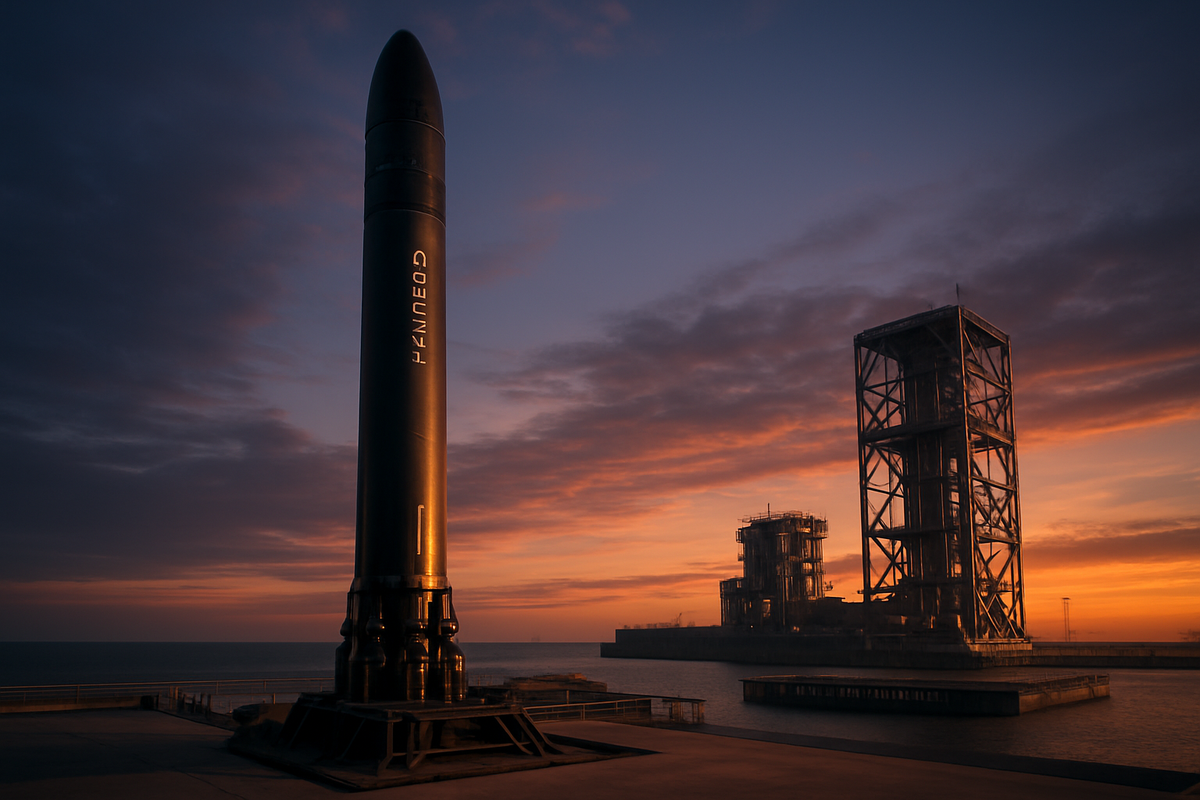
LONG BEACH, CA — Rocket Lab USA, Inc. (Nasdaq: RKLB) concluded its most successful fiscal year to date on December 31, 2025, reporting record-breaking annual revenue approaching $600 million. However, the financial triumph was tempered by the official announcement that the maiden flight of its highly anticipated medium-lift rocket, Neutron, has been rescheduled for mid-2026. This "quality-first" delay marks a strategic pivot for the company as it balances the aggressive scaling of its Space Systems division with the technical rigors of challenging the global launch monopoly held by SpaceX.
The market’s reaction to the dual announcement has been a complex mix of short-term volatility and long-term optimism. While the delay in the Neutron program initially sparked a minor sell-off among growth-focused investors, the company's robust 37% gross margins and a record $1.1 billion contract backlog have provided a strong floor for the stock. Analysts suggest that the shift in focus toward high-margin satellite manufacturing and space applications has fundamentally de-risked the company, even as the "big rocket" remains on the test stand.
Operational Excellence vs. Developmental Hurdles
Rocket Lab's 2025 performance was defined by a relentless launch cadence for its workhorse Electron vehicle. The company achieved a perfect 100% success rate across 21 missions for the year, nearly doubling its previous annual record. This operational consistency has solidified Rocket Lab’s position as the premier provider of dedicated small-satellite launches. However, the transition to the medium-lift Neutron—a vehicle designed to compete directly with the Falcon 9—has proven more technically demanding than originally forecasted.
The delay, announced during the Q3 earnings call and confirmed in year-end updates, pushes the first flight from late 2025 into the second quarter of 2026. CEO Sir Peter Beck attributed the shift to an extensive qualification campaign for the Archimedes engine. The 3D-printed, liquid oxygen/methane-powered engine completed several full-duration burns at NASA’s Stennis Space Center throughout the latter half of 2025, but the company opted to extend ground testing to "retire risks" before the vehicle arrives at the newly inaugurated Launch Complex 3 (LC-3) on Wallops Island, Virginia.
The timeline leading to this moment has been a race against time and engineering limits. Throughout 2025, Rocket Lab successfully inaugurated its state-of-the-art Neutron production facility and unveiled the "Return on Investment" (ROI) landing barge. Despite these infrastructure wins, the complexity of the "Hungry Hippo" fairing design and the integrated flight software required additional lead time. Stakeholders, including the U.S. Space Force and commercial constellation operators, have reportedly expressed support for the delay, prioritizing mission success over a rushed debut.
Winners and Losers in the Medium-Lift Shakeup
The delay of Neutron provides a temporary sigh of relief for competitors in the medium-lift sector. Northrop Grumman Corporation (NYSE: NOC), in partnership with Firefly Aerospace, is moving closer to the debut of the Antares 330, which is expected to launch in early 2026. This vehicle, and its successor the "Eclipse," aims to capture the same government cargo and commercial constellation markets that Neutron is targeting. By securing this window, Northrop Grumman may be able to lock in additional manifests for its Cygnus resupply missions to the International Space Station.
Conversely, the primary "loser" in this scenario could be seen as the small-satellite operators who were banking on Neutron’s massive capacity to lower the cost-per-kilogram for large-scale deployments. However, the blow is softened by the continued dominance of SpaceX, which saw its Falcon 9 launch over 170 times in 2025. For Lockheed Martin Corporation (NYSE: LMT), which finalized its acquisition of Terran Orbital in late 2024, the delay in a competitor's rocket is less impactful than the burgeoning demand for the satellite buses they now manufacture at scale.
Rocket Lab itself remains a winner in the financial sense. By pivoting heavily into "Space Systems," the company has insulated its balance sheet from the binary "success-or-failure" nature of rocket development. With the 2025 acquisitions of Geost, LLC and Mynaric AG (Nasdaq: MYNA), Rocket Lab now produces roughly 74% of its revenue from satellite components and sensors. This vertical integration means that even without a flying Neutron, Rocket Lab is profiting from the very constellations that will eventually fly on its rockets.
The Significance of the "Medium-Lift Gap"
The delay of Neutron highlights a broader trend in the aerospace industry: the widening "Medium-Lift Gap." As the world moves toward massive satellite constellations for telecommunications and national security, the demand for rockets capable of lifting 8 to 15 metric tons has skyrocketed. Currently, this market is almost entirely served by SpaceX, creating a strategic bottleneck for both commercial entities like Amazon.com, Inc. (Nasdaq: AMZN) and its Project Kuiper, and for the U.S. Department of Defense.
Historically, rocket programs of this scale—such as the Vulcan Centaur from United Launch Alliance, a joint venture between The Boeing Company (NYSE: BA) and Lockheed Martin—have faced years of delays. In this context, Rocket Lab’s six-month slip is relatively minor. It underscores the difficulty of moving from small-lift to medium-lift, a leap that many other startups have failed to make. The industry is watching closely to see if Rocket Lab can maintain its "Silicon Valley speed" while adopting the rigorous "Old Space" qualification standards required for national security missions.
Furthermore, the delay has regulatory implications. Rocket Lab is a key player in the National Security Space Launch (NSSL) Lane 1 program. The delay in Neutron’s debut means the U.S. Space Force will continue to rely heavily on existing providers for 2026 mission assignments. However, the successful qualification of the Archimedes engine in late 2025 suggests that the technical foundation is solid, keeping Rocket Lab in the running for future multi-billion-dollar government contracts.
What Comes Next for the Neutron Program
In the short term, Rocket Lab will focus on the transition from engine qualification to flight engine production. The company is currently manufacturing the ten Archimedes engines required for the first Neutron vehicle. Early 2026 will see the arrival of the first stage at Wallops Island, followed by integrated "wet dress rehearsals" and static fire tests. These milestones will be critical indicators for investors and customers alike.
Strategic pivots are already underway. Rocket Lab is increasingly positioning itself as a "prime contractor" rather than just a launch provider. By leveraging its Space Systems revenue, the company can afford to be methodical with Neutron. We may see the company announce further satellite constellation contracts in the coming months, using its internal launch capability as a "loss leader" or a guaranteed ride for its own hardware, a strategy that mimics the successful vertical integration of SpaceX’s Starlink.
The long-term scenario remains bullish for Neutron if it can achieve its mid-2026 launch target. With a reusable first stage and a unique carbon-composite structure, Neutron is designed for a high-cadence, low-cost future. If the maiden flight is successful, Rocket Lab will likely see a massive influx of orders for 2027 and 2028, potentially catapulting its annual revenue into the billion-dollar range.
Summary and Investor Outlook
Rocket Lab’s 2025 journey is a tale of two companies: a highly profitable, mature space systems manufacturer and an ambitious, risk-taking rocket developer. The record $600 million revenue and $1.1 billion backlog prove that the company is no longer just a "rocket startup," but a diversified aerospace powerhouse. The Neutron delay, while a disappointment to some, reflects a mature management decision to prioritize reliability over speed—a lesson learned from the volatile history of the aerospace sector.
Moving forward, the market will be watching the Archimedes flight engine production and the final assembly of the Neutron vehicle at Wallops Island. Investors should keep a close eye on the Q1 2026 earnings report for any further adjustments to the launch window. The real story for 2026 will not just be about when Neutron flies, but how much of the global satellite component market Rocket Lab can capture in the meantime.
Ultimately, Rocket Lab’s ability to generate record revenue while building a generational launch vehicle suggests a level of fiscal and operational discipline that is rare in the "New Space" era. While the path to orbit for Neutron has grown slightly longer, the financial foundation upon which it is being built has never been stronger.
This content is intended for informational purposes only and is not financial advice.