As the clock strikes midnight on December 31, 2025, the American retail sector is closing the books on a holiday season that was as record-breaking as it was revealing. While total nominal spending climbed by 4.2% year-over-year, the celebration is tempered by the reality that much of this growth was propped up by a massive surge in "Buy Now, Pay Later" (BNPL) services and a consumer base increasingly bifurcated by economic pressure. The resilience of the American shopper has once again defied the skeptics, but as we look toward the first quarter of 2026, the industry is bracing for a significant "spending hangover."
The immediate implications of the 2025 season are clear: the digital transformation of retail has reached a new terminal velocity. With mobile devices driving nearly 58% of all holiday purchases and AI-driven personalization becoming the standard rather than the exception, the gap between the technological "haves" and "have-nots" in the retail space has never been wider. While the headline numbers suggest a healthy economy, the underlying data reveals a consumer that is strategically hunting for value, trading down to private labels, and leveraging every available credit tool to maintain their standard of living.
The "Cyber Five" Surge and the AI Revolution
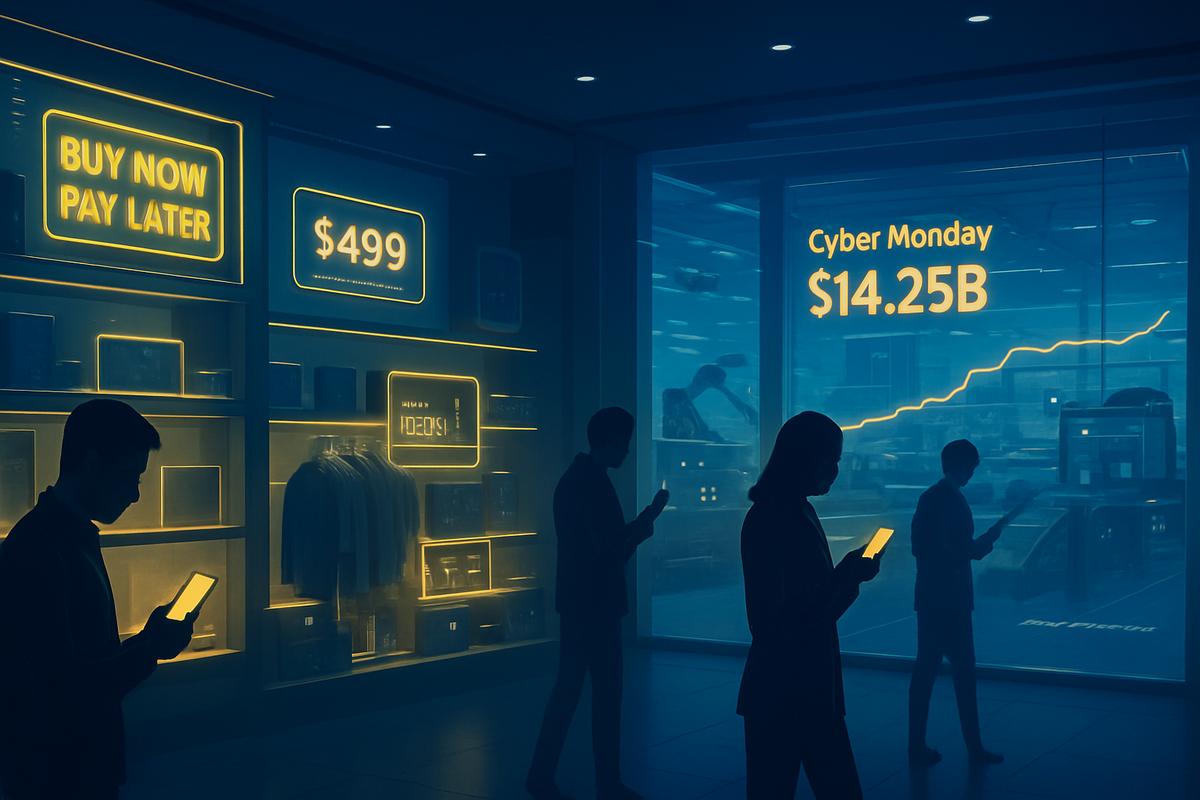
The 2025 holiday season was defined by the "Cyber Five"—the period from Thanksgiving through Cyber Monday—which saw a record 202.9 million consumers engage in the shopping frenzy. Black Friday online sales hit a staggering $11.8 billion, a 9.1% increase from 2024, while Cyber Monday solidified its status as the king of retail events with $14.25 billion in sales. At the peak of the rush, Americans were spending roughly $16 million per minute, a testament to the seamless integration of e-commerce and logistics that has matured over the last several years.
This year’s performance was not merely about volume; it was about the intelligence behind the transaction. AI-driven retail traffic surged by over 800% this season, with generative AI assistants helping shoppers navigate gift guides and compare prices in real-time. This technological shift resulted in a 38% higher conversion rate for AI-influenced shoppers compared to traditional browsing. The timeline for the season also shifted significantly, with major retailers launching "early access" events as early as mid-October to capture budget-conscious consumers before their discretionary funds were exhausted by rising costs in housing and services.
The Winners and Losers of the 2025 Value War
The clear victor of the 2025 retail landscape is Walmart Inc. (NYSE: WMT). By successfully capturing the "trade-down" shopper—households earning over $100,000 who are now seeking value—Walmart saw its US online sales surge by 28% in the latter half of the year. Their investment in the "Bettergoods" private-label line and a robust automated delivery network allowed them to dominate both the grocery and general merchandise categories. Similarly, Amazon.com, Inc. (NASDAQ: AMZN) maintained its stranglehold on the market, accounting for approximately 9.1% of all US retail spending by year-end. Amazon’s focus on delivery speed and its high-margin advertising segment, which grew 18% year-over-year, provided a cushion that allowed it to outprice competitors in the high-volume toys and electronics sectors.
On the other side of the ledger, Target Corporation (NYSE: TGT) faced a more turbulent year. Despite a late-season recovery, Target struggled with a 1.5% sales dip in the third quarter and was forced to slash prices on over 8,000 items to remain competitive with Walmart’s aggressive pricing. While Target’s exclusive partnerships and beauty segments remained bright spots, the retailer’s reliance on discretionary categories like home decor made it more vulnerable to the cautious spending habits of 2025. Meanwhile, mid-tier department stores like Macy's, Inc. (NYSE: M) and Kohl's Corp. (NYSE: KSS) continued to face headwinds as consumers bypassed the traditional mall experience in favor of the convenience and price transparency offered by big-box and digital-first retailers. Costco Wholesale Corporation (NASDAQ: COST), however, remained a stalwart, benefiting from its membership model and high renewal rates as families sought to bulk-buy essentials to combat the 2.7% inflation rate.
A Mainstream Shift to BNPL and the Debt Dilemma
The wider significance of the 2025 season lies in the fundamental shift in how Americans pay for their goods. BNPL has officially moved from a niche fintech offering to a mainstream financial staple. On Cyber Monday alone, BNPL spending hit $1.03 billion, contributing to a seasonal total of over $10.1 billion. For many Millennials and Gen Z shoppers, who accounted for over 70% of BNPL usage, these services were not just a convenience but a necessity to manage the "sticker shock" of a post-inflationary world.
This reliance on flexible payment terms comes at a cost. Total US household debt reached a record $18.6 trillion by December 2025. This event fits into a broader trend of "debt-fueled resilience," where consumer spending remains high despite cooling real wage growth. Historically, such periods are followed by a "cooling-off" phase, and the 2025 holiday season may be the final peak before a necessary deleveraging. Regulatory bodies are already taking note, with the Consumer Financial Protection Bureau (CFPB) expected to introduce stricter transparency requirements for BNPL providers in early 2026 to prevent a looming "phantom debt" crisis.
Looking Ahead: The 2026 "Post-Holiday Hangover"
As we transition into the first quarter of 2026, the retail sector faces a trio of challenges. First is the anticipated "spending breather," as consumers focus on paying down the credit and BNPL balances accumulated in November and December. Second, retailers are bracing for a massive wave of returns, which are projected to be 25% to 35% higher than previous years, particularly in the apparel sector. This "reverse logistics" nightmare will likely eat into the net margins of even the most efficient operators.
Furthermore, a unique "demand vacuum" is expected in early 2026 due to tariff front-loading. Many consumers and businesses accelerated their purchases of electronics and imported goods in late 2025 to avoid anticipated price hikes from new trade policies set to take effect in the coming months. This suggests that while the 2025 year-end numbers look strong, they may have "borrowed" growth from the first half of 2026, setting the stage for a potentially stagnant Q1 and Q2.
Closing the Books on 2025: A Market in Transition
In summary, the 2025 holiday season was a masterclass in retail adaptation. Companies that invested early in AI, logistics, and value-oriented private labels have emerged as the new market leaders, while those reliant on traditional promotional cycles have been left behind. The record-breaking $14.25 billion Cyber Monday is a sign of a digital economy that is firing on all cylinders, yet the $18.6 trillion in household debt is a flashing yellow light for the broader macroeconomy.
Moving forward, the market will likely see a period of consolidation. Investors should keep a close eye on delinquency rates for retail-branded credit cards and BNPL platforms, as these will be the first indicators of a potential consumer pullback. While the retail sector has shown incredible fortitude throughout 2025, the true test will be how it navigates the debt-laden landscape of early 2026. The "Value-First" era is here to stay, and for retailers, the margin for error has never been thinner.
This content is intended for informational purposes only and is not financial advice.