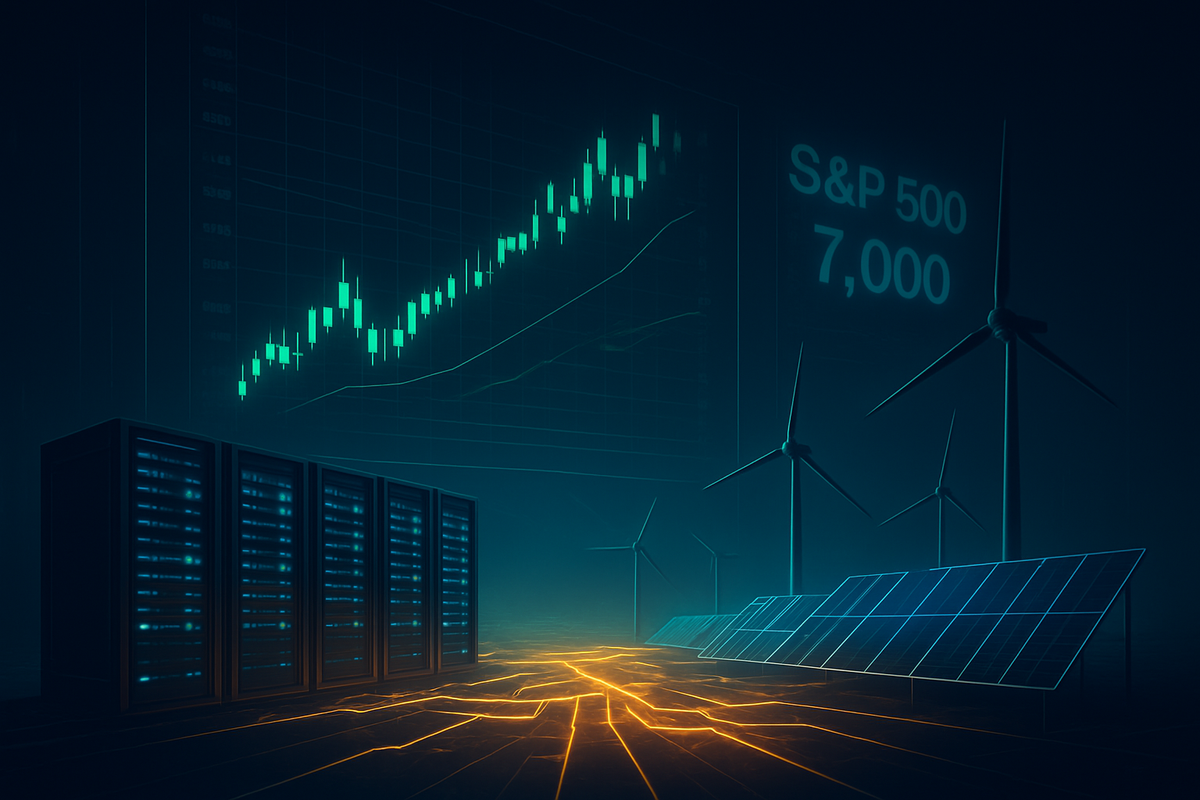
As the calendar flips to January 1, 2026, the U.S. equity markets are entering the new year with a definitive "risk-on" posture. The S&P 500 is currently hovering just below the psychologically significant 7,000 mark, driven by a series of technical breakouts among large-cap leaders that suggest the momentum of 2025 is far from exhausted. This surge is being fueled by a transition from speculative AI excitement into a phase of "industrial execution," where the massive capital expenditures of the previous two years are finally manifesting as tangible top-line growth.
The immediate implications for the market are profound. With the Federal Reserve having successfully navigated a "soft landing" and settled into a neutral rate environment, investors are rotating back into high-growth momentum stocks. Technical analysts point to a rare alignment of bullish chart patterns across the "Magnificent Seven" and the burgeoning energy sector, suggesting that the first quarter of 2026 could see one of the strongest starts to a year in recent memory.
The Path to 7,000: A Masterclass in Consolidation and Release
The current technical setup is the result of a multi-month consolidation phase that dominated the latter half of 2025. Throughout Q3 and Q4 of last year, the broader indices traded within a tightening range as the market digested the rapid gains of the early AI boom. This "cooling off" period allowed moving averages to catch up to price action, creating a springboard for the current breakout. Specifically, the Nasdaq-100 spent much of Autumn 2025 forming a massive "cup and handle" pattern, a classic bullish continuation signal that finally saw a decisive upside break in the final weeks of December.
Key stakeholders, including institutional asset managers and sovereign wealth funds, have been repositioning their portfolios to favor "sovereign AI" and infrastructure plays. The timeline leading to this moment was marked by the passage of the "One Big Beautiful Bill Act" (OBBBA) in mid-2025, which provided significant tax incentives for domestic data center construction and energy grid modernization. This legislative tailwind provided the fundamental floor that technical traders needed to justify pushing stocks to new all-time highs as 2026 began.
Initial market reactions to the year-end rally have been overwhelmingly positive, with trading volumes in call options reaching levels not seen since the post-pandemic frenzy. However, unlike the speculative bubbles of the past, the current move is backed by record-breaking corporate earnings and a stabilized interest rate environment. The "Golden Cross"—where the 50-day moving average rises above the 200-day moving average—is now visible on the charts of over 65% of S&P 500 constituents, signaling a broad-based participation in this rally rather than a narrow, tech-only surge.
The Winners of the Q1 Momentum Surge
Leading the charge into the first quarter is Nvidia (NASDAQ: NVDA), which has successfully cleared a critical resistance level at $194. After completing a falling wedge breakout in late December, the semiconductor giant is now eyeing the $205 pivot, with some analysts setting long-term targets as high as $350 for the year. The primary driver for Nvidia remains the transition to its "Rubin" architecture, which has seen unprecedented demand from national governments looking to build independent, "sovereign" AI clusters.
Microsoft (NASDAQ: MSFT) is another clear winner, testing a major breakout above $516. The company’s technical strength is supported by a staggering 112% year-over-year increase in commercial bookings for its Azure and Copilot services. This fundamental surge has validated the stock’s march toward a target range of $608 to $692. Meanwhile, Apple (NASDAQ: AAPL) has emerged as a "defensive momentum" play, with its stock price squeezing into a narrow consolidation range between $244 and $259. A breakout above the $259 level is widely viewed as a primary entry signal for Q1, as the company benefits from a robust holiday season and the traditional "January effect" that has historically favored its shares.
Beyond the traditional tech giants, the "AI-Energy Nexus" is producing new momentum leaders. Vistra Corp (NYSE: VST) and NextEra Energy (NYSE: NEE) have transitioned from sleepy utility stocks into high-growth vehicles. Vistra, in particular, is riding a trend-following breakout to all-time highs as the demand for nuclear power to fuel data centers reaches a fever pitch. On the other hand, potential "losers" in this environment are companies that have failed to show a return on their AI investments. Traditional retailers and legacy manufacturing firms that haven't integrated automated efficiencies are seeing their margins compressed by sticky 3% inflation, causing them to lag the broader market's technical ascent.
Broader Significance and the AI-Energy Nexus
The technical breakouts we are witnessing are more than just lines on a chart; they represent a fundamental shift in the global economy. The convergence of AI demand and energy infrastructure—the so-called "AI-Energy Nexus"—is becoming the defining trade of the decade. This trend is forcing a re-evaluation of the utilities sector, which is now being valued more like a growth industry than a defensive haven. This shift has massive ripple effects on competitors and partners alike, as the scramble for power grid priority becomes as competitive as the race for the fastest GPU.
From a regulatory standpoint, the current market environment is being shaped by the Federal Reserve's shift to a neutral rate of approximately 3.5% to 3.75%. This "Goldilocks" zone provides enough liquidity to support growth without reigniting the runaway inflation seen in previous years. Furthermore, the OBBBA legislation has created a policy environment that rewards capital-intensive infrastructure projects, favoring large-cap companies with the balance sheets to invest in long-term projects. This mirrors the historical precedent of the 1950s Eisenhower-era infrastructure boom, which laid the groundwork for decades of industrial dominance.
The wider significance also lies in the return of "price discovery" for stocks that lagged in 2025. For instance, Salesforce (NYSE: CRM) is showing signs of a "hard bottom" reversal as the market begins to price in the widespread adoption of "Agentic AI"—autonomous software agents that can perform complex business tasks. As these laggards begin to break out of their horizontal channels, the market's breadth is improving, which is historically a prerequisite for a sustained and healthy bull market.
The Road Ahead: Targets and Pivots
Looking forward, the short-term goal for the S&P 500 is a decisive close above 7,000, which would likely trigger a fresh wave of algorithmic buying. Wall Street firms have already revised their year-end 2026 targets upward, with the most bullish estimates reaching as high as 8,300. In the coming months, investors should expect a strategic pivot toward "Agentic" architectures and "Sovereign AI" as the primary narratives driving stock selection. Companies like AMD (NASDAQ: AMD) are already positioned for this, with their MI450 series gaining significant enterprise market share and pushing the stock toward new price discovery territory.
However, the path will not be without challenges. The primary risk remains "sticky" inflation, which could prevent the Fed from providing further support if the economy heats up too quickly. Additionally, the rapid ascent of stocks like Netflix (NASDAQ: NFLX), which is attempting a "sneaky comeback" after a volatile 2025, suggests that market leadership could remain fluid. Investors will need to be nimble, watching for potential "bull traps" if the S&P 500 fails to hold the 7,000 level on its first attempt.
Summary of the 2026 Market Outlook
As we move into the first quarter of 2026, the technical landscape for large-cap US stocks is exceptionally bullish. The combination of successful consolidation in late 2025, supportive federal policy, and a clear fundamental catalyst in the form of AI commercialization has created a "perfect storm" for momentum traders. The breakouts in leaders like Nvidia and Microsoft are not just isolated events but are indicative of a broader structural move higher across the entire S&P 500.
For the months ahead, investors should keep a close eye on the $7,000 level for the S&P 500 and the $200 level for Nvidia as key barometers of market health. While the "AI-Energy Nexus" remains the dominant theme, the broadening of the rally into financials, led by JPMorgan Chase (NYSE: JPM), and industrials suggests that the 2026 bull market is built on a solid foundation. The key takeaway is clear: the era of AI speculation is over, and the era of AI execution—and the technical breakouts that accompany it—has officially begun.
This content is intended for informational purposes only and is not financial advice.