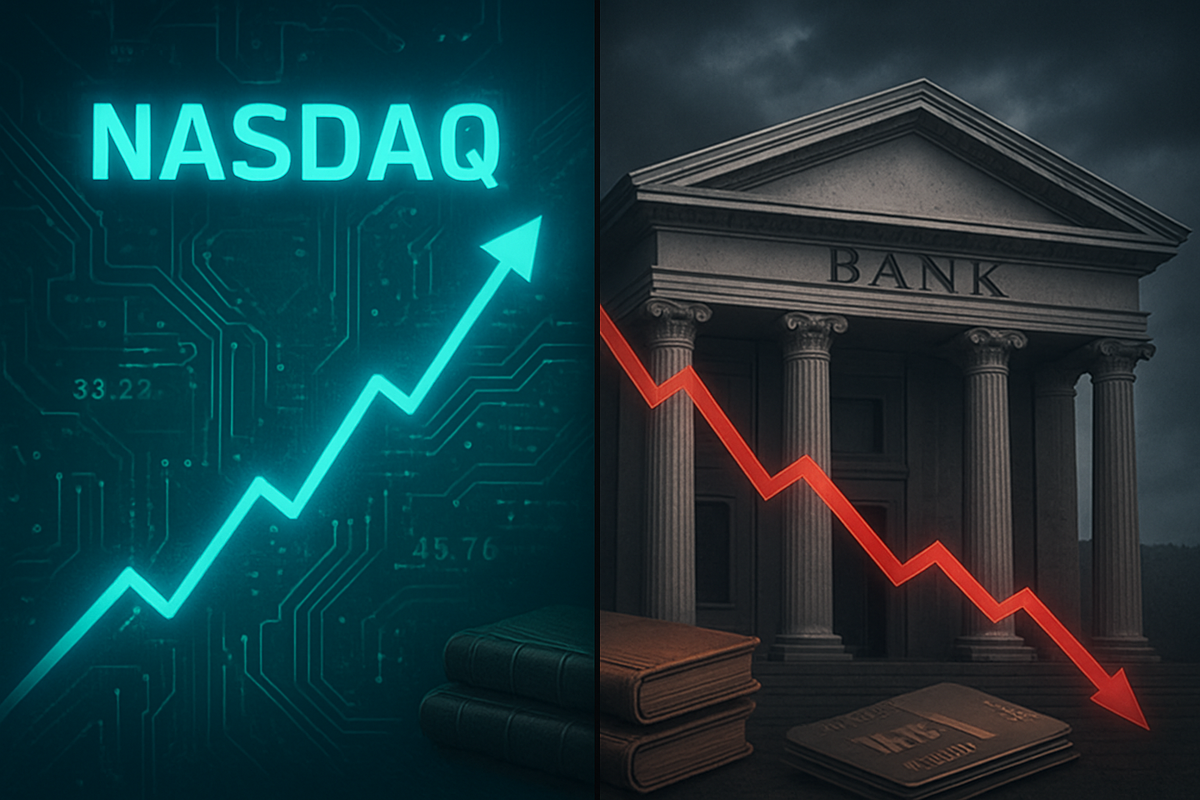
The U.S. stock market experienced a striking divergence on Monday, January 12, 2026, as a surge in artificial intelligence optimism propelled the Nasdaq Composite and S&P 500 to near-record levels, while a sudden regulatory shock to the banking sector left the Dow Jones Industrial Average languishing in the red. This "bifurcation" of the market highlights a growing divide between the high-flying "AI Economy" and the "Traditional Economy," which is currently grappling with aggressive legislative proposals and a historic crisis of confidence at the Federal Reserve.
By the closing bell, the tech-heavy Nasdaq Composite rose 0.4%, bolstered by a historic milestone for Alphabet and a strategic rally in retail giant Walmart. The S&P 500 managed a modest 0.1% gain, recovering from an early-morning slump. However, the Dow Jones Industrial Average (INDEXDJX: .DJI) fell 0.19%, or roughly 80 points, as its heavy concentration in financial and industrial heavyweights became a liability in the face of new populist economic policies.
Regulatory Shocks and Political Turmoil
The primary catalyst for the Dow's underperformance was a weekend announcement from the White House that sent shockwaves through the financial sector. President Trump proposed a temporary, one-year 10% cap on all credit card interest rates, set to take effect on January 20, 2026. The proposal, designed to provide relief for consumers holding over $1.17 trillion in credit card debt, was met with immediate hostility from Wall Street analysts who warned of a catastrophic hit to bank earnings and a potential freeze in consumer credit markets.
The market opened under a cloud of further uncertainty as news broke of a Department of Justice criminal investigation into Federal Reserve Chair Jerome Powell. The probe centers on allegations that Powell misled Congress regarding a $2.5 billion renovation of the Federal Reserve’s headquarters in Washington, D.C. While the investigation is ostensibly about construction costs, investors interpreted it as a direct assault on the Fed's independence, leading to an initial broad-market sell-off. While tech stocks eventually "shook off" the macro-political noise, the Dow's industrial and financial components remained weighed down by the prospect of a leaderless or politically compromised central bank.
Compounding the Dow's woes was a continued manufacturing slump. Industrial production data released early Monday suggested a deeper contraction in the "Rust Belt" economy than previously anticipated. This data, combined with the Fed probe, created a perfect storm for traditional blue-chip stocks, which are more sensitive to interest rate volatility and domestic economic health than their globalized technology counterparts.
The Winners and Losers: Tech Resilience vs. Banking Bloodbath
The divergence was most visible in the individual performance of market leaders. The day’s biggest winners were found in the technology and retail sectors. Nvidia (NASDAQ: NVDA) led the charge, gaining nearly 2% as it approached a $4 trillion market cap following the successful rollout of its "Rubin" AI architecture at the Consumer Electronics Show (CES). Alphabet (NASDAQ: GOOGL) also made history, officially crossing the $4 trillion threshold for the first time as investors cheered the integration of its Gemini AI models into global retail workflows.
Walmart (NYSE: WMT) provided a surprising boost to the Nasdaq-100, rising 3.5% to an all-time high of $118. The gains followed the announcement that the retail behemoth would officially join the Nasdaq-100 on January 20, replacing AstraZeneca. Analysts are increasingly viewing Walmart as a "tech-first" retailer, a sentiment bolstered by a new AI partnership with Google. Conversely, the "losers" list was dominated by credit card issuers. Synchrony Financial (NYSE: SYF) plummeted 8.5%, while Capital One (NYSE: COF) and American Express (NYSE: AXP) fell 6.5% and 4.4%, respectively. Because the Dow is a price-weighted index, the sharp decline in a high-priced stock like American Express exerted significant downward pressure on the average.
Other notable laggards included industrial stalwarts like Caterpillar (NYSE: CAT) and Boeing (NYSE: BA), both of which fell over 1% on fears of a prolonged manufacturing recession. Exxon Mobil (NYSE: XOM) also slipped about 1% after the administration suggested it might block the company’s potential reinvestment in Venezuela, highlighting the geopolitical risks currently facing the energy sector.
A Structural Shift in Market Dynamics
The events of January 12, 2026, represent more than just a bad day for the Dow; they signal a broader shift in market dynamics. For decades, the 1978 Supreme Court Marquette ruling allowed banks to export high interest rates across state lines, leading to a period of deregulation that fueled the growth of the financial sector. The proposed 10% cap represents a fundamental reversal of this trend, moving the U.S. toward a more regulated, populist economic model. This shift is creating a "regulatory premium" on traditional financial stocks, while tech companies—which are less reliant on traditional lending—remain relatively insulated.
Furthermore, the investigation into Chair Powell marks a historical low point in the relationship between the executive branch and the Federal Reserve. Not since the 1970s, when Arthur Burns faced intense pressure from the Nixon administration, has the Fed’s autonomy been so publicly challenged. The current situation is even more severe, as it involves a criminal probe rather than just political jawboning. This instability typically favors growth stocks, as investors seek refuge in companies with "secular growth" stories that do not depend on the stability of the central bank's monetary policy.
The "Walmart-to-Nasdaq" move also highlights a significant industry trend: the reclassification of traditional giants as technology companies. By abandoning the NYSE for the Nasdaq, Walmart is signaling that its future lies in data, AI, and automated logistics rather than traditional brick-and-mortar retail. This shift is likely to encourage other Dow components to reconsider their listing and index affiliations, potentially further hollowing out the "Old Economy" benchmarks.
What Comes Next: A Critical January 20 Deadline
The short-term outlook for the market is heavily dependent on the upcoming January 20 deadline. This date marks both the Presidential Inauguration and the proposed effective date for the 10% credit card cap. Investors will be watching closely to see if the proposal is formalized through an executive order or if it will face immediate legal challenges from the banking lobby. A successful implementation could lead to a further contraction in bank stocks, while a legal stay might trigger a relief rally in the Dow.
Strategically, financial institutions may be forced to pivot toward fee-based income or stricter lending standards to offset the loss of interest revenue. This could inadvertently slow down consumer spending, creating a headwind for the broader economy in the latter half of 2026. On the tech front, the focus will remain on whether Nvidia and Alphabet can maintain their $4 trillion valuations. Any sign of "AI fatigue" or a slowdown in corporate AI spending could leave the Nasdaq vulnerable, as it would no longer have the "tech shield" to protect it from the macro-economic turmoil affecting the Dow.
Market Wrap-Up and Investor Outlook
The divergence seen today is a stark reminder that the "stock market" is not a monolith. While the Nasdaq and S&P 500 are thriving on the back of a generational leap in artificial intelligence, the Dow is being dragged down by the weight of regulatory uncertainty and political strife. The key takeaway for investors is the importance of sector exposure; the traditional "safe haven" of blue-chip industrials and financials is currently facing some of the most significant headwinds in decades.
Moving forward, the market will likely remain volatile as the legal drama surrounding the Federal Reserve unfolds and the new interest rate policies take shape. Investors should keep a close eye on bank earnings reports in the coming weeks for clues on how they plan to navigate the proposed 10% cap. Additionally, the performance of Walmart in its new Nasdaq home will serve as a bellwether for whether other traditional companies can successfully "rebrand" as tech leaders. In the coming months, the ability to distinguish between innovation-driven growth and regulation-driven contraction will be the hallmark of a successful investment strategy.
This content is intended for informational purposes only and is not financial advice