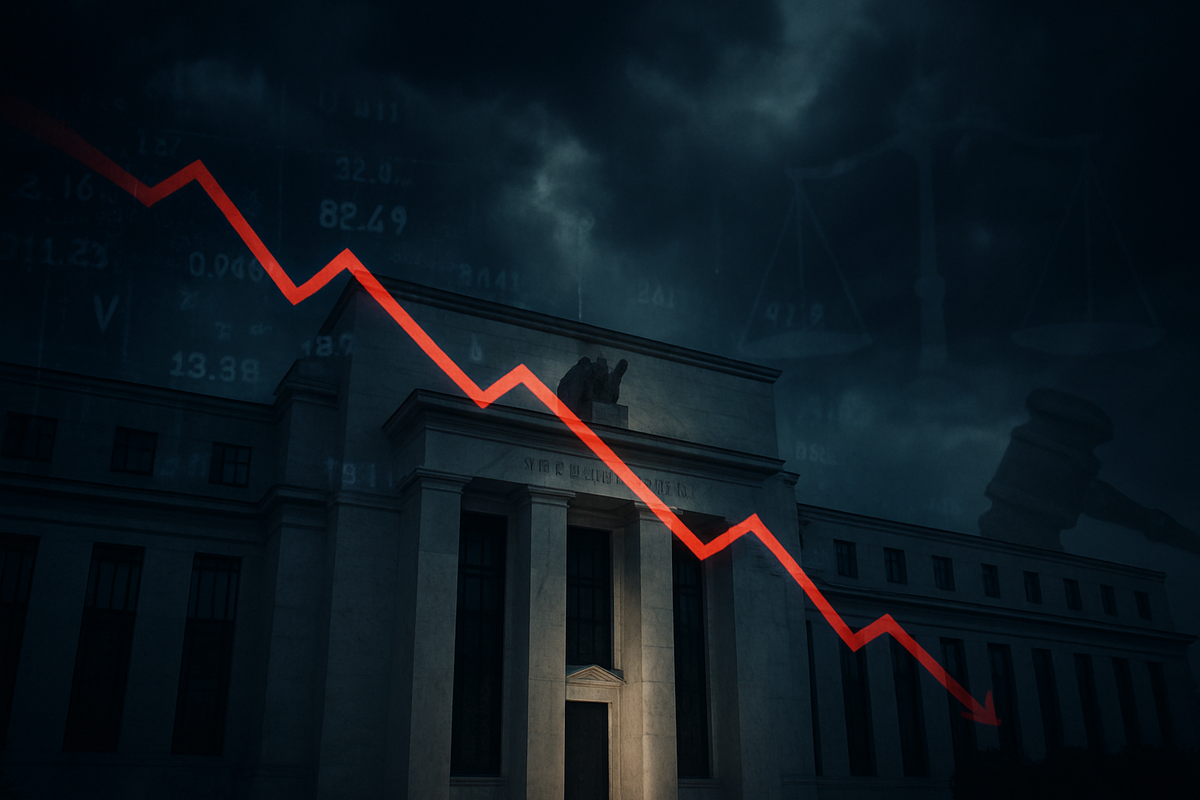
The century-long tradition of Federal Reserve independence is facing its gravest threat to date as the Department of Justice (DOJ) has launched an unprecedented criminal investigation into Fed Chair Jerome Powell. The news, which broke on January 11, 2026, has sent shockwaves through global financial markets, raising fears that the central bank is being systematically dismantled as an autonomous institution. Analysts warn that the move could trigger a "Sell America" trade, as the firewall between monetary policy and partisan politics appears to be crumbling just months before Powell’s term as Chair is set to expire.
The immediate implications are staggering: the U.S. dollar has softened against major currencies, and volatility indices have spiked to levels not seen since the inflation scares of 2024. Investors are now pricing in a "political risk premium" for U.S. assets, fearing that future interest rate decisions will be dictated by the White House rather than economic data. This confrontation marks a definitive turning point in the relationship between the executive branch and the nation's lender of last resort, creating a level of institutional uncertainty that threatens the stability of the global financial system.
A Targeted Strike: The Renovations Scandal and the Unitary Executive
The current crisis traces back to a video statement released by Jerome Powell on January 11, 2026, in which he confirmed that the DOJ, led by U.S. Attorney Jeanine Pirro, had served the Federal Reserve with grand jury subpoenas. The official focus of the probe is a $2.5 billion renovation project of the Federal Reserve’s Washington D.C. headquarters—the Eccles and Martin Buildings. Federal investigators allege that the project suffered from $600 million in cost overruns and included unauthorized "lavish" features, such as executive dining rooms and premium marble finishes. Powell, however, has framed the investigation as a "pretext," asserting that the legal pressure is direct retaliation for the Fed’s refusal to implement the 300-basis-point rate cuts demanded by the administration throughout 2025.
The timeline leading to this moment has been defined by escalating hostilities. Throughout 2025, the President repeatedly attacked Powell in public forums, labeling him a "political hack" for maintaining a cautious approach to monetary easing despite slowing growth. The tension reached a boiling point in late December 2025, when the Fed opted for a modest 25-basis-point cut, far short of the administration’s requirements. This investigative strike by the DOJ is seen by many as the "nuclear option" in a long-standing campaign to assert executive control over the central bank, utilizing the "Unitary Executive Theory" to argue that all executive-branch-related officials should serve at the pleasure of the President.
Key stakeholders, including members of the Board of Governors and regional Fed presidents, have reportedly rallied behind Powell, but the pressure is mounting. The controversy is set against the backdrop of an upcoming Supreme Court case, Trump v. Cook, scheduled for oral arguments on January 21, 2026. The case involves an attempt to fire Fed Governor Lisa Cook and will determine if the "for-cause" removal protections in the Federal Reserve Act of 1913 are constitutional. The intersection of a criminal probe and a landmark SCOTUS battle has created a perfect storm of legal and economic instability.
Market Winners and Losers: A Flight to Safety and the "Sell America" Trade
The primary losers in this unfolding drama are traditional U.S. equities and the domestic currency. Large-cap financial institutions like JPMorgan Chase & Co. (NYSE: JPM) and The Goldman Sachs Group, Inc. (NYSE: GS) saw their shares retreat as the prospect of a politicized Fed threatens the predictable interest-rate environment they rely on for long-term planning. The broader market, tracked by the SPDR S&P 500 ETF Trust (NYSE: SPY), experienced a sharp 1.5% intraday drop following the DOJ announcement, as the "institutional stability" that has long underpinned U.S. exceptionalism was called into question.
The U.S. Dollar has also taken a hit, with the Invesco DB US Dollar Index Bullish Fund (NYSE: UUP) showing notable weakness as international investors begin to weigh the risks of a central bank that may prioritize short-term political wins over long-term price stability. Conversely, the "winners" in this environment are traditional safe-haven assets. SPDR Gold Shares (NYSE: GLD) and other precious metal vehicles have seen a surge in inflows as investors hedge against the potential for "time-inconsistent" monetary policy—where a central bank lowers rates prematurely to satisfy political masters, eventually leading to unanchored inflation.
Beyond the immediate price action, regional banks and bond-heavy institutions are facing a perilous "wait-and-see" period. If the Fed's independence is compromised, long-term Treasury yields may skyrocket as the market demands a higher term premium to compensate for the risk of future inflation. This would negatively impact any company with high debt-refinancing needs, particularly in the tech and real estate sectors. Meanwhile, international markets may see a capital flight toward the Eurozone or Japan, where central bank independence remains more clearly defined.
Historical Echoes and the Erosion of Central Bank Independence
The current assault on Fed independence fits into a broader global trend of "populist economics," where executive leaders increasingly view central banks as tools for domestic policy rather than independent arbiters of the money supply. While historical precedents exist—most notably President Richard Nixon’s successful pressure on Arthur Burns to keep rates low ahead of the 1972 election—the current DOJ investigation represents a much more aggressive and formalized attempt to coerce the Fed. Unlike the private arm-twisting of the past, the use of the justice system to target a sitting Fed Chair is a move without modern parallel in the United States.
The ripple effects extend far beyond the Eccles Building. If the DOJ succeeds in sidelining Powell or forcing his resignation before his term ends on May 15, 2026, it sets a precedent that the central bank is effectively an arm of the White House. This could fundamentally alter the relationship between the U.S. Treasury and foreign central banks, who hold trillions in U.S. debt. The credibility of the Fed is its primary currency; once that credibility is traded for political expediency, the "inflation anchor" that has kept the U.S. economy stable for decades could come loose.
Regulatory and policy implications are equally profound. A politicized Fed might be pressured to use its regulatory powers to favor certain industries or penalize others based on the administration’s agenda. This shift would mirror the central bank structures found in many developing nations, where high inflation and currency devaluations are frequent consequences of executive interference. The market is currently grappling with the realization that the "institutional guardrails" long taken for granted in the U.S. financial system are more fragile than previously believed.
The Road to May 15: Potential Successors and Strategic Pivots
As we look toward the expiration of Jerome Powell’s term as Chair on May 15, 2026, the market is bracing for a period of extreme volatility. There is a high probability that Powell will attempt to serve out his term as a member of the Board of Governors (which lasts until 2028) even if he is replaced as Chair, creating a fractured and combative Board. However, if the DOJ investigation moves toward an indictment, a strategic resignation may become unavoidable. Investors should prepare for a potential leadership vacuum or a recessed appointment battle that could leave the Fed without a Senate-confirmed leader for months.
Potential successors currently being floated include Kevin Hassett, a proponent of aggressive rate cuts, and Kevin Warsh, a former Fed Governor who might be seen as a more market-friendly compromise. However, any nominee put forward by the current administration will likely face intense scrutiny from a divided Senate. Some key legislators have already stated they will block any confirmation until the DOJ investigation is resolved. This political deadlock could force the Fed into a defensive posture, where it remains paralyzed and unable to respond effectively to any sudden economic downturn or credit crunch.
For institutional investors, the strategic pivot involves shifting portfolios away from assets sensitive to inflation and toward those that can withstand a period of institutional decay. We may see an increase in "defensive" positioning, with a focus on companies with strong balance sheets and the ability to pass on costs to consumers. The "market opportunity" here lies in identifying which assets have been oversold due to panic, though the "challenge" remains the total lack of a historical playbook for a DOJ-led takeover of the Federal Reserve.
Final Assessment: What Investors Should Watch
The investigation into Jerome Powell is not merely a legal hurdle for one man; it is a stress test for the American financial system. The key takeaway for investors is that the "neutrality" of the Federal Reserve can no longer be assumed as a baseline. The coming months will be a gauntlet of legal filings, congressional testimonies, and Supreme Court rulings that will collectively decide the future of the U.S. dollar's status as the world's reserve currency.
Moving forward, the market will likely remain in a state of heightened anxiety. Investors should keep a close eye on the Trump v. Cook ruling later this month and any subsequent leaks from the DOJ grand jury. If the Supreme Court sides with the administration’s Unitary Executive Theory, the Fed’s independence will effectively exist only at the President’s discretion. This would be a seismic shift in the global order, likely leading to a permanent increase in U.S. borrowing costs.
In the final analysis, the significance of this event cannot be overstated. We are witnessing the possible end of the "Volcker Era" of central banking—an era defined by the belief that a central bank must be free to make unpopular decisions for the long-term health of the economy. For the first time in over a century, the person steering the world’s largest economy is doing so with a legal target on their back, and the markets are rightly terrified of what happens if they fall.
This content is intended for informational purposes only and is not financial advice.