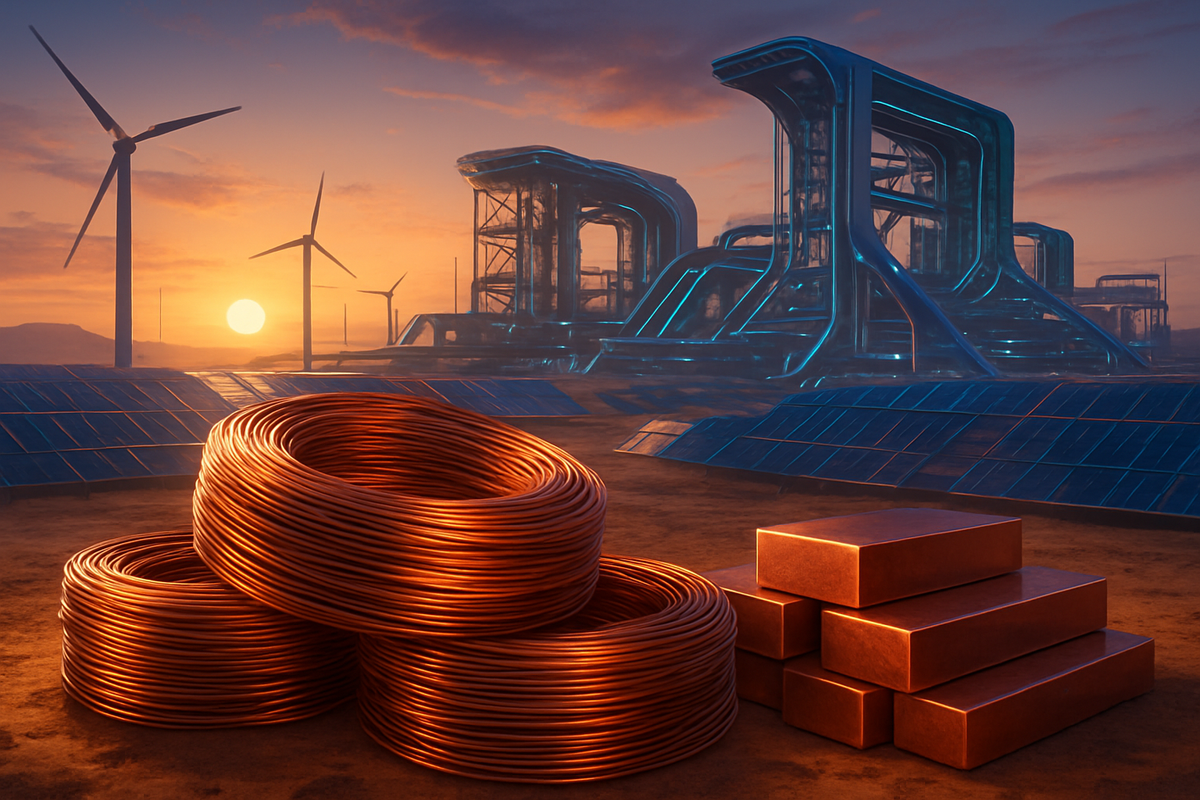
As of mid-January 2026, the global commodities market is witnessing a seismic shift as the Middle East transitions from a fossil-fuel giant to a critical minerals powerhouse. Recent data released at the 2026 Future Minerals Forum in Riyadh indicates that copper demand across the region is projected to surge by a staggering 40% by 2035. This unprecedented growth is being fueled by a relentless drive toward electrification, the construction of futuristic "giga-projects," and a regional pivot to renewable energy infrastructure that is reshaping the global supply chain for the "red metal."
The immediate implications are already being felt on the London Metal Exchange and COMEX, where copper prices have reached historic highs of $13,000 per ton in the opening weeks of 2026. As the Gulf Cooperation Council (GCC) nations accelerate their energy transition, the regional demand for high-grade copper—essential for everything from solar photovoltaic arrays to advanced cooling systems—is outstripping current supply forecasts. This surge is not merely a regional trend but a primary driver of what many analysts are calling the "second phase" of the green commodity supercycle.
A Strategic Shift to Electrification
The projected 40% surge in demand is the culmination of a decade-long strategic pivot by Middle Eastern economies to diversify away from hydrocarbons. Leading this charge is Saudi Arabia, which has seen its domestic copper consumption targets revised upward following the rapid expansion of NEOM and its flagship linear city, The Line. According to reports from the International Energy Agency (IEA) in late 2025, the Middle East's peak electricity demand is expected to rise by nearly 50% by 2035, necessitating a massive overhaul of national grids. Copper, as the premier conductor of electricity, is the indispensable backbone of this new infrastructure.
The timeline leading to this moment was accelerated by the 2024-2025 supply shortages in traditional mining hubs like Chile and Indonesia. This scarcity pushed Middle Eastern sovereign wealth funds to invest billions into domestic exploration and processing. By early 2026, countries like Oman and the United Arab Emirates have moved from minor players to vital nodes in the copper value chain. The regional strategy has shifted from simply importing refined metal to building massive, high-tech smelters that can process ore locally, thereby ensuring supply security for the region’s ambitious 2035 climate targets.
Key players in this transformation include regional ministries of investment and massive state-backed enterprises. The market reaction has been swift; global mining conglomerates are no longer viewing the Middle East solely as a source of capital, but as a primary market for their product. In January 2026, the "Critical Minerals Corridor"—a series of bilateral trade agreements between the GCC and copper-rich nations like Egypt and Chile—was formally solidified, creating a new geopolitical alignment centered around mineral security rather than oil output.
Winners and Losers in the Red Metal Race
The primary beneficiary of this demand surge is the Saudi Arabian Mining Co. (TADAWUL: 1211), commonly known as Ma’aden. As the regional leader, Ma’aden has pivoted its exploration budget aggressively, with over 70% of its current 2026 funding dedicated to copper and gold. By positioning itself at the center of the Arabian-Nubian Shield, Ma’aden is poised to become a vertically integrated giant, controlling both the extraction and the refining processes that will supply the region’s growing electrical grid.
On the global stage, major miners like Rio Tinto Group (NYSE: RIO) and Freeport-McMoRan Inc. (NYSE: FCX) are finding lucrative new opportunities in the Middle Eastern market. Freeport-McMoRan, in particular, is navigating supply constraints in Southeast Asia by eyeing new joint ventures in the Gulf, while Rio Tinto is actively exploring copper deposits in Egypt to feed the growing industrial hubs in the UAE. Conversely, companies focused solely on traditional fossil fuel infrastructure that fail to pivot toward electrical grid components may find themselves sidelined as regional capital shifts toward the "electrification of everything."
International players like Vedanta Limited (NSE: VEDL) are also making massive bets; the company recently broke ground on a $2 billion copper smelting complex in Saudi Arabia. This move is designed to capture the value-added segment of the market, producing copper rods and wires specifically for the Middle East’s booming construction and renewable sectors. For these companies, the "win" lies in the ability to bypass traditional, often bottlenecked, processing routes in China and establish a direct supply line to the heart of the Middle East’s industrial expansion.
Global Ripple Effects and Mineral Diplomacy
This event fits into a broader global trend of "mineral nationalism" and the decentralization of the energy supply chain. For decades, China has dominated the refining of critical minerals, but the Middle East’s 40% demand surge is forcing a redistribution of processing power. By building domestic refining capacity, the Middle East is providing a "third way" for global markets, offering a non-Chinese source of refined copper that appeals to Western nations looking to de-risk their supply chains. This ripple effect is likely to pressure competitors in East Asia to secure their own long-term off-take agreements.
Historically, the Middle East has used its oil wealth to influence global geopolitics; we are now seeing a precedent for "copper diplomacy." Similar to the oil shocks of the 20th century, the control over electrical infrastructure components is becoming a matter of national security. Regulatory frameworks in the region are being rewritten to fast-track mining licenses and environmental permits, often at a pace that far exceeds Western counterparts. This regulatory agility is attracting global capital that has grown frustrated with the long lead times in North American and European mining projects.
Furthermore, the surge highlights the critical link between water scarcity and mineral demand. A significant portion of the projected copper demand is tied to desalination plants and advanced air conditioning systems required to mitigate the effects of climate change in the desert. This creates a feedback loop: as temperatures rise, the demand for copper-intensive cooling and water systems increases, further driving up global prices and incentivizing deeper investments in the sector.
Looking Forward: Scenarios for 2035
Looking ahead to the remainder of 2026 and toward 2030, the primary challenge will be supply-side execution. While the demand projection is clear, the actual extraction of enough ore to meet a 40% surge remains a daunting task. Investors should expect a period of intense mergers and acquisitions as regional giants like Ma’aden look to acquire smaller, junior mining firms with promising deposits in the Arabian-Nubian Shield. Short-term volatility is likely as the market balances record-high prices against the massive capital expenditures required to bring new mines online.
A strategic pivot toward "urban mining" and recycling is also expected to emerge. As the cost of raw copper stays elevated, Middle Eastern cities may begin implementing advanced e-waste recovery systems to recapture copper from decommissioned electronics and old infrastructure. This presents a massive opportunity for technology firms specializing in mineral recovery and circular economy solutions. The market will also be watching for any potential "demand destruction"—if prices stay too high for too long, some renewable projects may be delayed or redesigned to use less copper, though current engineering alternatives like aluminum have limited viability in high-performance electrical applications.
Conclusion and Market Assessment
The projected 40% surge in Middle Eastern copper demand by 2035 marks the beginning of a new era in the global energy transition. It is no longer just about where the energy comes from, but how it is delivered and managed. The Middle East has recognized that its future relevance depends on its ability to command the minerals that power the modern world. For the market, this means that copper is no longer just a cyclical industrial metal; it is a strategic asset with a long-term growth trajectory that is increasingly decoupled from traditional economic cycles.
Moving forward, investors should keep a close watch on the progress of Saudi Arabia’s exploration initiatives and the timeline of new smelter completions in the UAE and Oman. The ability of the region to successfully bridge the supply-demand gap will determine whether copper prices stabilize or continue their record-breaking ascent. The lasting impact of this surge will be a fundamentally restructured global mineral market, with the Middle East serving as its new, electrified heart.
This content is intended for informational purposes only and is not financial advice