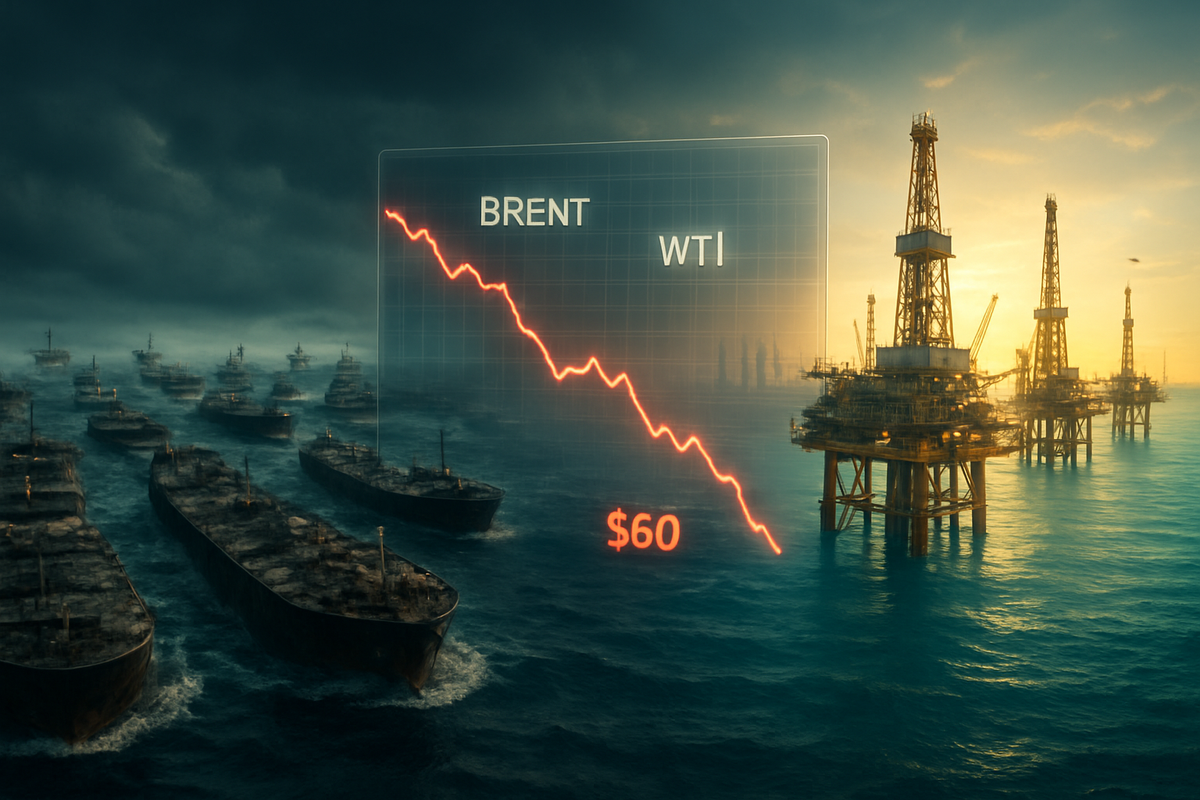
As the global financial markets open for the first week of 2026, the energy sector finds itself paralyzed by a high-stakes tug-of-war between two diametrically opposed forces. On one side, a tightening web of geopolitical sanctions and a crackdown on the "dark fleet" of tankers are threatening to choke off traditional supply routes from Russia, Iran, and Venezuela. On the other, a massive tidal wave of new production from the Americas—led by the United States, Brazil, and Guyana—is threatening to drown the market in a surplus of nearly 4 million barrels per day.
This fundamental mismatch has left crude oil futures drifting lower, with Brent and WTI struggling to find a floor. Investors are currently weighing the "Year of the Glut" narrative against the risk of a sudden supply shock, resulting in a market state that analysts are calling "extreme compression." As of January 2, 2026, the global oil market is not just facing a price correction; it is facing a structural identity crisis as the energy transition begins to permanently erode demand growth in major economies like China and Europe.
The January Opening: A Market in "Wait-and-See" Mode
The first trading days of 2026 have seen Brent Crude hovering precariously between $60.00 and $61.50 per barrel, while West Texas Intermediate (WTI) has dipped to the $57.00 mark. This downward drift follows a brutal 2025, where prices shed nearly 20% of their value. The immediate catalyst for the current standoff is the simultaneous arrival of record-breaking production from the "Atlantic Basin Triad." The United States, Brazil, and Guyana have all reached new production milestones, effectively neutralizing the production cuts that OPEC+ has maintained for years.
In response to this looming surplus, the OPEC+ alliance, led by Saudi Arabia and Russia, announced on January 4, 2026, a "strategic pause"—a three-month supply freeze for the first quarter of the year. This move delays the return of 1.1 million barrels per day (bpd) that the group had previously hoped to bring back to market. The alliance is currently navigating a sensitive internal debate over "maximum sustainable capacity" (MSC) as they attempt to set new production baselines for 2027, a process that has historically sparked friction between member states like the UAE and Saudi Arabia.
Compounding the supply issue is a dramatic escalation in the enforcement of Western sanctions. A major flashpoint occurred this week involving the Bella 1, a tanker with Iranian origins that has become the centerpiece of a diplomatic standoff. The U.S. has intensified its "maximum pressure" campaign, specifically targeting the "dark fleet"—a shadow network of aging tankers used to bypass price caps and export bans. While these sanctions are intended to tighten the market, the sheer volume of non-OPEC oil entering the system has, so far, prevented a price spike, leaving the market in a state of suspended animation.
Winners and Losers in the $60 Oil Era
The current price environment is creating a sharp divide between diversified energy giants and pure-play producers. ExxonMobil (NYSE: XOM) appears well-positioned to weather the storm, largely due to its dominant position in Guyana’s Stabroek block. By focusing on low-cost, high-margin offshore production, Exxon is able to maintain profitability even if Brent averages $55 in the coming months. Similarly, Petrobras (NYSE: PBR) is emerging as a winner of the supply surge, as it brings new Floating Production Storage and Offloading (FPSO) units online at the massive Buzios field in Brazil.
Conversely, companies with heavy exposure to higher-cost regions or those facing regulatory hurdles are feeling the squeeze. Chevron (NYSE: CVX) recently announced a 10% capital expenditure cut for 2026, a move seen by many as a defensive measure against both the price slump and the complexities of its operations in Venezuela, which remain under the shadow of U.S. sanctions. Hess (NYSE: HES) remains a critical player to watch, as its fortunes are inextricably linked to the rapid ramp-up in Guyana, making it a high-beta play on the current Atlantic production boom.
In the U.S. shale patch, the focus has shifted from growth to survival. Diamondback Energy (NASDAQ: FANG) has been identified by analysts as a "low-cost operator" that can remain cash-flow positive in a $50–$60 price range, but many of its smaller, more leveraged peers may face consolidation or bankruptcy if the surplus persists. Meanwhile, European majors like TotalEnergies (NYSE: TTE) and Equinor (NYSE: EQNR) are caught in the middle; while they benefit from production milestones in Brazil, they are also grappling with downstream margin compression as the energy transition accelerates across the European continent.
The Structural Shift: Peak Demand and the Energy Transition
The standoff of 2026 is unique because it is occurring against the backdrop of a permanent shift in global energy consumption. For the first time, the "energy transition" is acting as an active market-clearing force rather than a distant forecast. Rapid electric vehicle (EV) adoption in China—which reached a tipping point in late 2025—has significantly blunted the world's primary engine of oil demand growth. Global demand growth has slowed to less than 1 million bpd, a figure that is easily overwhelmed by the production capacity of the Americas.
This shift has changed the historical correlation between global GDP growth and oil demand. As industrial processes and transportation sectors electrify, the market is pivoting toward petrochemicals as the primary source of incremental growth. This transition has historical parallels to the 2014 oil price crash, but with a critical difference: in 2014, the market expected demand to eventually recover and grow. In 2026, there is a growing consensus that the world is approaching "Peak Oil Demand," making every barrel of surplus supply significantly more toxic to prices.
Regulatory pressures are also mounting. Governments are increasingly using sanctions not just as geopolitical weapons, but as tools to influence the carbon intensity of the global energy mix. The crackdown on the "dark fleet" is as much about environmental safety and maritime regulation as it is about geopolitical leverage. This regulatory environment creates a "risk premium" that is currently being offset by the "surplus discount," resulting in the sideways price action we see today.
What Lies Ahead: Strategic Pivots and Scenarios
In the short term, the market will be hyper-focused on the results of the OPEC+ baseline assessments. If the alliance fails to reach a consensus on 2027 production targets, the risk of a "market share war"—similar to the one seen in early 2020—could return. Such a scenario would likely see Brent Crude crash into the $40s, a move that would force a rapid and painful consolidation of the U.S. shale industry.
Longer term, the industry must adapt to a "lower-for-longer" price environment. We expect to see a wave of strategic pivots, where capital is diverted away from frontier exploration and toward "advantaged" barrels—oil that is both low-cost and low-carbon to produce. Companies that cannot compete on these two fronts will likely be phased out or acquired. The "Atlantic Basin Triad" will continue to dominate the supply side, but their success will depend on their ability to manage the political risks associated with their rapid expansion.
Market Outlook and Investor Takeaways
As 2026 begins, the oil market is a study in contradiction. The threat of geopolitical instability in the Middle East and Eastern Europe would normally send prices skyrocketing, yet the sheer weight of the 4-million-barrel surplus is keeping a firm lid on any rallies. For investors, the key takeaway is that the era of "scarcity-driven" pricing is over, replaced by a "surplus-driven" regime where operational efficiency and cost-per-barrel are the only metrics that matter.
Moving forward, the market will likely remain in this volatile holding pattern until either a major geopolitical event breaks the "dark fleet" supply chain or OPEC+ decides to abandon its price-support strategy in favor of reclaiming market share. Investors should watch the $60 Brent level closely; a sustained break below this mark could trigger a cascade of capital expenditure cuts and a new wave of M&A activity across the energy sector.
This content is intended for informational purposes only and is not financial advice.