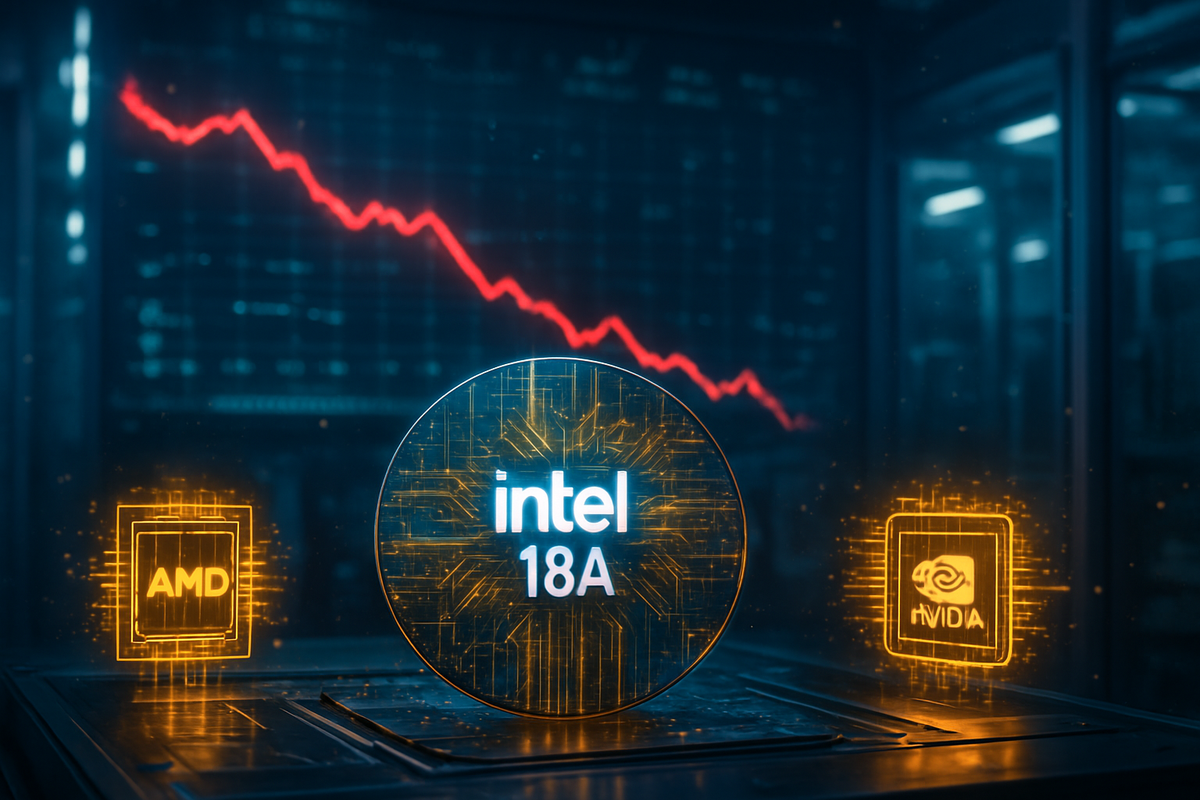
The semiconductor landscape received a jolting reality check this week as Intel Corporation (NASDAQ: INTC) released its fourth-quarter 2025 earnings. While the chipmaker delivered a "beat" on the headline numbers for the final months of 2025, its conservative forecast for the first quarter of 2026 sent shockwaves through its investor base. The market’s reaction was swift and unforgiving, as shares plunged more than 12% in Friday's trading session, reflecting a growing consensus that the stock had become detached from its immediate fundamental outlook during a massive 149% rally over the previous year.
The primary driver of the pessimism was a significant letdown in data center revenue guidance. Despite the global AI boom, Intel signaled that supply constraints and a shifting product mix would lead to a "breakeven" bottom line for the current quarter. This disappointing outlook has forced a re-evaluation of Intel's "turnaround" narrative, with analysts highlighting that while the company is making technical strides in its manufacturing process, the financial payoff remains further on the horizon than many bulls had hoped.
The Tale of Two Quarters: Strong Finish Meets Weak Start
On January 22, 2026, Intel reported fourth-quarter revenue of $13.7 billion, surpassing the $13.4 billion analyst consensus. Its adjusted earnings per share (EPS) of $0.15 also doubled the expected $0.08, driven by a 9% year-over-year increase in its Data Center and AI (DCAI) segment. However, the optimism evaporated once management turned the page to 2026. Intel issued Q1 revenue guidance between $11.7 billion and $12.7 billion—well below the $12.51 billion midpoint the street was looking for—and projected a staggering adjusted EPS of $0.00.
CFO David Zinsner identified the bottleneck as a "peak" in supply constraints for server CPUs, which is expected to hit its lowest point in the first quarter of 2026. While the company maintains that supply will improve in the second half of the year, the guidance miss suggests that Intel is struggling to keep pace with the hyper-accelerated demand cycles of the AI era. The report also highlighted the transition to the company’s highly anticipated 18A (1.8nm) process node, which is slated for production later this year, but currently lacks the massive external foundry customer announcements that investors have been craving to justify a higher valuation.
Winners and Losers in a Re-Balanced Market
The fallout from Intel’s earnings has crystallized a "discrimination phase" in the semiconductor sector. Advanced Micro Devices (NASDAQ: AMD) appears to be the primary beneficiary of Intel’s stumbles in the data center. AMD shares rose nearly 17% in the first three weeks of January 2026, as the company gained market share with its MI400 series AI accelerators. Analysts suggest that as Intel grapples with supply chain resets, AMD’s 2nm-based Instinct chips are capturing nearly 20% of the AI accelerator market, positioning it as the most viable alternative to the market leader.
Meanwhile, NVIDIA (NASDAQ: NVDA) has entered a period of relative consolidation. Despite the launch of its "Rubin" platform earlier this year, the stock has traded sideways as investors weigh its high forward P/E ratio against geopolitical risks surrounding chip exports. On the other hand, the "Memory Wall" has turned Micron Technology (NASDAQ: MU) and Western Digital (NASDAQ: WDC) into the sector’s new darlings. With Micron reporting that its 2026 HBM4 capacity is already sold out, and Western Digital benefiting from the massive storage requirements of trillion-parameter AI models, the market is rotating capital away from traditional compute processors and into the specialized components that keep AI models running.
Broader Industry Trends and the $1 Trillion Milestone
Intel’s current predicament reflects a broader shift in how the market values semiconductor companies. The era of "rising tides lifting all boats" has been replaced by a focus on specific architectural advantages and manufacturing efficiency. The global semiconductor industry officially crossed the $1 trillion annual revenue threshold in early 2026, four years earlier than most 2020 forecasts. However, reaching this milestone has come with increased volatility, as the sheer scale of investment required for sub-2nm fabrication creates a high barrier to entry and a low margin for error.
Historically, Intel’s challenges mirror the transition periods seen by other giants like IBM or Cisco during previous technological paradigm shifts. The company is attempting a "moonshot" by simultaneously trying to regain its lead in processor design while building a world-class foundry business. This dual-track strategy is capital-intensive and subject to regulatory scrutiny, particularly as the U.S. government continues to prioritize domestic chip production through the CHIPS Act. For Intel, the pressure to deliver on its 18A roadmap is not just about beating competitors; it is about proving the viability of the American semiconductor manufacturing model.
Navigating the Path to Recovery
In the short term, Intel must navigate a difficult Q1 where earnings will hover around the breakeven mark. Management has pinned its hopes on a strong second-half recovery in 2026, predicated on the successful ramp-up of the Core Ultra Series 3 and the 18A process. For the company to regain investor trust, it will likely need to announce a "marquee" external foundry customer—a Tier-1 hyperscaler or a major mobile chip designer—to prove that its manufacturing services can compete with the likes of TSMC.
Market opportunities may emerge in Intel’s custom ASIC business, which saw a 50% growth rate in late 2025. As big tech companies seek to design their own specialized AI silicon, Intel’s ability to offer bespoke design and fabrication services could become its most important growth lever. However, the road ahead remains fraught with execution risks, and any further delays in the 18A timeline could lead to another round of downward revisions for the stock.
Summary and Investor Outlook
The recent volatility in Intel’s stock is a stark reminder that even in a trillion-dollar industry, execution is everything. While Intel’s Q4 results were respectable, the Q1 2026 guidance miss revealed a company still caught in the friction of a massive internal transformation. Investors are no longer willing to pay a premium for "potential" alone, as evidenced by the sharp sell-off that brought shares closer to analysts' fair value estimates.
Moving forward, the semiconductor sector remains a high-stakes environment where the winners are those who can balance cutting-edge innovation with reliable supply chains. Investors should keep a close watch on Intel’s manufacturing milestones in the coming months, specifically any updates on the 18A node and HBM4 integration. While the AI boom continues to drive industry-wide demand, the "Intel letdown" serves as a warning that not all participants in this cycle are created equal.
This content is intended for informational purposes only and is not financial advice.