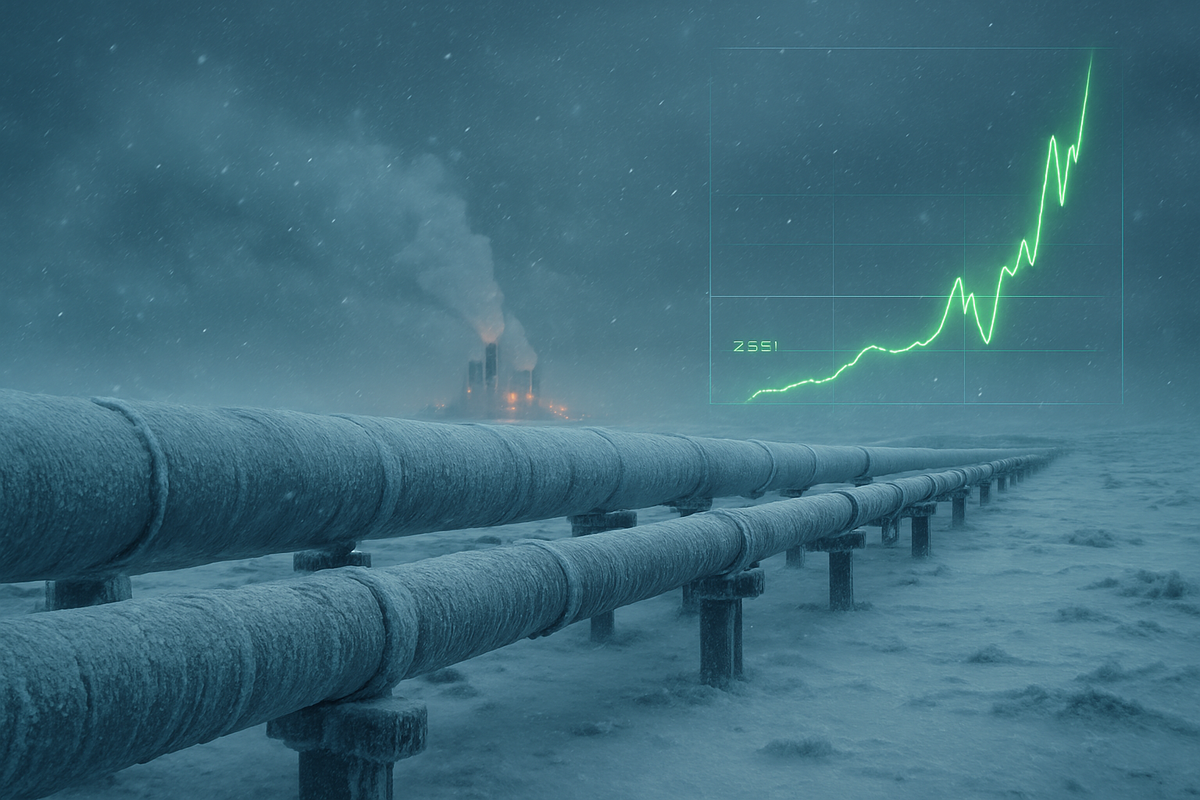
The United States energy market is grappling with a historic supply-demand shock this week as a relentless Arctic blast has sent natural gas futures soaring past the $6.00 per MMBtu threshold for the first time in over three years. As of January 26, 2026, benchmark Nymex futures peaked at $6.221, driven by record-breaking heating demand and a sudden collapse in production caused by "freeze-offs" in major shale basins. The price spike has triggered emergency declarations across several regional power grids, leaving investors and regulators scrambling to assess the stability of the nation’s energy infrastructure.
The immediate implications are stark: heating costs for millions of Americans are expected to jump by double digits, while the industrial sector faces potential curtailments to prioritize residential service. In the financial markets, the "Polar Vortex" disruption has sparked a massive rotation into upstream producers, while simultaneously putting immense pressure on utilities that must navigate astronomical spot market prices to keep the lights on and homes warm.
A Perfect Storm: Timeline of the January Freeze
The current crisis was set in motion during the third week of January when a series of three consecutive weather systems—Winter Storms Blair, Cora, and Fern—shattered a previously mild winter outlook. On January 19, weather models began predicting a significant disruption of the Polar Vortex, sending prices on a vertical trajectory. By January 23, natural gas futures had already logged their largest one-week percentage jump in history, settling at $5.275 per MMBtu before gapping up another 15% when trading resumed for the final week of the month.
The physical reality on the ground has been even more severe than the futures market suggests. In the Northeast, pipeline constraints at the Transco Zone 6 hub led to spot trades between $50 and $100 per MMBtu as demand outpaced delivery capacity. Meanwhile, production across the Appalachian and Permian basins fell by an estimated 8.5 to 20.4 billion cubic feet per day (Bcf/d) as extreme cold caused liquids to solidify at wellheads, effectively "freezing" nearly 10% of the nation’s total gas output.
Regional grid operators have been forced into defensive postures to prevent a repeat of past catastrophic failures. The PJM Interconnection, which manages the grid across 13 states and D.C., reported nearly 21 gigawatts of generation outages—roughly 16% of its total capacity—prompting a pre-emergency order to mandate curtailment. In the Midwest, the Midcontinent Independent System Operator (MISO) declared a Maximum Generation Emergency on January 24 as wind chills plummeted to -50°F, forcing real-time power prices at some nodes to surge past $1,100 per megawatt-hour.
Winners and Losers in the Energy Sector
The primary beneficiaries of this price surge are the massive upstream producers who have maintained operational integrity through the freeze. Shares of EQT Corporation (NYSE: EQT), the nation’s largest natural gas producer, have climbed over 9% since the start of the storms. Investors are increasingly viewing EQT not just as a commodity play, but as a critical infrastructure partner in the burgeoning "AI-Energy Nexus," as the company has recently signed long-term supply agreements to fuel gas-fired data centers.
Similarly, Cheniere Energy (NYSE: LNG) has seen its stock rally as it maintains high utilization at its Gulf Coast export terminals. Despite the domestic price spike, record-high global demand ensures that Cheniere remains a "permanent drain" on U.S. supply, providing a firm floor for prices even as the current weather event eventually subsides. Midstream giant Kinder Morgan (NYSE: KMI) has also seen shares rise by 2.8%, bolstered by record pipeline throughput and the critical performance of its underground storage facilities, such as the Markham facility in Texas, which has been essential for grid balancing.
On the losing side of the ledger, major utilities are facing a margin squeeze and heightened regulatory scrutiny. Duke Energy (NYSE: DUK) and Southern Company (NYSE: SO) have both seen their stock prices stagnate or dip slightly as they grapple with the skyrocketing cost of fuel. While many utilities can eventually pass these costs to consumers, the immediate cash flow requirements and the political fallout of 10.8% year-over-year increases in piped gas services present significant headwinds for these traditionally stable investments.
The AI Factor and a Changing Regulatory Landscape
This 2026 Arctic blast is notable for being the first major grid event where the rapid growth of artificial intelligence (AI) data centers has played a central role in energy policy. The Department of Energy (DOE), led by Secretary Chris Wright, issued a rare emergency order this week allowing the Electric Reliability Council of Texas (ERCOT) to direct AI data centers to switch to backup diesel generators. This move was designed to preserve the grid’s natural gas-fired generation for residential heating, highlighting a new hierarchy in energy priority.
The event fits into a broader trend of "electricity scarcity" that has come to define the mid-2020s. Unlike the 2021 Winter Storm Uri, the 2026 freeze saw a significantly more robust response from battery storage and solar power in Texas, which provided a slim but vital 6,000 MW reserve margin. However, the sheer scale of the new "data center load"—now consuming more than 1 Bcf/d of gas—has added a layer of demand that did not exist during previous winter crises.
Federal regulators at the FERC and NERC have already announced a joint inquiry into the impacts of the January freeze. The investigation is expected to focus on "dual-fuel" capabilities for power plants and whether data center operators should be classified as "interruptible" loads during extreme weather events. This marks a shift toward a more interventionist regulatory environment where the digital economy and the physical energy grid must coexist under stricter reliability mandates.
Looking Ahead: Volatility as the New Normal
In the short term, market participants are watching for any sign of a "thaw" in the weather models. If temperatures remain below average through mid-February, the current storage deficits could lead to a sustained period of high prices, potentially keeping natural gas above $5.00 for the remainder of the winter. Producers will likely attempt to accelerate well completions to take advantage of the $6+ pricing, but the physical limitations of "freeze-offs" mean that production recovery often lags behind the rise in temperatures.
Longer-term, the strategic pivot toward "energy reliability" will likely accelerate. Expect to see more public companies in the energy sector investing heavily in weatherization and on-site storage. For the AI sector, this week’s DOE emergency order is a wake-up call; companies like Microsoft or Google may be forced to invest in their own proprietary energy generation or long-duration storage to avoid being the first ones "tripped" offline during future freezes.
The current market opportunity lies in the infrastructure that connects production to demand. As volatility becomes the "new normal," the value of flexible assets—such as salt-cavern storage and bi-directional pipelines—will only increase. Investors should watch for a flurry of M&A activity in the midstream space as larger players look to consolidate assets that offer high reliability during extreme events.
Summary and Investor Outlook
The surge in natural gas prices above $6 in January 2026 is a stark reminder of the fragile balance between a rapidly growing digital economy and an aging energy infrastructure. The combination of Winter Storms Blair, Cora, and Fern has exposed the vulnerability of the U.S. grid to "freeze-offs" while highlighting the indispensable role of major producers like EQT and Cheniere Energy.
Moving forward, the market will be defined by how well it integrates the massive new demand from AI data centers with the traditional needs of residential and industrial consumers. For investors, the takeaway is clear: the energy transition is not just about moving away from fossil fuels, but about ensuring the reliability of the fuels that remain. The winners will be those who can provide "always-on" power in an era of increasingly frequent "never-before-seen" weather events.
In the coming months, keep a close eye on storage injection reports and the final report from the FERC/NERC inquiry. The regulatory fallout from this January freeze could reshape the cost structure of the utility sector and the operational requirements for data centers for years to come.
This content is intended for informational purposes only and is not financial advice.