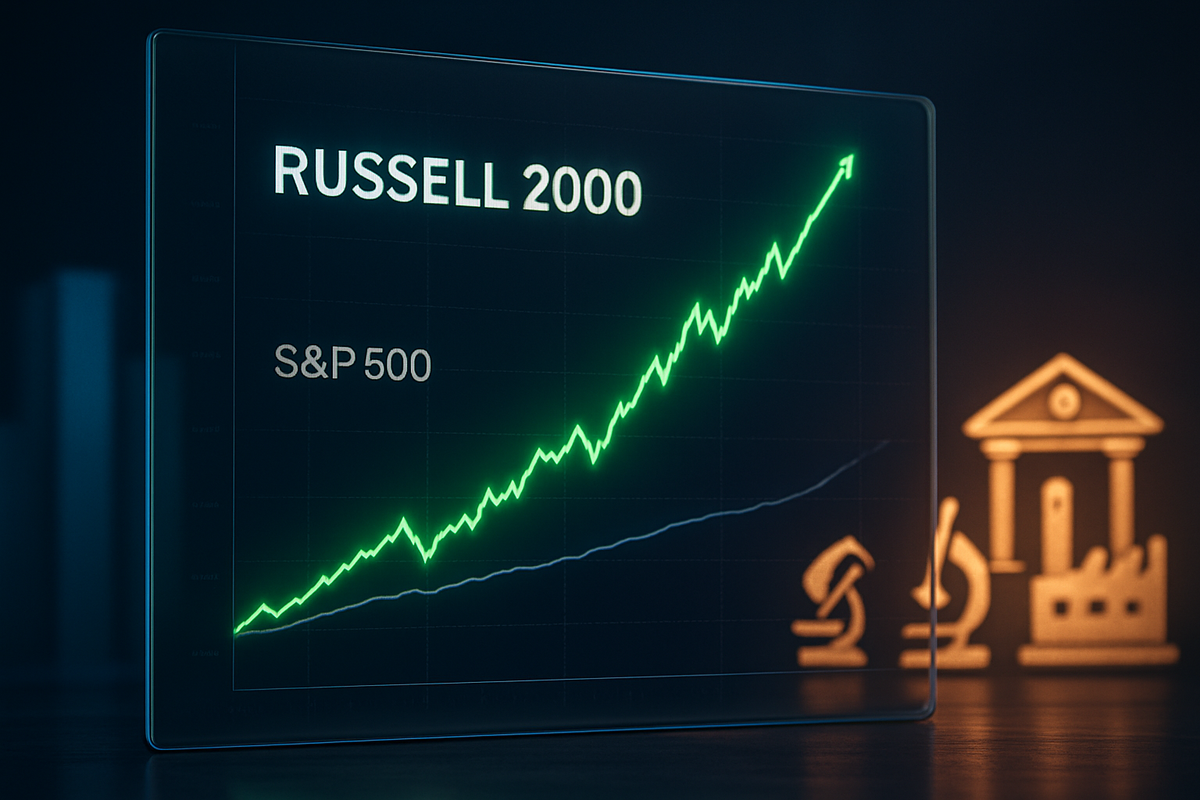
In a move that has rewritten the record books of Wall Street, the small-cap-heavy Russell 2000 index recently concluded a historic 15-session winning streak of daily outperformance against the S&P 500. This rally, which reached its zenith on January 22, 2026, represents the longest period of small-cap dominance since May 1996. The streak signaled a profound "Great Rotation" in investor sentiment, as capital flowed out of the tech behemoths that defined the last decade and into the "Main Street" companies that underpin the domestic economy.
While the streak was finally snapped on Friday, January 23, 2026, with a 1.8% pullback in the Russell 2000, the implications for the broader market remain significant. The surge wasn't merely a technical bounce; it was a fundamental repricing of risk and opportunity. As the Federal Reserve’s 2025 easing cycle lowered the federal funds rate to the 3.50% range, the financial burden on smaller, domestic-focused firms began to lift, creating a "Goldilocks" environment that has caught many institutional investors off guard.
The Anatomy of a Record-Breaking Run
The 15-session streak began in early January 2026, fueled by a unique confluence of macroeconomic data and policy shifts. From January 5 through January 22, the Russell 2000 surged nearly 8.2%, compared to a meager 1.9% gain for the S&P 500. On average, small caps "trounced" their large-cap counterparts by approximately 45 basis points every single day. This relentless outperformance was driven by a shift in the "earnings handoff." While growth for the "Magnificent Seven" was projected to decelerate from 36% in 2024 to 18% in 2026, earnings for Russell 2000 companies were forecasted to grow by a staggering 60% in 2026 as previously unprofitable firms finally turned the corner.
The timeline leading up to this moment was paved by the 2025 easing cycle. For much of 2023 and 2024, nearly 40% of the Russell 2000 index was comprised of companies that were either unprofitable or burdened by floating-rate debt. As the Fed cut rates throughout 2025, these companies saw an immediate "relief valve" for their balance sheets. Market participants began to realize that the domestic economy was proving far more resilient than the "higher-for-longer" narrative of previous years had suggested.
Key stakeholders, including hedge funds and retail investors, participated in a massive "catch-up trade." By mid-January, the sentiment had shifted from skepticism to FOMO (Fear Of Missing Out), as the valuation gap between the top-heavy S&P 500 and the depressed small-cap sector reached levels not seen since the dot-com era. The initial market reaction was one of disbelief, followed by a frantic reshuffling of portfolios that saw record outflows from tech-heavy ETFs and into small-cap value funds.
Winners and Losers in the Small-Cap Resurgence
The primary winners of this rotation were domestic, cyclically sensitive sectors that had been largely ignored during the AI-driven mania of 2023 and 2024. Regional banks, such as Huntington Bancshares (NASDAQ: HBAN) and Regions Financial (NYSE: RF), led the charge. These institutions benefited from a steepening yield curve and a lighter regulatory environment, allowing them to expand lending to the very small businesses that populate the Russell 2000.
The biotechnology sector also experienced a powerful "resurgence." After years of capital constraints, firms like Axsome Therapeutics (NASDAQ: AXSM)—which recently reported a 65% revenue surge—and Apogee Therapeutics (NASDAQ: APGE) saw their stock prices soar as the cost of capital for R&D plummeted. Similarly, Roivant Sciences (NASDAQ: ROIV) emerged as a standout, capitalising on the renewed appetite for innovation outside of the mega-cap tech space. Industrials and housing-related firms like Prologis (NYSE: PLD) also thrived, as lower borrowing costs spurred a recovery in residential construction and logistics infrastructure.
Conversely, the "losers" in this period were the erstwhile market darlings. The Magnificent Seven, particularly Nvidia (NASDAQ: NVDA) and Microsoft (NASDAQ: MSFT), saw their relative performance sag. In early 2026, while the Russell was setting records, the Mag 7 were collectively down about 1.4% for the month. Investors began locking in massive profits from the AI trade, redirected that capital toward value plays that offered more attractive entry points and higher domestic growth leverage.
Historical Precedents and Economic Implications
The 15-session streak has invited comparisons to the peak of the dot-com bubble in February 2000. At that time, market concentration reached extreme levels before a massive shift in leadership occurred. Analysts note that in 1980, the top 10 stocks in the S&P 500 reached a record 26% concentration—a figure that was eclipsed in late 2025 when the top heavyweights accounted for nearly 40% of the index's total value. The 2026 rotation mirrors the 1980 shift from energy and industrials to technology, but in reverse: a move from concentrated tech back to the broader, cyclical "Main Street" economy.
The wider significance of this event is also tied to the fiscal landscape. The passage of the "One Big Beautiful Bill" Act (OBBBA) in July 2025 provided a massive tailwind for small-cap companies. Key provisions included the restoration of 100% bonus depreciation and permanent 20% deductions for qualified business income. These policies disproportionately favored domestic-focused small businesses over multinational tech giants that often utilize complex offshore tax structures.
From a regulatory standpoint, the shift suggests a market that is pricing in a more fragmented, domestic-centric economic model. While large-cap tech faces ongoing antitrust scrutiny and global regulatory headwinds, small-cap firms are seen as the primary beneficiaries of "onshoring" initiatives and a renewed focus on American industrial policy. This event fits into a broader trend of "de-globalization," where investors are placing higher premiums on companies with local supply chains and domestic customer bases.
What Comes Next: A New Market Regime?
In the short term, market participants are watching to see if the January 23 pullback was a healthy consolidation or the start of a deeper correction. The volatility seen at the end of the streak is a reminder that small-cap stocks are inherently more volatile than their large-cap peers. However, the long-term outlook remains bullish for many analysts. The "earnings handoff" is still in its early stages; if Russell 2000 earnings do indeed grow by 60% in 2026, the current rally may only be the beginning of a multi-year cycle of small-cap outperformance.
Strategic pivots will be required for institutional investors who have spent the last five years "overweighting" tech. We may see a continued "re-weighting" toward equal-weighted indices and value-oriented ETFs. The challenge will be navigating the "unprofitable" tail of the Russell 2000; while the index as a whole is rising, the gap between the "quality small-cap" and the "zombie companies" remains wide.
Possible scenarios for the remainder of 2026 include a "broadened market," where small caps and large caps rise together, or a more aggressive "cyclical bull," where small caps continue to leave the S&P 500 in the dust. The key variables will be the path of inflation and the Fed’s willingness to continue the easing cycle. If inflation remains anchored and the domestic economy continues its "soft landing," the Russell 2000 could see its most successful year in decades.
Closing Thoughts on a Historic Milestone
The Russell 2000’s 15-session winning streak against the S&P 500 is more than just a statistical anomaly; it is a signal that the era of extreme market concentration may be coming to an end. This "Great Rotation" reflects a fundamental shift in investor confidence toward the domestic economy, spurred by lower interest rates and supportive fiscal policy. The move from speculative AI growth to tangible "Main Street" value suggests a maturing bull market that is finding new ways to grow beyond its traditional leaders.
Moving forward, investors should keep a close eye on regional bank health and biotech R&D spending as barometers for the small-cap sector. While the "Magnificent Seven" will likely remain core holdings for many, their days of undisputed market dominance are being challenged by a broader, more diverse group of companies. The 2026 rally has proven that in a changing economic landscape, small can indeed be beautiful.
As we move into the second quarter of 2026, the key takeaway is clear: the market has broadened, and the domestic engine is firing on all cylinders. Investors should remain vigilant for signs of overheating in small-caps but should also recognize that the "Main Street" rally is backed by significant fundamental shifts that could define the market for years to come.
This content is intended for informational purposes only and is not financial advice