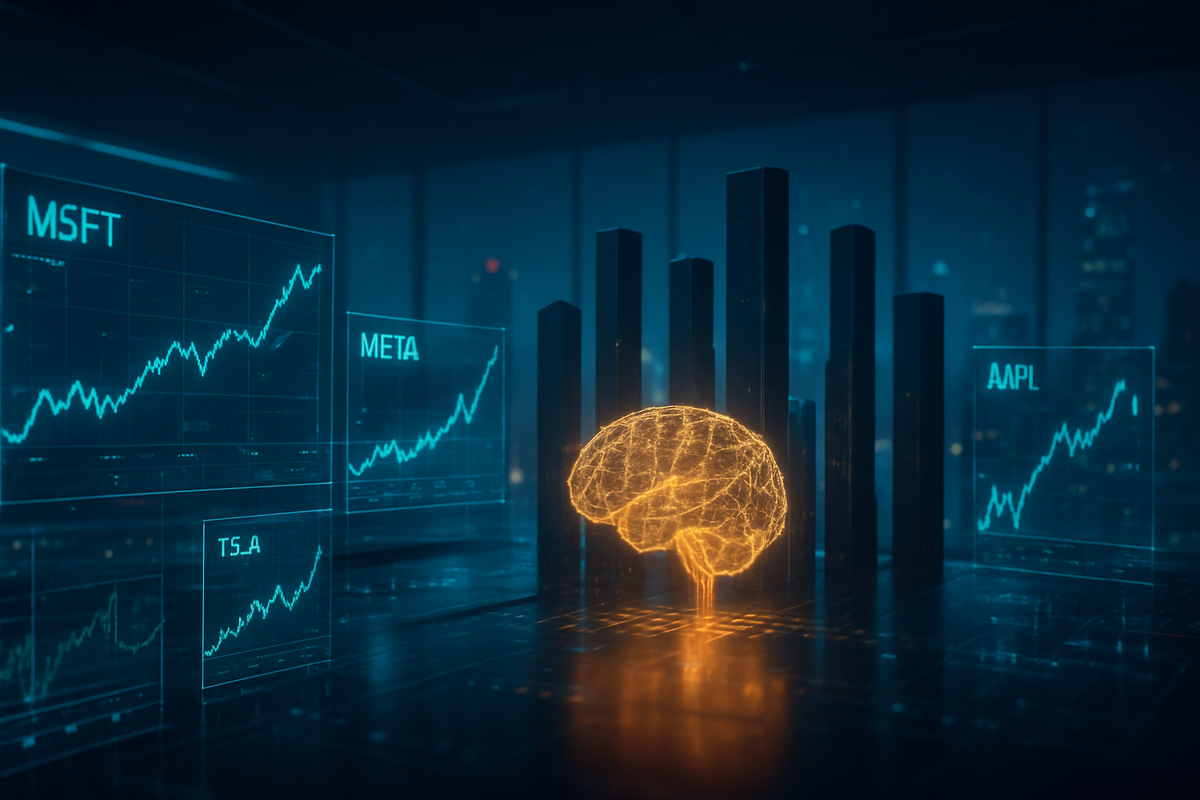
The final week of January 2026 marks a pivotal "moment of truth" for the global equity markets as four of the "Magnificent Seven" tech giants prepare to pull back the curtain on their fourth-quarter 2025 results. With the Nasdaq 100 hovering at a historically elevated Price-to-Earnings (P/E) ratio of 35.18, investors are no longer content with promises of a decentralized AI future; they are demanding cold, hard evidence of return on investment (ROI). As Microsoft, Meta, Tesla, and Apple prepare to report, the stakes have never been higher for a market that has increasingly priced in perfection.
The upcoming "earnings blitz" is expected to be a referendum on the massive capital expenditure (CapEx) cycles that defined 2025. While the broader indices like the Dow Jones Industrial Average have seen a "Great Rotation" into value and small-cap sectors throughout early January, the tech-heavy Nasdaq remains locked in a consolidation pattern. The results released this week will likely determine whether the "AI trade" has hit a ceiling or if the next leg of the bull market is just beginning.
A High-Stakes Timeline: The Big Four Take the Stage
The earnings gauntlet begins on Wednesday, January 28, with a double-header from Microsoft Corp. (NASDAQ: MSFT) and Tesla Inc. (NASDAQ: TSLA). Microsoft enters the fray after a year of "hyper-investment," with 2025 CapEx estimated at a staggering $91 billion to $93 billion. Analysts are looking for revenue of $80.3 billion and an EPS of $3.86, but the real story will be Azure’s AI-driven growth. In the 2025 fiscal year, Microsoft’s narrative centered on building the "foundational plumbing" of AI; now, the market expects to see the "Copilot" suite translating into significant bottom-line contributions.
Simultaneously, Tesla Inc. (NASDAQ: TSLA) faces a more skeptical audience. Following Q4 delivery data that showed 418,227 vehicles—a 1% miss from consensus and a second consecutive annual decline—CEO Elon Musk is expected to pivot the conversation toward the "AI-first" evolution of the company. Investors will be laser-focused on the February roadmap for Robotaxi operations and the scaling of the Optimus humanoid robot. Despite the vehicle delivery slump, Tesla’s energy storage division, which deployed a record 14.2 GWh in Q4, remains a potential wildcard that could soothe investor nerves.
The momentum continues Thursday, January 29, when Meta Platforms Inc. (NASDAQ: META) and Apple Inc. (NASDAQ: AAPL) report. Meta has signaled that its 2026 CapEx could exceed $100 billion, a figure that has sparked both awe and anxiety. Meanwhile, Apple stands as the "capital-light" contrarian, having spent only a fraction of its peers on infrastructure. Instead, Apple’s quarter will be judged on the strength of the iPhone 17 "Super Cycle" and the initial monetization of "Apple Intelligence" features, which the company hopes will sustain its premium 33.2x P/E ratio.
Strategic Divergence: Winners, Losers, and the CapEx Gap
The upcoming reports highlight a growing divide in how Big Tech approaches the AI era. Microsoft Corp. (NASDAQ: MSFT) and Meta Platforms Inc. (NASDAQ: META) are the primary "spenders," doubling down on data centers and H100/H200 Blackwell chips. Meta, in particular, has seen its stock buoyed by an AI-powered advertising engine that has significantly boosted Reels monetization. If Meta can prove that its $100 billion infrastructure bet is already improving ad targeting and user retention, it could emerge as the definitive winner of the "Infrastructure Phase" of AI.
Conversely, Apple Inc. (NASDAQ: AAPL) is positioning itself as the "distributor" of AI. By utilizing a hybrid model—using third-party cloud capacity for heavy lifting while focusing on on-device processing—Apple has maintained a leaner balance sheet than its rivals. However, this strategy is not without risk. If the iPhone 17 fails to ignite a massive upgrade cycle in China and the U.S., Apple’s lack of proprietary AI infrastructure could be viewed as a competitive disadvantage rather than a fiscal virtue.
Tesla Inc. (NASDAQ: TSLA) remains the most volatile variable. While the company’s core automotive margins have been squeezed by global competition, its pivot to "Dojo" supercomputing and Full Self-Driving (FSD) subscriptions represents a high-margin software play. If Wednesday’s report suggests that FSD adoption is stalling or that the Robotaxi timeline is slipping further into 2027, the stock may struggle to maintain its valuation, which remains decoupled from traditional automotive metrics.
The AI Paradox and the Nasdaq's Valuation Trap
This earnings cycle fits into a broader industry trend where the "AI Paradox" is reaching a breaking point: companies must spend billions to remain competitive, but that very spending threatens the profit margins that investors prize. The Nasdaq 100’s P/E of 35.18 is roughly 44% above its historical median, a valuation that assumes not just growth, but an acceleration of growth. Any guidance that suggests a "digestion period" for AI hardware could trigger a sharp correction across the semiconductor and software sectors.
Historically, periods of extreme CapEx like the current 2025-2026 cycle have led to significant market leadership shifts. We saw similar patterns during the fiber-optic buildout of the late 1990s and the mobile cloud transition of 2011-2012. The ripple effects are already being felt; smaller cloud providers and AI software startups are finding it difficult to compete with the sheer scale of the Magnificent Seven, leading to increased regulatory scrutiny. Both the U.S. and EU regulators are closely monitoring the "gatekeeper" status of these companies as they consolidate the hardware necessary to run the next generation of the internet.
Looking Ahead: The 2026 Roadmap
In the short term, the market is braced for volatility. If the "Big Four" provide conservative guidance for the first half of 2026, we could see an acceleration of the rotation into small-cap stocks (as tracked by the Russell 2000) and traditional value sectors like energy and industrials. Investors are looking for a "Goldilocks" scenario: high enough CapEx to show commitment to AI, but low enough to maintain double-digit margin expansion.
Long-term, the focus will shift from "AI Training" to "AI Inference." The strategic pivots required in 2026 will involve moving away from simply buying GPUs to creating proprietary agentic workflows that can replace or augment human labor at scale. This transition will create new market opportunities in specialized AI applications, potentially benefiting companies that can provide the "last mile" of AI integration for enterprise customers.
Closing Thoughts: A Litmus Test for Tech
The late January 2026 earnings blitz is more than just a quarterly update; it is a litmus test for the sustainability of the modern tech economy. The key takeaway for investors is that the "quality" of earnings now matters more than the "beat." A revenue beat driven by one-time factors will likely be ignored if it is accompanied by a spike in unproductive CapEx.
As we move forward, the market will be watching for three specific signals: the pace of Azure's AI acceleration, the monetization rate of Meta’s Llama 4 models, and the "Super Cycle" status of the iPhone 17. For the Nasdaq 100 to break out of its current consolidation and justify its 35x multiple, these tech titans must prove that the billions spent in 2025 have laid the groundwork for a more profitable 2026.
This content is intended for informational purposes only and is not financial advice.