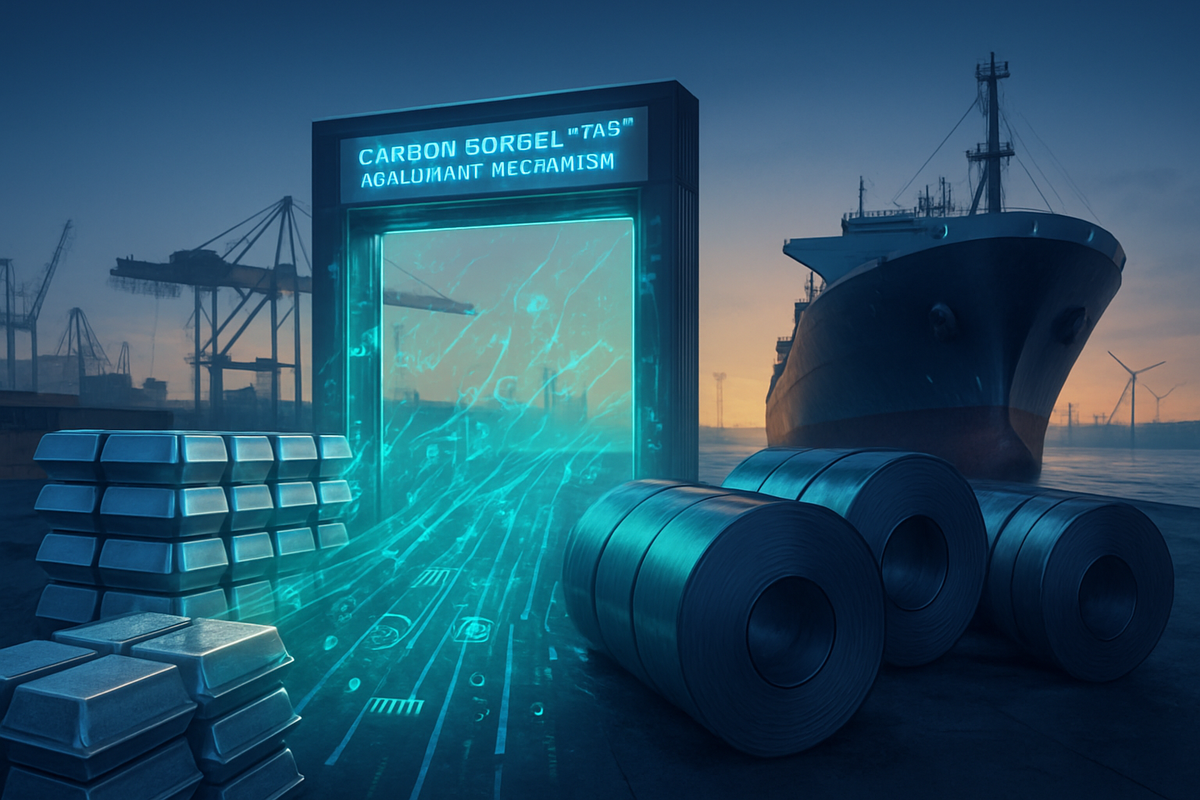
As of January 1, 2026, the European Union has officially entered the "definitive phase" of its Carbon Border Adjustment Mechanism (CBAM), ending the era of carbon-free imports for energy-intensive commodities. For the first time, importers of steel, aluminium, cement, electricity, fertilizers, and hydrogen must account for the carbon footprint of their products with the same financial rigor as domestic EU producers. The transition from a mere reporting exercise to a direct financial liability has already triggered significant volatility in the European carbon market, with EU Emissions Trading System (ETS) prices briefly surging above €100 per tonne in mid-January as traders scrambled to adjust to the new reality.
The immediate implications are profound: global manufacturers are no longer competing solely on labor costs or efficiency, but on the carbon intensity of their energy grids. In the first four weeks of implementation, the market has seen a distinct "CBAM premium" emerging on high-carbon imports, particularly in the steel and aluminium sectors. With the EU beginning the gradual phase-out of free emissions allowances for its own domestic industries—starting with a 2.5% reduction this year—the regulatory "double-edged sword" is now fully unsheathed, forcing a radical recalibration of global supply chains that feed into the world’s largest single market.
The Definitive Phase: A New Regulatory Regime
The shift that occurred on New Year’s Day 2026 represents the most significant change to European trade policy in decades. Moving beyond the pilot phase that began in 2023, importers are now required to be "Authorized CBAM Declarants." This status is not merely administrative; it mandates that any shipment of covered goods exceeding 50 tonnes must be accompanied by verified emissions data from accredited third-party auditors. While the transitional period allowed for the use of "default values" to simplify reporting, the definitive phase makes verified primary data the standard, effectively penalizing exporters who cannot or will not provide transparent environmental disclosures.
The financial mechanism is tied directly to the EU ETS. Importers must now purchase and surrender "CBAM certificates," the price of which is determined by the weekly average auction price of EU carbon allowances. Although the first formal surrender of these certificates is not due until September 2027, the costs are being priced into contracts today. In the aluminium sector, for instance, primary metal from high-carbon origins is already seeing estimated price adjustments of nearly €200 per tonne. This has led to a flurry of renegotiations, with buyers shifting toward "Delivered Duty Paid" (DDP) terms to force exporters to shoulder the regulatory and financial risk of the new carbon levies.
Industrial reactions have been swift and, in some cases, severe. In late January, major steel producers reported that the "safety valve" of inexpensive, high-emission imports has essentially vanished. This has allowed domestic EU producers to establish a higher price floor for flat steel products, citing the combined pressure of their own declining free allowances and the new costs imposed on their foreign competitors. However, the complexity of the task remains a hurdle; companies like Tata Steel (NSE:TATASTEEL) have noted the extreme administrative burden of requesting verified carbon data from tens of thousands of global suppliers, illustrating the friction this policy has introduced into the gears of global commerce.
Industrial Winners and Losers in a Carbon-Taxed World
The implementation of CBAM has created a sharp divide between "green" producers and those reliant on fossil-fuel-heavy grids. Norsk Hydro (OSE:NHY), the Norwegian aluminium giant, stands as a primary beneficiary of the new regime. With its extensive portfolio of low-carbon, hydropower-based primary aluminium, the company is well-positioned to capture the market share surrendered by higher-carbon competitors. However, Norsk Hydro has also been a vocal critic of the "scrap loophole"—the current exclusion of aluminium scrap from CBAM fees—arguing that it allows some non-EU producers to bypass carbon costs by blending secondary materials while EU primary producers still face the full weight of ETS compliance.
Conversely, high-carbon exporters from regions like India and China are facing an existential challenge to their European margins. Baowu Steel (SHA:600019), the world’s largest steelmaker, is seeing its price advantage in Europe shrink by an estimated €65 to €144 per tonne, depending on the product grade. This has accelerated the company's pivot toward "green rebar" and other niche low-carbon products to maintain its foothold in the EU. Similarly, POSCO (NYSE: PKX) has established an internal task force to manage the dual threats of CBAM: the direct financial cost and the risk of "confidential data leakage" required by EU regulators regarding their proprietary production methodologies.
In the steel sector, ArcelorMittal (NYSE: MT) has already demonstrated the disruptive power of the new policy. In late January 2026, the company announced the closure of a production unit at its Kryvyi Rih plant in Ukraine, explicitly citing that CBAM has effectively "closed the market" for certain high-emission exports that were previously vital to the region's economy. Meanwhile, German industrial giant ThyssenKrupp (ETR:TKA) has issued urgent calls for the EU to reconsider the speed of the free allowance phase-out, warning that the capital being drained by carbon costs is the very capital needed to fund the massive "Green Steel" transition required to stay competitive in the long term.
The Broader Significance: Carbon Leakage and Global Tensions
The Jan 1 activation of CBAM is not just a trade policy; it is the EU’s primary defense against "carbon leakage"—the risk that its ambitious environmental goals would simply drive heavy industry to relocate to countries with more relaxed standards. By equalizing the carbon cost between domestic and imported goods, the EU is attempting to force a global standard for industrial emissions. This move has fundamentally altered the calculus for global commodity traders, who must now weigh the "carbon cost of delivery" as heavily as shipping or insurance premiums.
The ripple effects are causing significant geopolitical friction. As of late January 2026, India has warned of a potential 10% decline in its engineering exports to Europe due to the high "default values" applied to non-compliant shipments. This tension has spilled over into broader trade negotiations, with several nations threatening to challenge the CBAM mechanism at the World Trade Organization (WTO), arguing it serves as a "green" protectionist barrier. The policy also sets a historical precedent, being the first major instance where a trade bloc has successfully used its market size to export its internal environmental regulations to the rest of the world.
Furthermore, the expansion of CBAM is already being felt in "downstream" industries. Manufacturers of automobiles and appliances—companies like Volkswagen (OTC:VWAGY) and Electrolux (OTC:ELUXY)—are watching the situation with growing concern. While CBAM currently applies only to raw materials, the rising costs of steel and aluminium are inflating the prices of finished goods. There is already intense lobbying in Brussels to delay the planned 2028 expansion of CBAM to these downstream products, as European manufacturers fear they will be priced out of global markets if their input costs continue to decouple from the global average.
What Comes Next: Strategic Pivots and Market Evolution
Looking ahead, the next 18 to 24 months will be a period of intense adaptation. In the short term, many traders are working through "pre-cleared" stocks that were imported before the January 1 deadline. Market analysts expect a much sharper supply disruption in April and May 2026 as these inventories are exhausted and the full cost of CBAM-compliant imports hits the ledger. This will likely lead to a "tiered" pricing system in the European metals market, where low-carbon "Green Certificates" become as valuable as the physical metal itself.
Strategically, global producers will be forced to accelerate their decoupling from coal-based energy. We are likely to see a wave of "carbon-optimized" trade routes, where cleaner production hubs in Canada, Norway, and parts of South America prioritize shipments to the EU, while higher-carbon production is diverted to regions without carbon border taxes. However, as other major economies like the UK and potentially the US explore their own versions of a carbon border tax, the room for high-emission producers to hide is rapidly shrinking.
The most critical factor to watch in the coming months will be the "verification crunch." The sudden requirement for thousands of international plants to be audited by a limited pool of EU-accredited verifiers could create a bottleneck that halts trade faster than the carbon tax itself. Companies that have already invested in robust ESG (Environmental, Social, and Governance) reporting frameworks will likely gain a significant competitive advantage in terms of market access and "speed of clearance" at EU borders.
Wrap-Up: A Permanent Shift in the Commodity Landscape
The definitive implementation of CBAM on January 1, 2026, marks the end of the "wild west" for carbon-intensive trade. The event has transitioned from a theoretical regulatory risk into a concrete financial obligation that is actively reshaping the global competitive landscape. While the initial market reaction has been characterized by price spikes and administrative confusion, the long-term impact will be a permanent premium on low-carbon industrial production.
For investors, the key takeaway is that carbon intensity is now a primary metric of corporate valuation in the materials and energy sectors. The performance of leaders like Rio Tinto (NYSE: RIO) and Alcoa (NYSE: AA) will increasingly depend on their ability to navigate this regulatory maze while maintaining margins in a higher-cost environment. The market is moving toward a future where "green" is not just a branding exercise but a prerequisite for market entry.
Moving forward, the focus will shift from the implementation of the rules to their enforcement and potential expansion. Investors should closely monitor the quarterly EU ETS auction prices and the ongoing negotiations regarding the "scrap loophole" and downstream expansion. As the EU continues to phase out free allowances for its domestic giants, the pressure on global trade partners to decarbonize will only intensify, making the Jan 1, 2026, deadline the opening bell of a new, carbon-conscious era of global capitalism.
This content is intended for informational purposes only and is not financial advice.