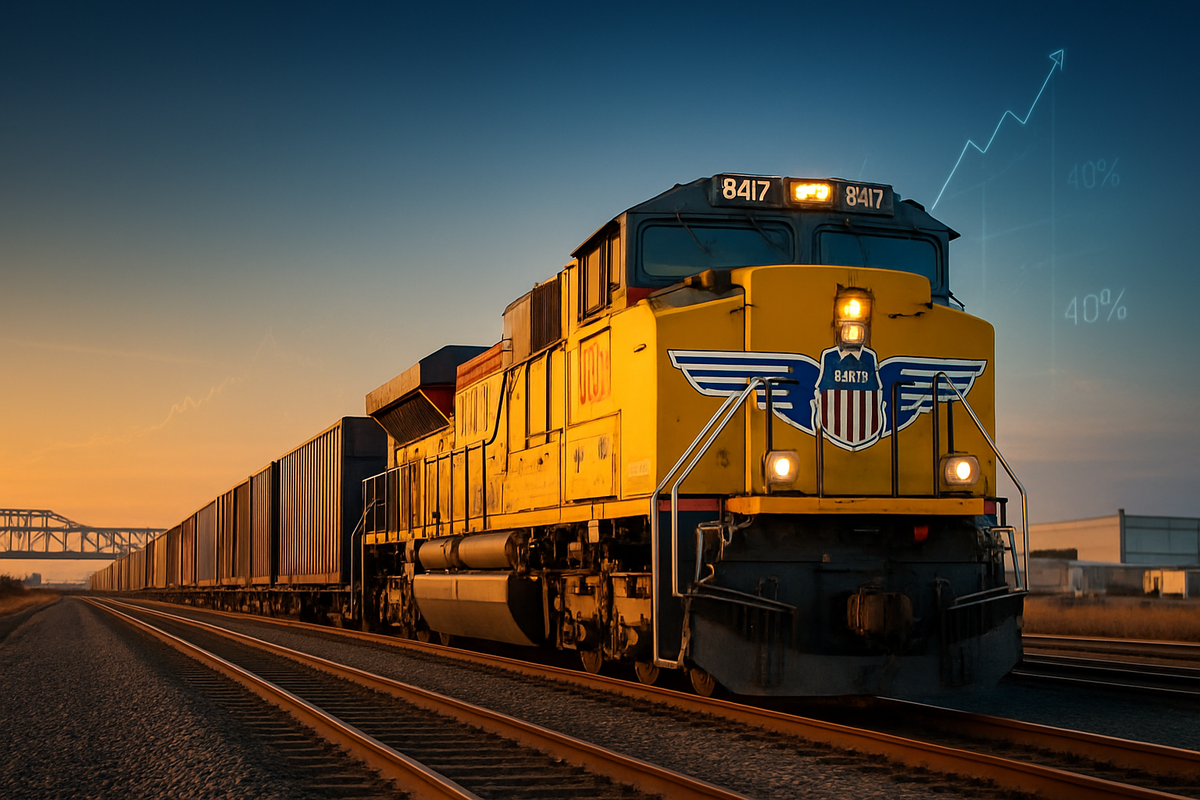
In a demonstration of operational resilience, Union Pacific (NYSE: UNP) reported its fourth-quarter 2025 financial results today, January 27, 2026, revealing a 5% increase in net income despite a notable decline in shipping volumes. The Omaha-based railroad giant posted a net income of $1.8 billion, or $3.11 per diluted share, effectively navigating a "subdued industrial demand environment" that saw total carloadings drop by 4% compared to the same period last year.
The results underscore a strategic shift led by CEO Jim Vena, who has pivoted the company toward a high-margin service model. By leveraging significant pricing power and aggressive efficiency gains, Union Pacific managed to bolster its bottom line even as total operating revenue dipped 1% to $6.1 billion. While the headline profit figure was aided by $234 million in industrial park land sales, the company's core performance highlighted a robust ability to extract value from a leaner freight network.
Precision Performance in a Cooling Economy
The fourth quarter of 2025 was a period of tactical execution for Union Pacific. While the 4% drop in carload volumes reflected a broader cooling in the industrial and manufacturing sectors, the railroad utilized its "service drives price" philosophy to offset the slack. Core pricing gains—defined by management as price increases that exceed inflation—remained a primary driver of profitability. This pricing power allowed the railroad to maintain healthy margins even as the mix of freight shifted and fuel surcharge revenue fluctuated.
Operational metrics for the quarter showed significant improvement, which directly translated to cost savings. Under Vena’s leadership, freight car velocity increased by 9% to 239 daily miles per car, while terminal dwell time—the time a car spends sitting in a yard—decreased by 9% to 19.8 hours. Furthermore, the company increased its average train length by 3% to 9,729 feet. These efficiencies allowed Union Pacific to move more freight with fewer "train starts," reducing labor and fuel expenses per ton-mile.
However, the quarter was not without its pressures. The reported operating ratio (OR)—a key metric of railroad efficiency where a lower number is better—deteriorated to 60.5%, an 180-basis-point increase from the previous year. This reflected the difficulty of maintaining a fixed-cost infrastructure against falling volumes. The boost in net income was also heavily supported by $234 million in one-time gains from land sales, without which adjusted net income would have seen a slight year-over-year decline to $1.7 billion.
The Competitive Landscape: Winners and Losers
Union Pacific’s ability to remain profitable in a downturn places it in a position of relative strength compared to its peers. CSX Corporation (NASDAQ: CSX) recently reported a 1% revenue dip and a 2% drop in net earnings, struggling with similar merchandise volume weaknesses but without the same level of asset-monetization support seen at UNP. Meanwhile, Norfolk Southern (NYSE: NSC) has faced a more turbulent path, with analysts expecting a nearly 9% drop in its upcoming quarterly profit report as it navigates both industrial headwinds and the complexities of its pending merger with Union Pacific.
The clear "winner" in this scenario appears to be Union Pacific’s shareholders, who continue to see the benefits of a disciplined capital allocation strategy and aggressive cost management. On the other hand, shippers—the companies that rely on rail to move goods—may find themselves in a "loser" position. UNP’s strategy of keeping prices high despite lower demand suggests that the era of cheap rail freight may be over, as railroads prioritize margin over volume growth.
A Transcontinental Vision and Industry Shifts
The broader significance of Union Pacific’s Q4 performance is inextricably linked to the proposed merger with Norfolk Southern, a deal dubbed "The Great Connection." Announced in late 2025, the merger aims to create America’s first true transcontinental railroad, linking 23 western states with 22 eastern states. By reporting stable profits in a challenging Q4, Union Pacific is signaling to regulators and the market that it has the financial stability to lead such a massive consolidation.
This event fits into a wider industry trend where Class I railroads are evolving beyond the initial "Precision Scheduled Railroading" (PSR) model toward a more sophisticated, service-oriented approach. The goal is to compete more effectively with the trucking industry by offering more reliable schedules and single-line service. If the merger with Norfolk Southern proceeds, the ability to bypass congested interchanges in Chicago and St. Louis could convert an estimated 2 million truckloads to rail, fundamentally altering the logistics landscape of North America.
Navigating Regulatory Hurdles and Economic Headwinds
Looking ahead, the immediate future for Union Pacific will be dominated by the Surface Transportation Board (STB) and its review of the Norfolk Southern merger. In mid-January 2026, the STB flagged the initial merger application as "incomplete," requiring more detailed data filings by February. The railroad's ability to maintain its high service standards while managing these regulatory hurdles will be critical.
In the short term, Union Pacific faces a cautious 2026 outlook. Most industry analysts project only mid-single-digit growth as the industrial sector continues its slow recovery. The company will need to balance its aggressive pricing strategy with the need to attract new volume to its network. If demand remains sluggish, the pressure to find further efficiency gains will intensify, potentially leading to more workforce productivity pushes or additional asset sales.
Conclusion: A High-Stakes Strategy for 2026
Union Pacific’s Q4 2025 earnings report serves as a testament to the power of operational discipline and strategic pricing. By focusing on "Safety, Service, and Operational Excellence," CEO Jim Vena has managed to keep the company's financial engine humming despite a cooling economy. The 5% rise in profit, though bolstered by one-time gains, reflects a railroad that is leaner and more agile than it was just a few years ago.
As we move further into 2026, investors should keep a close eye on the STB’s response to the transcontinental merger and whether Union Pacific can sustain its pricing power if shipment volumes continue to lag. The railroad industry is at a crossroads, shifting from a focus on pure cost-cutting to a focus on network-wide integration and service reliability. Union Pacific has placed a massive bet on this future, and today's results suggest they have the financial fortitude to see it through.
This content is intended for informational purposes only and is not financial advice.