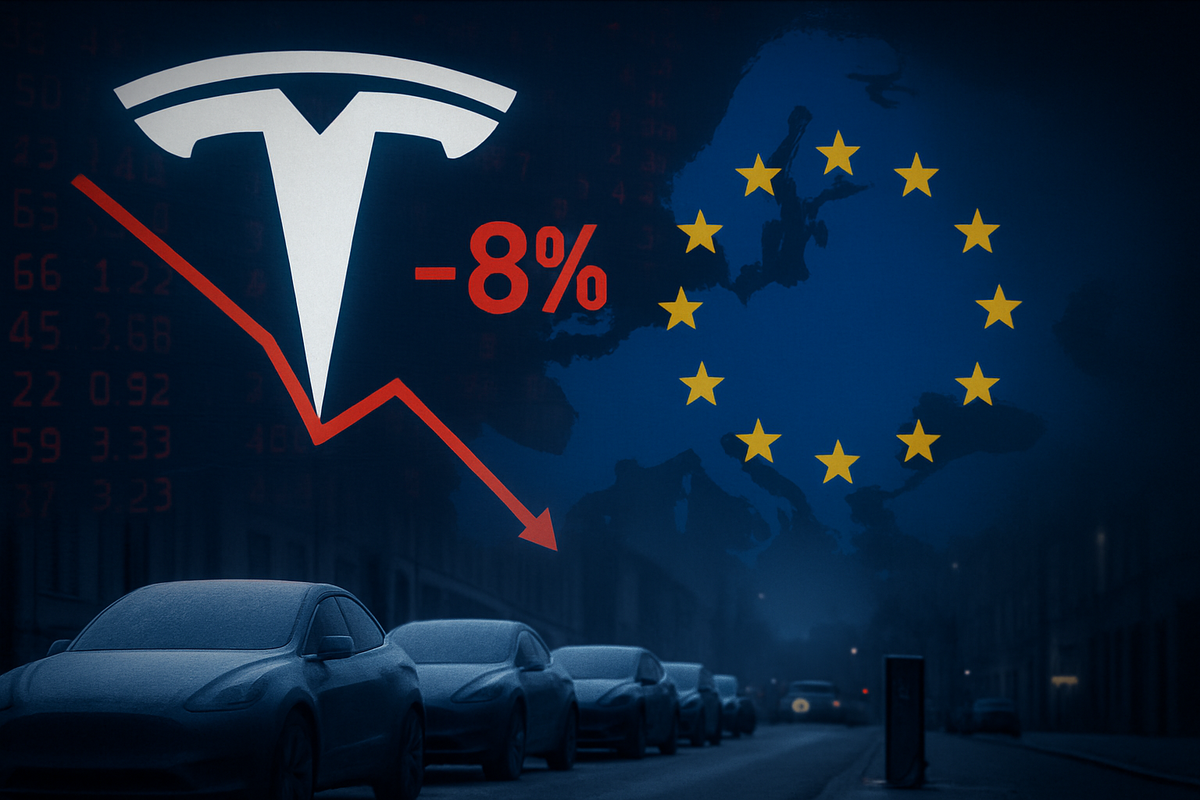
The era of uncontested dominance for Tesla, Inc. (NASDAQ: TSLA) in the European Union appears to have hit a significant roadblock. On Tuesday, January 27, 2026, shares of the Austin-based automaker plummeted by 8%, following a series of data releases from the European Automobile Manufacturers' Association (ACEA) that confirmed a staggering double-digit decline in vehicle registrations across the continent. This sharp sell-off reflects growing investor anxiety that the "high-growth" narrative surrounding the world's most valuable automaker is being rewritten by aggressive competition and shifting regulatory landscapes in its most critical overseas market.
The immediate implications are stark: Tesla has officially lost its title as the world's top seller of pure electric vehicles to China’s BYD Company Ltd. (OTCMKTS: BYDDY). For the first time, market participants are pricing Tesla not as a disruptive tech titan with infinite scale, but as a mature industrial manufacturer facing the same cyclical headwinds and margin pressures as its legacy peers. The decline in the EU—a region once considered Tesla's most loyal stronghold—signals a potential "demand cliff" that may force further price cuts, threatening the company’s industry-leading margins just ahead of its highly anticipated Q4 2025 earnings report.
The Anatomy of a Sales Slump
The 8% intraday drop on January 27 was triggered by the ACEA’s final 2025 registration data, which painted a grim picture of Tesla’s European performance. According to the report, Tesla’s sales in the European Union plummeted by 37.9% over the course of 2025, falling to just 150,504 units from over 242,000 the year prior. December 2025 was particularly brutal, with registrations down 31.9% year-over-year. This wasn't a case of a shrinking market—the overall European EV market actually grew during the same period—but rather a rapid erosion of Tesla’s market share, which fell from 2.3% in 2024 to a mere 1.4% in 2025.
The timeline of this decline can be traced back to the middle of 2024, when the first signs of "Model Y fatigue" began to surface. While the Model Y remained a top seller, it faced a localized "perfect storm." In Germany, Tesla's largest European market, registrations crashed by 48.4% in 2025, exacerbated by the abrupt end of federal subsidies in late 2023 and a widely publicized 45% failure rate for Model Y units during rigorous local safety inspections. In France, sales dropped 37.5%, while Sweden saw a 66.9% year-over-year collapse as ongoing labor disputes and union-led boycotts against Tesla’s refusal to sign collective bargaining agreements took a heavy toll on brand loyalty.
Key stakeholders, including institutional investors who have long defended Tesla's premium valuation, are now questioning the company's "Giga Berlin" strategy. While the factory was intended to insulate Tesla from logistics costs and tariffs, it has struggled to reach its 500,000-unit annual capacity due to local environmental protests and supply chain interruptions. The initial market reaction has been one of "decoupling," with Tesla’s stock performance diverging sharply from other tech giants like Microsoft and Apple, as analysts recalibrate their expectations for Tesla’s 2026 delivery targets.
The Rising Giants: Winners and Losers in the 2026 Landscape
The primary beneficiary of Tesla’s European retreat has been the Volkswagen Group (OTCMKTS: VWAGY). As of early 2026, Volkswagen has officially reclaimed the title of Europe’s leading EV seller. By refining its ID series—specifically the ID.7 and the refreshed ID.4—VW has managed to win back traditional European buyers who prioritize build quality and a dense service network. For VW, this shift represents a massive win, validating their multi-billion dollar "New Auto" strategy and providing a much-needed boost to their stock, which has seen a 12% uptick since the start of the year.
Close on their heels is BYD, whose European registrations surged over 200% in 2025. By leveraging its first European assembly plant in Hungary, BYD has successfully bypassed the EU’s anti-subsidy duties that have hampered other Chinese exporters. The BYD Seal and Atto 3 models are now frequently out-selling Tesla’s Model 3 in southern European markets. Meanwhile, Stellantis N.V. (NYSE: STLA) has carved out a winning niche by dominating the hybrid and plug-in hybrid (PHEV) segments, which have seen a resurgence as European consumers look for "bridge" technologies amid high electricity prices and charging infrastructure gaps.
On the losing end, Tesla faces a unique set of challenges. Beyond the sales figures, the company's brand identity in Europe is fracturing. Analysts point to "reputational headwinds" stemming from CEO Elon Musk's political activism, which has reportedly alienated a significant portion of the progressive-minded European consumer base. Additionally, SAIC Motor’s MG brand, while still growing, has been forced to absorb nearly 38% in EU tariffs, limiting its ability to compete on price with localized European manufacturers. For investors, the takeaway is clear: the EV market is no longer a "winner-takes-all" game, but a fractured battlefield where local production and political alignment are becoming as important as battery range.
Policy, Regulation, and the Shifting EV Paradigm
Tesla’s current woes are inseparable from the broader shift in EU industrial policy. In early 2026, the European Union implemented a "socially targeted" subsidy model, pioneered by France and later adopted by Italy and Germany. These new rules favor "European-made" vehicles with low carbon footprints throughout their entire supply chain. Because Tesla still relies heavily on components sourced from China for its Giga Berlin operations, it has found itself ineligible for many of these localized incentives, effectively making its cars thousands of euros more expensive than rivals from Volkswagen or Stellantis.
Furthermore, the impending arrival of the Euro 7 emissions standard in November 2026 is creating a new regulatory hurdle. Unlike previous standards, Euro 7 includes regulations on non-exhaust emissions, such as brake dust and tire particles—areas where heavy EVs like Tesla's fleet face scrutiny. These rules also mandate minimum battery durability, requiring 80% capacity after five years. This regulatory creep is forcing Tesla to invest heavily in battery chemistry and material science at a time when its margins are already being squeezed by price wars.
Historically, this moment mirrors the Japanese auto invasion of the 1980s, where domestic manufacturers initially lost share but eventually regained it through localization and improved quality. However, the 2026 landscape is unique due to the speed of the Chinese ascent. The EU’s move to protect its domestic industry through tariffs and localized subsidies represents a significant pivot away from the free-market idealism that allowed Tesla to flourish in the 2010s. For the wider market, this signals an era of "protectionist electrification," where trade barriers may become as common as tailpipe emissions once were.
The Path Ahead: "Juniper" and the Pivot to AI
Looking forward, Tesla’s recovery in Europe hinges on two primary factors: the successful rollout of the "Model Y Juniper" refresh and the company's pivot toward autonomy. The "Juniper" update, which began volume production in early 2026, aims to address the aesthetic and interior quality concerns that led to the 2025 sales slump. If Tesla can convince European buyers that the new Model Y is a premium, refined product rather than a minimalist utility vehicle, it may be able to stabilize its market share by the second half of 2026.
However, the long-term strategic pivot is more ambitious. With the global EV market maturing, Tesla is increasingly positioning itself as an AI and robotics company rather than a mere carmaker. The rumored "Cybercab" and the development of a "stripped-down" affordable platform—often referred to as the "Model 2"—are seen as the company's best chance to tap into the mass-market segment where BYD currently dominates. Market opportunities may also emerge in the software space, as Tesla continues to lobby EU regulators to allow the full deployment of its Full Self-Driving (FSD) suite, which could provide a high-margin recurring revenue stream to offset hardware margin compression.
Potential scenarios for late 2026 vary widely. In an optimistic outcome, the Juniper refresh and a softening of EU-China trade tensions could allow Tesla to regain its 2% market share. Conversely, if European manufacturers continue to close the technology gap and Chinese brands successfully localize production, Tesla may find itself relegated to a "niche premium" player in the EU, similar to Volvo or BMW, rather than the mass-market leader it once aspired to be.
Summary and Outlook for Investors
The 8% drop in Tesla’s stock on January 27, 2026, serves as a wake-up call for the broader market. The key takeaways are undeniable: Tesla’s first-mover advantage in Europe has evaporated, and the company is now locked in a grueling battle for market share against well-funded incumbents and aggressive Chinese challengers. The sharp contraction in EU sales highlights a fundamental shift in consumer behavior, where brand loyalty is being replaced by price sensitivity and a preference for localized production.
As we move forward, the market will be watching Tesla’s Q4 2025 earnings call with intense scrutiny. Investors should look for updates on Giga Berlin’s efficiency, the timeline for the "Model 2," and any signs of margin stabilization. While Tesla remains a powerhouse in energy storage and AI development, its automotive division—the core driver of its valuation—is facing its most significant test since the 2018 production ramp-up. In the coming months, the ability of Tesla to adapt its European strategy to the new "socially targeted" subsidy landscape will be the ultimate barometer of its long-term health in the region.
This content is intended for informational purposes only and is not financial advice