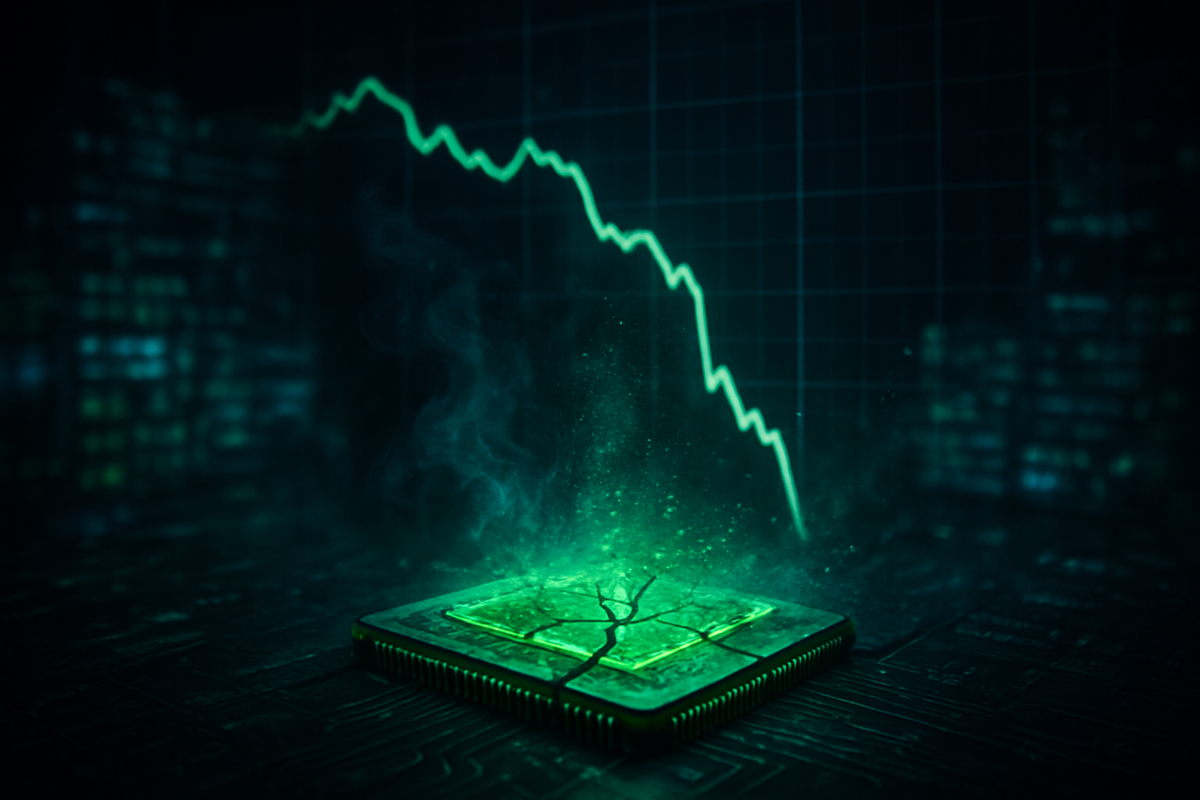
Exactly one year ago, the financial world witnessed a seismic shift that redefined the artificial intelligence era. In late February 2025, following a highly anticipated earnings release, NVIDIA Corporation (NASDAQ: NVDA) experienced a historic single-day market cap loss that eventually peaked at a staggering $600 billion in value destruction. This event, now etched into market history as "The Great AI Reset," did more than just shave a third of the value off a trillion-dollar titan; it signaled the end of the "GPU at any cost" era and fundamentally restructured how investors value high-growth technology stocks.
The immediate implications were catastrophic for the broader markets. The Nasdaq Composite (INDEXNASDAQ: .IXIC) suffered its worst single-session decline since the 2022 bear market, as the "Nvidia halo effect" that had carried the S&P 500 to record highs suddenly inverted. For months leading up to the crash, Nvidia had been the undisputed engine of the global economy, but by the close of trading on February 27, 2025, it had become a cautionary tale of "perfect pricing" meeting a "less-than-perfect" geopolitical and technological reality.
The Perfect Storm: Earnings, Tariffs, and the DeepSeek Shadow
The events of late February 2025 were the culmination of a "perfect storm" that had been brewing since late January. On February 26, 2025, Nvidia released its Q4 fiscal year results, which, on paper, were spectacular. The company reported $39.3 billion in revenue—a 78% year-over-year increase—and record-breaking Blackwell architecture shipments totaling $11 billion in just its first full quarter. However, the report also contained the first signs of sequential growth deceleration, with Q1 guidance projecting a move into single-digit quarterly growth for the first time in years.
The timeline of the collapse was accelerated by a series of external shocks. Just weeks prior, on January 27, 2025, the market had been rattled by the "DeepSeek shock," where a Chinese AI model demonstrated parity with Western LLMs using a fraction of the hardware costs. This "efficiency narrative" haunted the late February earnings call, as analysts grilled CEO Jensen Huang on whether the massive capital expenditure of "Hyperscalers" was sustainable if AI models were becoming drastically cheaper to train. The final blow came the morning after earnings, on February 27, when the U.S. administration announced 25% tariffs on goods from Mexico and Canada, alongside a 10% surtax on China, threatening the complex global supply chains that Nvidia relies on for its advanced H200 and Blackwell chips.
Stakeholders, from institutional giants like BlackRock to retail "HODLers," watched in disbelief as Nvidia shares plummeted 17% in a single session. This one-day loss of roughly $600 billion in market capitalization—the largest in stock market history—was not just a reaction to earnings but a total recalibration of risk. The market's initial reaction was one of pure panic, as the fear of an "AI bubble burst" shifted from a theoretical discussion to a realized market event, leading to a liquidity vacuum that saw buy orders vanish for hours.
Winners, Losers, and the Shifting Semiconductor Hierarchy
The fallout from Nvidia’s crash created a ripple effect that spared few but created a new set of market leaders. Among the biggest losers were Nvidia’s closest ecosystem partners. Super Micro Computer (NASDAQ: SMCI) saw its stock crater by 16% in the immediate aftermath, as investors feared that a slowdown in Nvidia GPU demand would directly translate to fewer server rack orders. Similarly, Taiwan Semiconductor Manufacturing Company (NYSE: TSM), the sole foundry for Nvidia’s advanced chips, saw its valuation take a hit as the market priced in a potential reduction in future wafer starts and the looming impact of the new trade tariffs.
However, the "Reset" also paved the way for "winners" who focused on AI efficiency rather than raw power. Advanced Micro Devices (NASDAQ: AMD) initially fell in sympathy but recovered faster than its rival as investors sought diversified exposure to the data center market. Companies specializing in AI networking and custom "ASIC" (Application-Specific Integrated Circuit) designs, such as Broadcom (NASDAQ: AVGO) and Marvell Technology (NASDAQ: MRVL), began to attract capital from those rotating out of Nvidia. These firms were seen as better positioned to benefit from the shift toward "efficiency-first" AI development, which required more sophisticated interconnects and specialized silicon rather than just massive clusters of general-purpose GPUs.
Intel Corporation (NASDAQ: INTC) also saw a surprising bottoming process during this period. As the "AI at any price" trade faded, Intel’s focus on domestic manufacturing (the "CHIPS Act" narrative) and its efforts to build a third-party foundry business began to look more attractive to long-term investors concerned about the geopolitical fragility of the Taiwan-centric supply chain. The crash effectively ended the "monolithic AI trade" and replaced it with a more nuanced, "pick-and-shovel" approach to semiconductor investing.
The End of the AI Infallibility Myth
In a broader historical context, Nvidia’s $600 billion loss is now viewed similarly to the 2000 Nasdaq crash or the 2021 SaaS correction. It marked the moment when the market stopped valuing AI companies on "potential" and started demanding "proof of ROI" (Return on Investment). For two years, Nvidia had benefitted from a "GPU scarcity" premium; the February 2025 event proved that even the most dominant monopoly is subject to the laws of supply and demand—and the threat of technological disruption.
The event fit into a broader trend of "AI Sovereignism," where nations and startups began seeking ways to bypass the expensive Nvidia-centric ecosystem. The DeepSeek R1 model's success in late January had already proven that hardware-constrained innovation could compete with brute-force computing. This sparked a regulatory shift as well, with U.S. policymakers facing pressure to reconsider export controls and tariff structures that were inadvertently accelerating the development of efficient AI alternatives in China and elsewhere.
The "ripple effects" also extended to the energy sector. Stocks like Vistra (NYSE: VST) and Constellation Energy (NYSE: CEG), which had surged on the promise of powering massive new Nvidia-based data centers, saw a sharp correction. The market realized that if AI training was becoming more efficient and required fewer GPUs, the projected "unlimited" demand for nuclear and renewable energy to power these centers might have been overblown. This forced a recalibration of the entire "AI power trade," which had been one of the most crowded positions on Wall Street in early 2025.
Looking Ahead: The Path to a Rational AI Market
One year later, in January 2026, the market has moved into what analysts call "The Deployment Phase." The short-term pain of 2025 forced Nvidia and its peers to pivot their strategies. Nvidia has since doubled down on its software ecosystem, CUDA, and its "AI-as-a-Service" offerings, attempting to transition from a hardware vendor to a full-stack platform company. This strategic pivot was required to maintain its valuation in a world where hardware is no longer the primary bottleneck for AI development.
Market opportunities have emerged in the wake of the crash, particularly in "Edge AI" and decentralized computing. The challenges of 2025—tariffs, efficiency gains, and valuation resets—have created a more resilient tech sector. We are now seeing the emergence of a "Tiered AI Market," where high-end Blackwell chips are reserved for the most intensive foundation model training, while a plethora of specialized, cheaper chips handle the day-to-day inference tasks that power consumer applications.
Potential scenarios for the remainder of 2026 suggest a period of "steady-state" growth rather than the parabolic moves of 2023 and 2024. The massive market cap loss taught a generation of investors that while AI is undoubtedly the future, the path to that future is rarely a straight line. The market has become more discerning, and the "Nvidia premium" has been replaced by a "proven utility" requirement that applies to every company in the AI value chain.
Conclusion: Lessons from the Great Reset
The $600 billion wipeout of late February 2025 remains a defining moment for modern finance. It served as a stark reminder that even the most revolutionary technologies are subject to the gravity of valuation and the volatility of geopolitics. The key takeaway for investors is the importance of distinguishing between a company’s fundamental success—as Nvidia's earnings were still objectively strong—and the market's "hallucination" of infinite growth.
Moving forward, the market appears healthier for having endured this correction. The "AI at any price" mania has been replaced by a more disciplined approach to capital allocation. Investors should continue to watch for the long-term impact of 2025's trade policies and whether the promised "productivity boom" from AI actually begins to manifest in the earnings of non-tech companies.
As we look back on the anniversary of this historic event, the significance of Nvidia's $600 billion loss is clear: it didn't kill the AI revolution; it simply made it more professional. The market's move toward efficiency and ROI over raw power and hype is a maturation process that was as necessary as it was painful. For those watching the markets in 2026, the lesson remains: in technology, the only constant is change—and even the giants can stumble when the winds of innovation and policy shift.
This content is intended for informational purposes only and is not financial advice