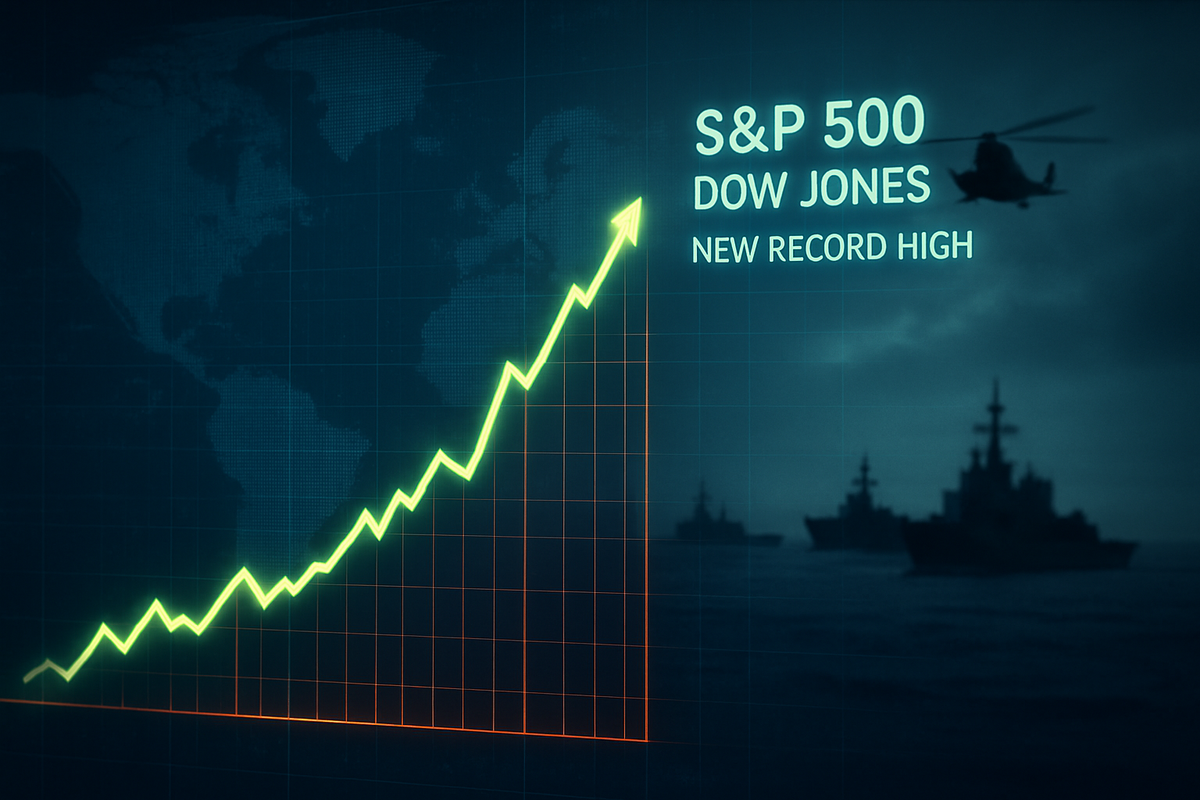
In a display of remarkable resilience, the U.S. stock market has rapidly moved past the geopolitical shock of "Operation Absolute Resolve"—the military intervention in Venezuela that culminated in the capture of Nicolás Maduro on January 3, 2026. While such a significant military action might historically have triggered a "flight to safety," investors have instead pushed major indices to record highs. As of January 6, 2026, the narrative on Wall Street has shifted decisively from the jungles of South America back to the concrete realities of the U.S. economy, specifically focusing on upcoming labor and inflation data.
The immediate implications of the conflict have been largely viewed through an optimistic lens by market participants. The removal of a long-standing geopolitical adversary and the potential reopening of one of the world’s largest oil reserves have provided a "pro-risk" catalyst. However, the initial euphoria is now being replaced by a more sober analysis of domestic fundamentals, as the market prepares for a week dominated by critical economic releases that will dictate the Federal Reserve's path for the remainder of the year.
Operation Absolute Resolve: From Blockade to Capture
The military intervention on January 3, 2026, was the climax of a multi-year escalation. Following a tightening naval blockade in December 2025 that immobilized an estimated 17.5 million barrels of oil, U.S. Special Operations forces, including Delta Force and the 160th Special Operations Aviation Regiment, launched a precision strike in Caracas. The operation resulted in the capture of Nicolás Maduro and his inner circle, who were subsequently transported to New York to face narco-terrorism charges. By January 5, 2026, a transitional government led by Vice President Delcy Rodríguez was established, promising a 90-day path toward democratic stabilization.
The market's reaction was swift and decisive. On Monday, January 5, the first full trading session following the operation, the Dow Jones Industrial Average surged 595 points, or 1.23%, to reach a new all-time high of 48,977.18. The S&P 500 followed suit, gaining 0.64% to close at 6,902.05. This "headline shock" failed to trigger the expected volatility, as the CBOE Volatility Index (VIX) actually retreated, suggesting that investors viewed the military outcome as a definitive resolution rather than the start of a prolonged quagmire.
Key stakeholders, including the U.S. State Department and regional allies, have emphasized that the intervention was a "surgical" necessity to restore regional stability. For Wall Street, the speed and perceived success of the operation removed a significant "tail risk" that had been weighing on energy markets and Latin American focused equities throughout the latter half of 2025.
Winners and Losers: Rebuilding a Fallen Petro-State
The primary beneficiaries of the Venezuelan transition are concentrated in the energy and infrastructure sectors. Chevron (NYSE: CVX), which maintained a tenuous presence in Venezuela throughout the crisis, saw its shares jump 5.1% as investors bet on the company's pole position to lead the rehabilitation of the country's decaying oil fields. Similarly, oilfield service giants like Halliburton (NYSE: HAL) surged 7.8%, with analysts estimating that the reconstruction of Venezuela’s oil infrastructure could represent a $100 billion-plus opportunity over the next decade.
The defense sector also saw a significant boost. Lockheed Martin (NYSE: LMT) and General Dynamics (NYSE: GD) both hit record highs, buoyed by the successful demonstration of U.S. military technology and the anticipation of replenished domestic stockpiles and potential regional security contracts. On the financial side, Goldman Sachs (NYSE: GS) and JPMorgan Chase (NYSE: JPM) rose more than 3% as the prospect of restructuring billions in Venezuelan sovereign debt began to materialize. Venezuelan bonds, long considered "zombie" assets, surged 10 cents on the dollar in secondary markets.
Conversely, the "losers" in this scenario include traditional safe-haven assets. Gold and U.S. Treasuries saw a mild sell-off as the anticipated geopolitical chaos failed to emerge, prompting a rotation back into equities. Companies with heavy exposure to Chinese and Russian interests in the region also faced uncertainty, as the new transitional government signaled a pivot toward Western economic partnerships, potentially jeopardizing existing contracts held by non-Western state-owned enterprises.
Wider Significance: Geopolitics vs. Fundamentals
The market's ability to "shrug off" a major military intervention fits into a broader historical trend where domestic economic health often outweighs foreign policy developments. Much like the market reactions to the 1991 Gulf War or the 2003 invasion of Iraq, the initial uncertainty was quickly replaced by a focus on the "knowns" of the U.S. economy. In the current context, the S&P 500's 16% gain in 2025 provided a strong "bullish" backdrop that made the market less susceptible to geopolitical panic.
Furthermore, this event highlights a shift in the global energy map. A pro-Western Venezuela could eventually provide a massive non-OPEC supply of heavy crude, potentially capping long-term oil prices and acting as a disinflationary force for the U.S. economy. This structural change is being weighed against the immediate "sticky" inflation currently seen in the U.S., where the Consumer Price Index (CPI) remains stubbornly between 2.7% and 3.0%.
The regulatory landscape is also expected to shift. The U.S. Treasury’s Office of Foreign Assets Control (OFAC) is already being lobbied to ease sanctions quickly to allow for humanitarian and industrial aid. This suggests a rapid transition from a "war footing" to a "reconstruction footing," a move that historically supports domestic industrial and financial sectors.
What Comes Next: The Pivot to Domestic Data
As the smoke clears in Caracas, the focus for the remainder of the week shifts to the December Jobs Report, scheduled for release on Friday, January 9, 2026. Early forecasts suggest a modest gain of 55,000 to 60,000 jobs, a figure that indicates a cooling but still resilient labor market. For investors, this domestic data is far more consequential than the capture of a foreign dictator, as it will directly influence the Federal Reserve's interest rate trajectory.
The market is currently pricing in roughly 60 basis points of interest rate easing for 2026. However, if the jobs report comes in significantly stronger than expected, or if the upcoming CPI data shows that inflation is not retreating toward the Fed's 2% target, the recent record highs could be tested. Additionally, the ISM Manufacturing PMI, which recently fell to 47.9, suggests that the U.S. industrial base is softening, creating a divergence between the "hard power" of the military and the "soft power" of the domestic economy.
Investors will also be watching for any signs of an "insurgency" or prolonged instability in Venezuela that could disrupt the expected timeline for oil production. Any setback in the transitional government's ability to maintain order could lead to a spike in oil prices, complicating the Fed's fight against inflation.
Summary and Investor Outlook
The U.S. stock market has proven once again that its primary engine is domestic economic health. The successful execution of "Operation Absolute Resolve" removed a long-standing geopolitical thorn, but it is the "Powell Transition" and the health of the American consumer that remain the true North Stars for Wall Street. The rally to record highs on January 5 reflects a market that is confident in U.S. hegemony but remains hyper-focused on the nuances of the labor market and inflation.
Moving forward, investors should keep a close eye on the energy and defense sectors for continued momentum, while remaining cautious about the broader market's sensitivity to Friday's employment data. The resilience seen this week is a testament to the current "pro-risk" environment, but in the world of finance, a successful military operation is merely a backdrop to the more pressing concerns of monetary policy and corporate earnings.
The coming months will determine if the "Venezuela Rally" was a sustainable leap or a momentary distraction from a cooling domestic economy. For now, the bulls remain in control, looking past the front-page headlines of Caracas and toward the spreadsheets of the Bureau of Labor Statistics.
This content is intended for informational purposes only and is not financial advice.