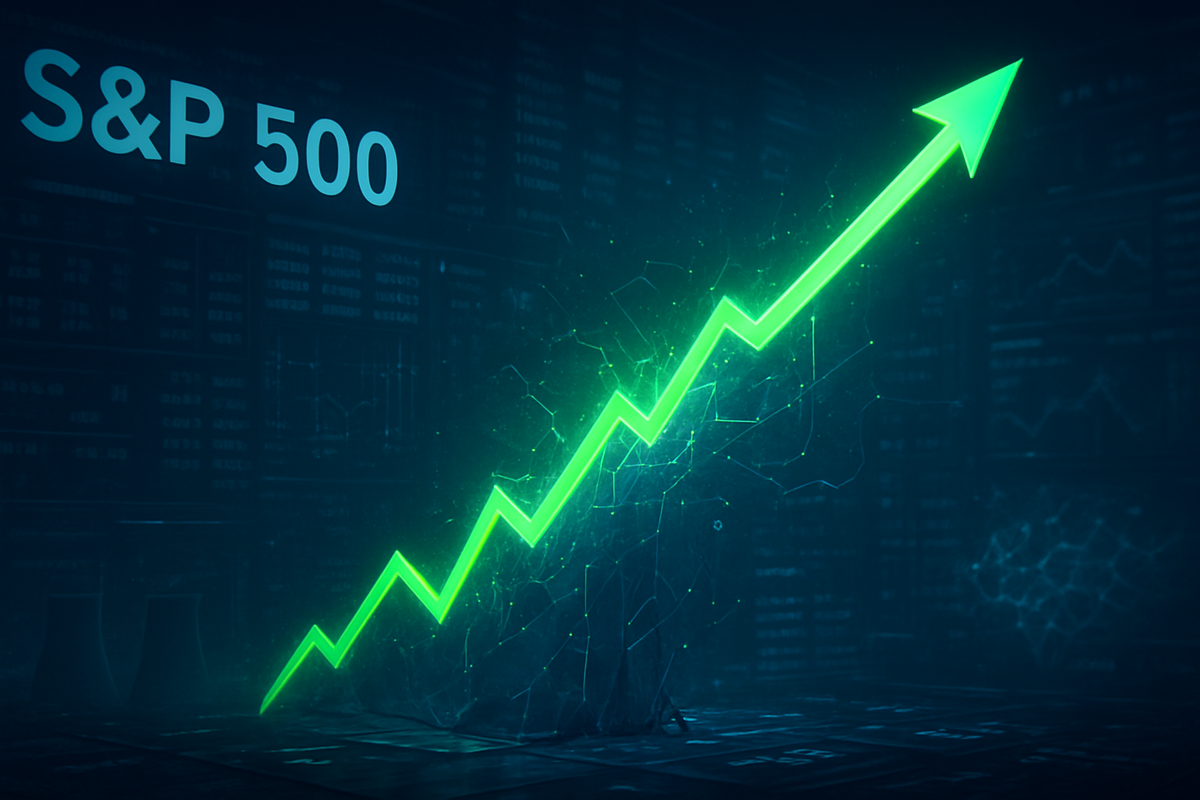
The S&P 500 climbed to a fresh all-time high on Wednesday, January 7, 2026, as investors cheered a combination of fiscal stimulus tailwinds and the accelerating commercialization of "Agentic AI." The benchmark index surged 1.2% during the session, briefly touching an intraday peak of 7,624.88 before settling slightly lower. This technical breakout above the psychologically significant 7,600 level marks a triumphant start to the year, though the milestone was met with a complex tapestry of market sentiment ranging from "melt-up" euphoria to deep-seated concerns over valuation and "sticky" inflation.
The rally comes at a pivotal moment for the U.S. economy, as the market begins to fully price in the effects of the One Big Beautiful Bill Act (OBBBA), the massive fiscal package signed into law in mid-2025. While the index's ascent suggests a "soft landing" has been achieved, the underlying mixed sentiment stems from a divergence between mega-cap technology performance and a broader rotation into value sectors like energy and financials. As the "January Barometer" takes hold, Wall Street is now debating whether this breakout is a sustainable climb toward 8,000 or a final "blow-off top" ahead of a anticipated mid-year correction.
Technical Breakout and the 'Shadow Chair' Effect
The path to today’s record high was paved by a series of technical signals that converged in the first week of 2026. After consolidating near the 7,450 level throughout late December, the S&P 500 broke through key resistance early in the Wednesday session, fueled by strong manufacturing data and optimism surrounding the upcoming Federal Reserve meeting on January 27–28. The timeline of this rally is inextricably linked to the "Shadow Chair" effect—the market's reaction to President Trump’s signal that Kevin Hassett will likely succeed Jerome Powell as Fed Chair in May 2026. Investors are already pricing in a more dovish, growth-oriented monetary policy for the latter half of the year, even as the current federal funds rate remains held at 3.50%–3.75%.
Initial market reactions were swift. Trading volumes spiked 15% above the 30-day average as institutional algorithms triggered buy orders upon the breach of 7,600. Key players in the rally included major asset managers who shifted capital back into equities following a brief year-end tax-loss harvesting period. However, the mood on the floor of the New York Stock Exchange was not purely celebratory. Traders noted that while the headline number is impressive, the "frothy" forward P/E ratio of 22x is causing some long-term value investors to pull back, citing the risk of a "valuation reset" if inflation—currently hovering between 2.4% and 2.8%—does not continue its descent.
The mixed sentiment is further complicated by the fiscal reality of the OBBBA. While the permanent extension of the 2017 tax cuts and the new "No Tax on Overtime" rule are boosting consumer discretionary outlooks, the roughly $1 trillion in cuts to SNAP and Medicaid are beginning to weigh on specific sub-sectors. This has created a "K-shaped" sentiment within the market, where high-growth tech and energy sectors are booming while low-income consumer-facing stocks face headwinds.
Winners and Losers in the New Record Era
The primary beneficiaries of today’s record-breaking session were companies at the intersection of AI infrastructure and energy production. Constellation Energy (NASDAQ: CEG) saw its shares climb 4.5% following reports that its technical refurbishment of the Crane Clean Energy Center is ahead of schedule. Similarly, Vistra Corp (NYSE: VST) reached new highs after finalizing its $4 billion acquisition of Cogentrix Energy, a move designed to secure natural gas capacity to backstop its nuclear-powered AI data center contracts. The "AI-Nuclear hybrid" trade has become the darling of 2026, as energy constraints remain the primary bottleneck for tech expansion.
In the technology sector, Microsoft (NASDAQ: MSFT) and NVIDIA (NASDAQ: NVDA) continued their leadership roles, though the focus has shifted from hardware to "Agentic AI"—autonomous digital coworkers capable of executing multi-step workflows. Microsoft’s integration of these agents into its enterprise suite has driven a surge in recurring revenue, while NVIDIA’s dominance in the specialized chips required for agentic reasoning remains unchallenged. Conversely, Apple (NASDAQ: AAPL) saw more modest gains as it navigates a transition toward AI-integrated hardware, facing stiff competition from emerging "agent-first" devices.
The "losers" of this milestone day were found primarily in the retail and healthcare sectors impacted by the OBBBA’s spending cuts. Dollar General (NYSE: DG) and Humana (NYSE: HUM) both traded lower as analysts adjusted earnings models to account for reduced federal spending on social safety nets and Medicaid. Furthermore, traditional rate-sensitive sectors like regional banking, represented by the likes of KeyCorp (NYSE: KEY), showed signs of strain as the "higher for longer" inflation narrative keeps the Fed from aggressive rate cuts, despite the "Shadow Chair" optimism.
The Wider Significance: Agentic AI and Fiscal Dominance
Today’s record high is more than just a number; it represents a fundamental shift in the market’s DNA. We are witnessing the transition from the "Experimentation Era" of 2023–2024 to the "Execution Era" of 2026. The widespread adoption of AI Bills of Materials (AI-BOMs) has brought a new level of governance and transparency to the tech sector, allowing heavily regulated industries like JPMorgan Chase (NYSE: JPM) to deploy AI agents at scale for everything from fraud detection to automated wealth management. This productivity boost is a major factor in why the market is tolerating higher valuations.
Historically, this event draws comparisons to the late 1990s "dot-com" boom, but with a critical difference: the current rally is backed by significant fiscal stimulus and tangible corporate earnings. The OBBBA has essentially replaced monetary easing as the primary engine of growth. However, this "fiscal dominance" creates a ripple effect for global competitors. European and Asian markets are struggling to keep pace with the U.S. "capital magnet," leading to concerns about a strengthening dollar and its impact on multi-national exporters like ExxonMobil (NYSE: XOM), which must balance domestic growth with international currency headwinds.
Regulatory implications are also looming large. As AI agents become more autonomous, the SEC and FTC are expected to introduce new frameworks for "algorithmic accountability" by mid-2026. Today’s market high suggests that investors believe these hurdles will be manageable, but any surprise regulatory "tariffs" on AI data usage could quickly dampen the current enthusiasm.
Looking Ahead: The Road to 8,000
The immediate focus for investors now shifts to the Federal Reserve’s January 27 meeting. While a "hold" is the consensus, the market will be hypersensitive to Jerome Powell’s rhetoric regarding the "Shadow Chair" speculation and the fiscal impact of the OBBBA. In the short term, a "January Effect" could push the S&P 500 toward the 7,700 mark, but the potential for a "mid-year goring"—a correction of 10% or more—remains a persistent concern for strategists at firms like Bank of America and LPL Financial.
Strategic pivots will be required for those currently over-indexed in mega-cap tech. The rotation into "AI-adjacent" sectors—such as specialized real estate, advanced cooling infrastructure, and nuclear energy—is expected to accelerate. Furthermore, the rumored IPO of Anthropic in late Q1 2026 is already being viewed as a potential liquidity event that could either validate current AI valuations or signal a "peak" in the cycle. Investors should also watch for the first "Agentic AI" earnings reports in February, which will provide the first hard data on how much these autonomous systems are actually contributing to the bottom line.
Wrap-Up: A Milestone with a Warning Label
The S&P 500’s breach of 7,600 on January 7, 2026, is a testament to the resilience of the U.S. economy and the transformative power of Agentic AI. The convergence of permanent tax cuts and a technological revolution has created a potent, albeit volatile, environment for equity growth. Key takeaways from today include the undeniable dominance of the AI-Nuclear hybrid trade and the market's increasing reliance on fiscal policy over traditional monetary levers.
Moving forward, the market appears poised for further gains, but the "mixed sentiment" observed today should not be ignored. The divergence between sectors and the "sticky" nature of inflation suggest that the path to 8,000 will be fraught with volatility. Investors should maintain a diversified stance, watching closely for the Fed’s transition in May and the real-world impact of social spending cuts on consumer behavior. While the records are breaking, the margin for error in 2026 is becoming increasingly thin.
This content is intended for informational purposes only and is not financial advice.