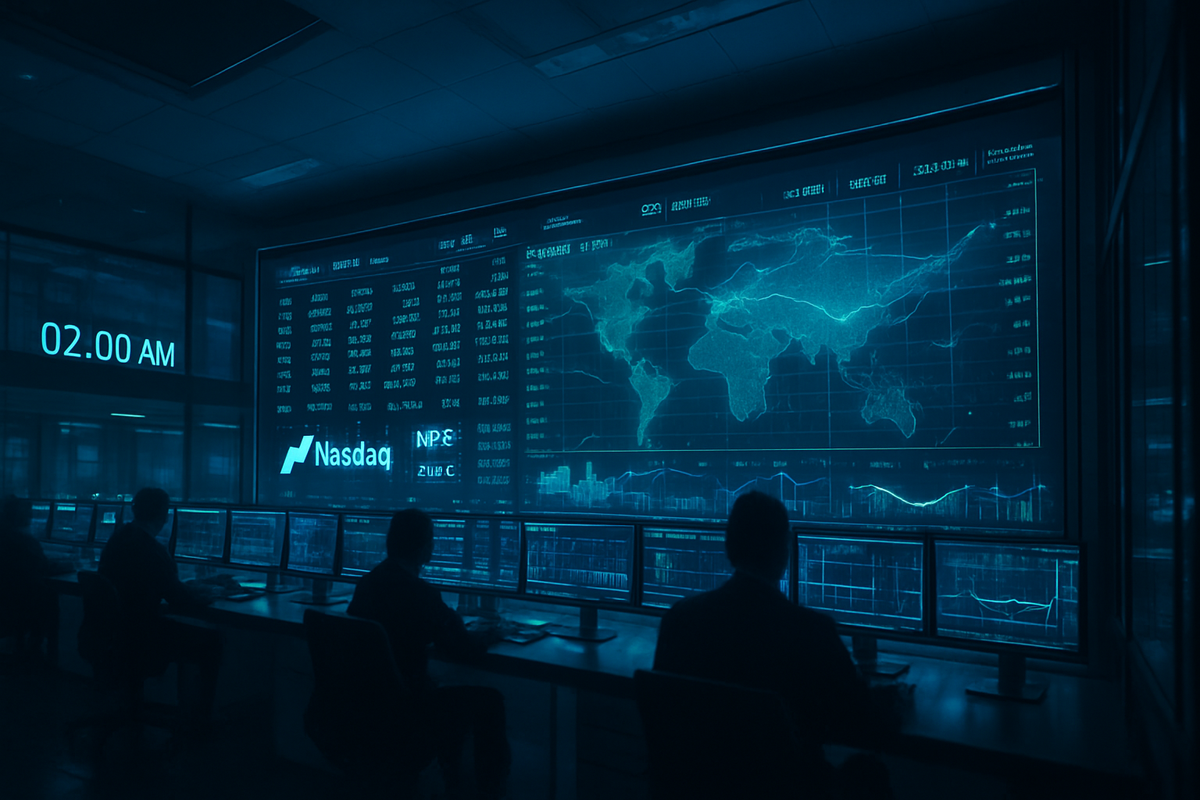
As the sun sets over the Hudson River on January 8, 2026, the traditional silence that once signaled the end of the trading day is becoming a relic of the past. The U.S. financial system is currently undergoing its most radical transformation in a century as the Securities and Exchange Commission (SEC) moves through the final stages of reviewing landmark filings from the world’s largest stock exchanges. Following years of pressure from retail investors and global competition, Nasdaq (NASDAQ: NDAQ) and the New York Stock Exchange (owned by Intercontinental Exchange, NYSE: ICE) are no longer just exploring extended hours—they are actively dismantling the 9:30-to-4:00 paradigm in favor of a near-continuous, 24-hour trading cycle.
The immediate implications of this shift are profound. For the first time, institutional and retail investors will be able to react to geopolitical events, earnings reports, and economic data in real-time, regardless of the hour. While this "always-on" environment promises to align U.S. equities with the 24/7 nature of the cryptocurrency markets and global currency exchanges, it also presents unprecedented challenges for market stability. As the SEC prepares to greenlight the final technical hurdles, the financial industry is bracing for a future where the "closing bell" is merely a ceremonial gesture rather than a functional stop to the movement of trillions of dollars.
The Road to 23 Hours: A Timeline of Transformation
The momentum toward a 24/7 market reached a fever pitch in late 2025. In December 2025, Nasdaq officially submitted a landmark proposal to the SEC to expand its trading window to 23 hours per weekday. The proposed model includes a "Day Session" and a new "Night Session," separated only by a one-hour technical pause from 8:00 PM to 9:00 PM ET for system maintenance and clearing. This move followed the New York Stock Exchange’s successful bid in February 2025, when it received accelerated SEC approval to extend trading on its fully electronic NYSE Arca platform to 22 hours per day.
This regulatory shift was not an overnight occurrence. The catalyst can be traced back to April 2024, when the NYSE conducted a massive industry survey that revealed a stark divide: retail brokers reported a 25% surge in demand for overnight access, while traditional banks expressed deep concerns over staffing and liquidity. However, the emergence of 24 Exchange (24X), a startup that received SEC approval in November 2024 and launched its first stage of operations in October 2025, forced the hand of the "Big Two." With 24X already capturing a growing slice of the overnight pie, Nasdaq and NYSE had little choice but to evolve or risk losing their dominance to more agile, tech-native competitors.
Key stakeholders, including the Depository Trust & Clearing Corp (DTCC) and the Securities Information Processor (SIP), have been working frantically behind the scenes to upgrade the "plumbing" of the market. As of early 2026, the DTCC’s subsidiary, NSCC, is on track to launch full 24/5 clearing by June 28, 2026. This infrastructure is essential because it provides the central counterparty guarantee that institutional investors require to trade safely outside of traditional hours. Without it, the overnight market would remain a "Wild West" of fragmented liquidity and higher risk.
Winners and Losers in the "Always-On" Era
The transition to 24/7 trading is creating a new hierarchy on Wall Street. The clearest winner has been Robinhood Markets, Inc. (NASDAQ: HOOD), which pioneered the 24-hour market for retail users years ago. By January 2026, Robinhood has solidified its position as the primary gatekeeper for the "crypto-native" equity investor. Because its infrastructure was built in the cloud and designed for automation, Robinhood has been able to scale its overnight offerings with significantly lower overhead than its legacy competitors. Its stock has reflected this dominance, outperforming the broader financial sector as its net interest revenue and "Gold" subscription tiers hit record highs.
Conversely, traditional investment banking giants like Goldman Sachs (NYSE: GS) and JPMorgan Chase & Co. (NYSE: JPM) are finding themselves in a defensive crouch. These institutions are the primary "losers" in the immediate term due to the massive structural costs associated with staffing global trading desks 24/7. JPMorgan recently shocked analysts by forecasting a multi-billion dollar increase in technology and personnel expenses for 2026, much of which is dedicated to keeping legacy systems "always on." While retail platforms can rely on automation, institutional banks still require human oversight for complex, large-block trades, leading to a surge in compensation costs and employee burnout.
Market makers like Virtu Financial (NASDAQ: VIRT) occupy a more precarious middle ground. While Virtu has successfully captured market share as traditional banks retreat from low-margin overnight liquidity provision, the "tech arms race" has compressed their margins. To provide low-latency quotes around the clock, Virtu has had to invest heavily in AI-driven execution engines, and the firm remains under pressure from high "payment for order flow" (PFOF) expenses as they compete to fill the massive overnight order books of retail brokers.
Global Competition and the "Crypto-fication" of Equities
The push for 24/7 trading is not merely a domestic trend; it is a strategic response to the shifting centers of global wealth. With nearly $17 trillion in U.S. equities held by foreign investors, the 12-hour time zone gap between New York and major Asian hubs like Tokyo and Hong Kong has long been a friction point. By moving to a 23-hour model, U.S. exchanges are effectively attempting to "onshore" the trading volume that currently takes place on foreign platforms or private "dark pools" during the overnight hours.
This evolution also marks the final stage of the "crypto-fication" of traditional finance. The rise of digital assets, which trade 24/7/365, has fundamentally altered investor expectations. Younger generations of traders, who grew up with the perpetual availability of Bitcoin, view the concept of a "market close" as an archaic limitation. By adopting these hours, the NYSE and Nasdaq are acknowledging that the barrier between traditional stocks and digital assets is thinning. However, this shift brings regulatory headaches; the SEC is currently grappling with how to maintain "investor protection" when there is no "National Best Bid and Offer" (NBBO) equivalent during the low-volume hours of 2:00 AM.
Historical precedents, such as the transition from fractional to decimal pricing in 2001 or the rise of high-frequency trading in the late 2000s, suggest that while these changes initially cause volatility, they eventually lead to more efficient markets. However, the 24/7 shift is unique because it challenges the human element of finance. Critics argue that spreading the same pool of orders across 24 hours will lead to "liquidity fragmentation," where large trades move prices more drastically because there are fewer participants active at any given moment.
The Path Forward: Q3 2026 and Beyond
Looking ahead to the second half of 2026, the market is bracing for the "Full Launch" phase. Nasdaq’s 23-hour session is expected to go live in Q3, assuming the final SIP testing is successful. In the short term, we should expect a period of heightened volatility during the newly established "Night Sessions." Strategic pivots are already underway; many hedge funds are reportedly building "overnight pods"—specialized teams of traders and data scientists tasked with hunting for alpha in the quiet hours before the European markets open.
In the long term, the success of 24/7 trading will depend on whether institutional liquidity follows the retail lead. If major pension funds and asset managers remain hesitant to trade at 3:00 AM due to wider bid-ask spreads, the overnight market may remain a retail-dominated playground. However, if the DTCC’s 24/5 clearing proves robust, we could see a "virtuous cycle" where increased institutional participation narrows spreads, attracting even more volume. The potential for a "flash crash" in the middle of the night remains the primary "black swan" event that regulators and exchanges are desperately trying to model and prevent.
Final Thoughts for the 2026 Investor
As we move further into 2026, the key takeaway for investors is that the "market hours" are no longer a safety net. The period between 4:00 PM and 9:30 AM, once a time for reflection and research, is now a live-fire zone. Investors must ensure their risk management tools—such as stop-loss orders and limit prices—are calibrated for a market that never sleeps. The era of waking up to a "gap up" or "gap down" based on overnight news is being replaced by a continuous price discovery process that rewards those with the best technology and the most resilient systems.
Moving forward, the market will likely be characterized by a "two-speed" reality: high-volume, liquid daytime trading for institutional blocks, and a thinner, more volatile overnight session dominated by retail and algorithmic players. For the savvy investor, this creates new opportunities for arbitrage and global positioning, but it also demands a higher level of vigilance. As the SEC completes its final reviews this spring, the message to Wall Street is clear: the bell has rung for the last time, and the lights in the exchange data centers are staying on for good.
This content is intended for informational purposes only and is not financial advice.