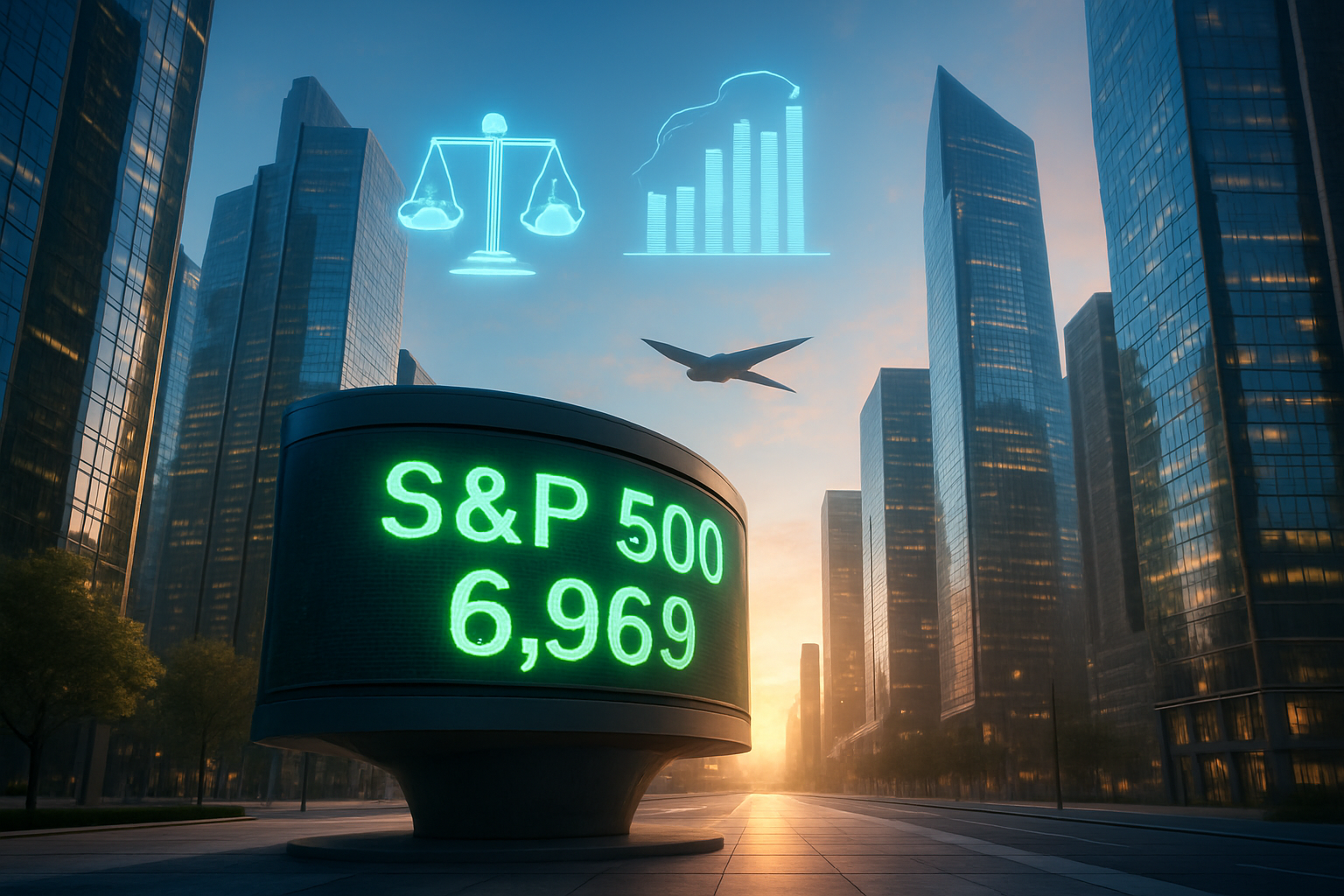
The S&P 500 index surged to a historic intraday and closing high on Friday, January 9, 2026, as investors cheered a December employment report that appeared to hit the "Goldilocks" sweet spot for the U.S. economy. The benchmark index finished the session at approximately 6,969 points, a gain of 0.69%, flirting with the psychologically significant 7,000 level.
The rally comes on the heels of data from the Bureau of Labor Statistics showing a cooling but resilient labor market. This balance has reinforced the narrative that the Federal Reserve can successfully navigate a "soft landing," bringing inflation toward its target without triggering a broad economic contraction.
A "Speed Limit Economy": Inside the December Jobs Data
The December 2025 employment situation report, released early Friday morning, provided the primary catalyst for the market's record-breaking performance. The U.S. economy added just 50,000 non-farm payroll jobs during the month, significantly trailing the consensus forecast of 73,000. While a miss of this magnitude might normally spark recession fears, the underlying data suggested a more nuanced "low-hire, low-fire" environment.
Surprisingly, the unemployment rate ticked down to 4.4% from a revised 4.5% in November, defying expectations that it would hold steady. This discrepancy—fewer jobs added but lower unemployment—was largely attributed to a slight dip in the labor force participation rate to 62.4%. Meanwhile, average hourly earnings grew by a modest 0.3%, bringing the annual wage growth to 3.8%. For the Federal Reserve, these figures represent a cooling trend that is consistent with its efforts to tame "sticky" inflation, which currently sits at 2.7%.
The timeline leading to this record high has been marked by a year of decelerating job growth. 2025 now stands as the weakest year for job creation since the 2020 pandemic era. However, the market has viewed this deceleration as a necessary "speed limit" for an economy that had previously been overheating. The initial reaction from Wall Street was a swift move into equities, as the 10-year Treasury yield softened on expectations that the Fed will initiate multiple interest rate cuts throughout 2026.
Winners and Losers: The Great Rotation in Large-Cap Equities
While the broader index hit new heights, the internal dynamics of the market revealed a stark divergence among the technology giants. Nvidia (NASDAQ: NVDA) maintained its crown as the world’s most valuable company with a market capitalization of $4.6 trillion. Despite the index's record, NVDA shares saw a modest lift but remained in a tactical 12% drawdown from December peaks, as investors began to scrutinize the immediate return on investment for artificial intelligence infrastructure.
In a significant shift in the market hierarchy, Alphabet (NASDAQ: GOOGL) officially overtook Apple (NASDAQ: AAPL) as the second-most valuable public company in the world. Apple shares continued to struggle, falling for a sixth consecutive session as concerns mounted over its AI product roadmap and the potential retirement of long-time CEO Tim Cook. Conversely, Meta Platforms (NASDAQ: META) was a notable winner, gaining ground after announcing long-term nuclear energy agreements designed to power its massive AI data centers.
Microsoft (NASDAQ: MSFT) proved to be one of the day's laggards, closing down 1.01%. Analysts pointed to a "cooling of enthusiasm" for big-cap software after a dominant 2025, suggesting that capital is beginning to rotate out of overcrowded tech trades and into other sectors. Defensive plays and utilities saw increased interest as the "Goldilocks" scenario made yield-sensitive sectors more attractive.
The Significance of the 'Soft Landing' Narrative
The market's reaction on January 9 underscores a classic "bad news is good news" paradigm. The tepid job growth is seen as a shield against further interest rate hikes, effectively cementing the end of the Fed's tightening cycle. This event fits into a broader trend of economic normalization following the post-pandemic volatility. By maintaining a 4.4% unemployment rate despite slow hiring, the U.S. economy is demonstrating a level of structural resilience that many economists doubted was possible a year ago.
Historically, the S&P 500's approach to the 7,000 mark draws parallels to the late 1990s and the 2021 bull runs, though current valuations are being supported by a more stable—if slower—earnings environment. The ripple effects of this report are likely to be felt in global markets, as a weaker U.S. dollar—driven by lower rate expectations—could provide a tailwind for international value plays and emerging markets.
However, the policy implications remain delicate. The Federal Reserve must now balance the need to support a slowing labor market with the reality of 2.7% inflation. If wage growth remains at 3.8% while productivity stalls, the "Goldilocks" scenario could quickly transition into a "stagflationary" one. For now, the regulatory and policy focus remains squarely on the timing of the first rate cut of 2026.
What Lies Ahead: The Path to 7,000
In the short term, the market's focus will shift from employment data to the upcoming Q4 earnings season. Investors will be looking for confirmation that the "Speed Limit Economy" is not eroding corporate margins. The primary challenge for large-cap companies will be justifying their premium valuations in an environment of slower top-line growth. If earnings can hold steady, the S&P 500 is widely expected to breach the 7,000 level before the end of the first quarter.
Strategic pivots are already underway, as seen with Meta’s move into nuclear energy. We can expect more large-cap firms to seek unconventional partnerships to secure the resources—whether energy or specialized labor—needed to maintain their competitive edge in the AI era. A potential scenario to watch is a "melt-up" in the broader market if the Fed provides a definitive timeline for rate cuts, which could see capital flow back into the small-cap and mid-cap sectors that have lagged behind the S&P 500.
Conclusion: A Milestone for the 2026 Market
The S&P 500’s record high on January 9, 2026, serves as a powerful validation of the "soft landing" thesis. By delivering a jobs report that was neither too hot to fuel inflation nor too cold to signal a recession, the U.S. economy has provided investors with a clear green light to start the year. The milestone of 6,969 points is more than just a number; it represents a market that has learned to thrive in a high-interest-rate environment and is now anticipating the relief of a more accommodative monetary policy.
Moving forward, the market's trajectory will depend on the Fed's agility and the continued resilience of the American consumer. While the "Magnificent Seven" are seeing a shift in leadership—exemplified by Alphabet’s rise and Apple’s stagnation—the broader market's strength suggests a healthy diversification of growth. Investors should remain vigilant, watching for any signs that "sticky" inflation might prevent the very rate cuts the market is currently pricing in. For now, the 2026 market is off to a historic start, driven by a labor market that is perfectly balanced for a new era of growth.
This content is intended for informational purposes only and is not financial advice.