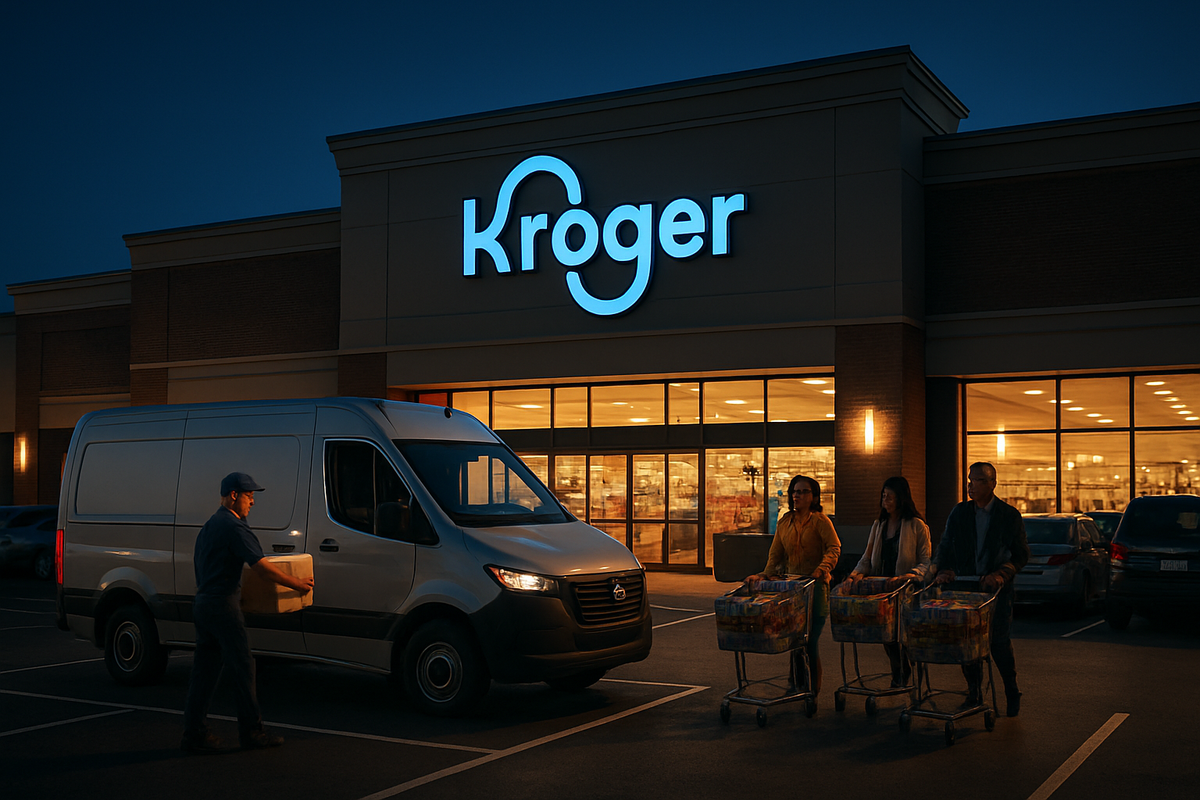
As the first trading weeks of 2026 unfold, the financial landscape is defined by a cautious rotation toward stability. Following a year of cooling economic growth and persistent market volatility in late 2025, institutional investors are increasingly anchoring their portfolios in consumer staples. At the center of this defensive shift is The Kroger Co. (NYSE: KR), which has transitioned from a merger-distracted giant into a lean, value-driven powerhouse. Despite the shadow of a failed multi-billion dollar merger and a recent multi-billion dollar impairment charge, Kroger’s fundamental valuation metrics and dominant market position are positioning it as the sector's premier "value play" for the year ahead.
The current enthusiasm for Kroger stems from its ability to deliver "boring but beautiful" results in an uncertain climate. While high-growth tech stocks face valuation scrutiny, Kroger’s core grocery business remains a fortress of cash flow. In its most recent earnings report from December 2025, the company demonstrated that its "Plan B" strategy—a store-centric, private-label-focused model adopted after its merger with Albertsons was blocked—is not just a fallback, but a highly profitable path forward.
Strategic Pivot and Financial Resilience
The road to Kroger’s current status as a 2026 value leader was paved by a significant strategic pivot in late 2025. In December, Kroger reported a GAAP loss for its third fiscal quarter, driven by a massive $2.6 billion non-cash impairment charge. This charge was the result of a decisive move to shutter several underperforming automated fulfillment centers, signaling an end to the company’s expensive pursuit of a centralized e-commerce hub model. Instead, Kroger has doubled down on a "store-centric" hybrid approach, utilizing its existing 2,700+ locations for last-mile delivery and pickup—a move that analysts say has drastically shortened the timeline to e-commerce profitability.
Despite the headline loss, the underlying numbers told a different story. Adjusted earnings per share came in at $1.05, beating Wall Street estimates, while identical sales (excluding fuel) grew by a healthy 2.6%. This resilience is largely attributed to the company’s "Our Brands" portfolio, which includes labels like Simple Truth and Kroger. As consumers continued to battle the lingering effects of 2025's inflation, Kroger’s private labels reached record sales penetration, offering higher margins for the company and better value for the shopper.
The timeline leading to this moment was defined by the December 2024 termination of the $24.6 billion merger with Albertsons Companies, Inc. (NYSE: ACI). After federal and state judges blocked the deal on antitrust grounds, Kroger spent much of 2025 aggressively restructuring. The company redirected the capital originally intended for the merger into a massive $5 billion share repurchase program and a focused technology overhaul. By January 2026, the market has begun to reward this discipline, viewing Kroger as a more focused and agile competitor than it was during the years of merger uncertainty.
The Competitive Landscape: Winners and Losers
In the high-stakes battle for the American pantry, Kroger occupies a unique middle ground that is currently attracting value-conscious investors. Its primary rival, Walmart Inc. (NYSE: WMT), continues to dominate the sector with a roughly 23.6% market share. However, Walmart’s valuation has soared to a forward P/E ratio of over 32x, as it is increasingly priced like a high-growth technology and retail media company. For investors seeking a "pure-play" grocery stock without the premium tech multiple, Kroger’s forward P/E of approximately 14.5x represents a significant discount.
On the other side of the spectrum, Target Corporation (NYSE: TGT) remains a competitor for the "multi-channel" shopper but carries higher risk due to its heavier exposure to discretionary categories like apparel and home goods. As consumer spending on non-essentials softened in late 2025, Target has struggled with inventory volatility, making Kroger’s 90% grocery-and-essentials mix look far more attractive for those seeking stability. Meanwhile, Costco Wholesale Corporation (NASDAQ: COST) remains a favorite for its membership model, but its high entry price and low dividend yield often push value-oriented funds toward Kroger’s more accessible 2.0% yield.
The "loser" in the current environment appears to be Albertsons. Still reeling from the failed merger, Albertsons is currently locked in a bitter legal battle with Kroger over a $600 million termination fee and alleged breaches of contract. While Kroger has successfully moved on to its "standalone" strategy, Albertsons faces a more difficult path as it attempts to modernize its aging store fleet without the scale benefits a merger would have provided.
Wider Significance and Industry Trends
Kroger’s emergence as a value leader reflects a broader industry-wide trend: the "death of the dark store." The 2025 impairment charge taken by Kroger was a bellwether for the entire retail sector, signaling that the era of massive, automated "dark" warehouses for grocery delivery is over. The industry has realized that the most efficient way to fulfill online orders is through the existing brick-and-mortar footprint. This shift has massive implications for real estate and urban planning, as grocery stores are once again viewed as the ultimate multi-purpose hubs.
Furthermore, Kroger’s success with private labels highlights a permanent shift in consumer psychology. The "trade-down" effect, once seen as a temporary reaction to inflation, has become a permanent habit for many American households. By manufacturing 30% of its own private-label units, Kroger has effectively vertically integrated its supply chain, protecting itself from the pricing whims of major consumer packaged goods (CPG) companies. This has set a precedent that other regional players are now scrambling to follow.
Historically, this period mirrors the post-2008 era, where value-oriented staples led the market recovery. However, the 2026 version of this trend is powered by data. Kroger’s use of operational AI for dynamic pricing and personalized loyalty offers has allowed it to maintain margins even as labor costs rise. This "tech-enabled value" is a new frontier for the sector, proving that a company doesn't need to be a "tech stock" to reap the benefits of the digital revolution.
The Road Ahead: 2026 and Beyond
Looking toward the remainder of 2026, Kroger faces both a clear runway and a few significant hurdles. The short-term focus will be the resolution of the litigation with Albertsons. While a settlement is expected by mid-year, any unexpected legal setbacks could impact Kroger's cash reserves. However, most analysts believe the company has already priced in these risks, and a settlement would likely act as a "clearing event" that removes the last bit of merger-related uncertainty from the stock.
The long-term opportunity for Kroger lies in its "Retail 3.0" strategy—expanding its retail media network. By leveraging the data from its 60 million loyal households, Kroger is building a high-margin advertising business that rivals the growth of its actual grocery sales. If Kroger can successfully scale its media business to contribute a larger percentage of its operating profit, the "value" multiple it currently carries could see a significant upward re-rating, closing the gap with Walmart.
Investors should also watch for potential strategic acquisitions. Now that the "mega-merger" path is closed, Kroger may look to acquire smaller, regional specialty grocers or technology startups focused on "shrink" reduction and supply chain AI. The challenge will be maintaining its disciplined capital allocation while pursuing these growth avenues.
Summary and Investor Outlook
Kroger enters 2026 as a textbook example of a value play: a fundamentally sound company trading at a discount to its peers, with a clear strategy for margin expansion. The company has successfully navigated the fallout of the largest attempted merger in grocery history, emerged with a stronger balance sheet, and pivoted its e-commerce strategy toward a more profitable, store-centric model.
For the market moving forward, Kroger serves as a barometer for the health of the American consumer. As long as household budgets remain tight, Kroger’s dominance in private labels and its reputation for value will likely keep its "identical sales" in positive territory. The key takeaways for investors are clear: Kroger offers a rare combination of defensive stability, a healthy dividend, and a massive share buyback program, all at a P/E multiple that significantly undercuts the broader market.
In the coming months, watch for the company’s Q4 FY2026 earnings in March, which will provide the first full look at the post-impairment margins. If Kroger can continue to grow its digital sales while improving its bottom line, the "value play" of 2026 may very well become the "performance play" of 2027.
This content is intended for informational purposes only and is not financial advice.