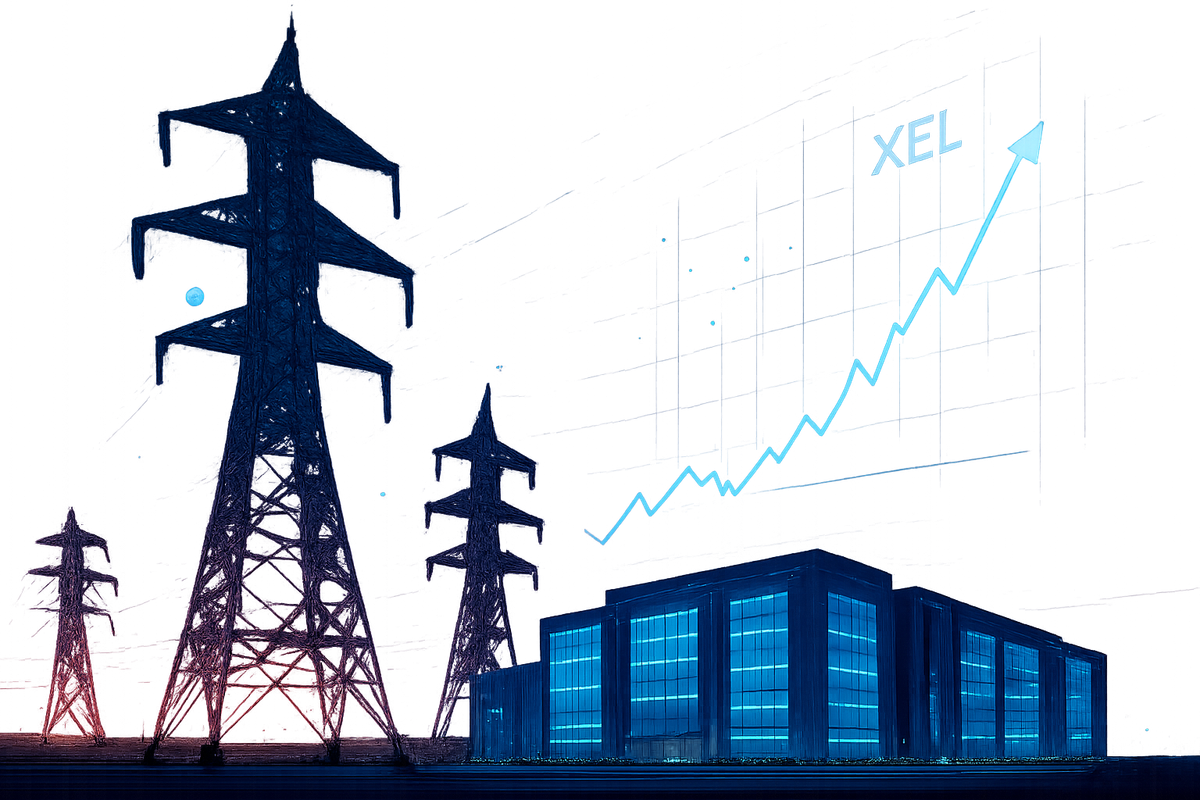
In a striking shift for the traditionally sedate utility sector, Xcel Energy Inc. (NASDAQ: XEL) surged to an all-time high on February 24, 2026, with shares climbing past the $82.37 resistance level to reach a record intraday peak of $83.40. The move represents a 10.5% year-to-date gain, catapulting the Minneapolis-based utility into the spotlight as a premier "picks and shovels" play for the ongoing artificial intelligence revolution. As the broader market experiences a rotation toward physical infrastructure, Xcel's performance signals a new era where regulated utilities are no longer viewed merely as defensive "bond proxies," but as high-growth engines essential to the digital economy.
The breach of previous historical highs is the culmination of an intermediate uptrend that began in late 2025, fueled by a fundamental reassessment of energy demand. With the NASDAQ 100 (NASDAQ: NDX)—of which Xcel is a notable member—witnessing increased volatility in software and semiconductor valuations, institutional capital is increasingly flowing into the energy providers that power the data centers behind the AI models. For Xcel, this record-breaking price action is a validation of its aggressive pivot toward high-capacity grid modernization and its massive $60 billion capital investment strategy.
The momentum behind Xcel’s record-breaking day was driven by a confluence of strong 2025 year-end earnings and a strategic update released earlier this month. In its February investor presentation, Xcel management doubled its contracted data center capacity target from 3 gigawatts (GW) to a staggering 6 GW by 2027. This ambitious expansion aims to address a 20 GW pipeline of large-load requests, predominantly from AI-focused hyperscalers. Investors reacted enthusiastically to news that data centers are now projected to account for approximately 62% of Xcel’s total energy growth in key service territories, particularly in the tech-heavy corridors of Colorado and Minnesota.
The timeline leading up to today’s peak was marked by a series of de-risking events that restored investor confidence. Throughout 2025, Xcel successfully navigated complex regulatory hurdles and reached settlements regarding past wildfire liabilities, including the Marshall Fire in Colorado. By resolving these legal overhangs, the company cleared the path for its 2026–2030 capital plan, which focuses on adding 7,500 MW of new renewable generation and 1,900 MW of battery storage. Market reaction on February 24 was swift, with high trading volume early in the session as technical traders triggered buy orders once the $82.37 threshold was cleared.
Xcel Energy stands as the primary beneficiary of this valuation surge, but the ripples are being felt across the industry. NextEra Energy, Inc. (NYSE: NEE) and GE Vernova (NYSE: GEV) have emerged as critical partners in Xcel’s growth story, forming a tri-party alliance in early 2026 to accelerate the deployment of gigawatt-scale grid technology. As Xcel builds the infrastructure, GE Vernova provides the high-efficiency turbines and grid solutions, while NextEra collaborates on large-scale renewable projects, creating a "winner’s circle" of companies positioned to profit from the AI infrastructure supercycle.
Conversely, the massive energy requirements of AI data centers present a potential cost challenge for tech giants like Alphabet Inc. (NASDAQ: GOOGL) and Meta Platforms, Inc. (NASDAQ: META). While these companies are the primary drivers of demand, the rising cost of power and the competition for grid access could pressure their operational margins. Furthermore, legacy industrial manufacturers in Xcel's service areas may face higher "reliability premiums" as the utility prioritizes high-priority data center loads, potentially creating a tiered energy market where the highest-margin tech players edge out traditional industrial consumers.
The ascent of Xcel Energy into record territory reflects a broader industry trend dubbed the "Utility Renaissance." For the first time in decades, the Utilities Select Sector SPDR Fund (NYSE Arca: XLU) is outperforming traditional growth sectors like enterprise software. This shift highlights a fundamental realization: the digital future is grounded in physical reality. Without a massive increase in electrical generation and transmission capacity, the AI revolution cannot scale. Xcel’s position in the NASDAQ 100—an index usually dominated by "asset-light" tech firms—underscores how the definition of a "growth stock" is evolving to include capital-intensive infrastructure.
This event also draws historical parallels to the early 2000s tech boom, though with a critical difference. While the dot-com era was built on speculative software, the current AI cycle is driving a tangible "infrastructure supercycle" reminiscent of the mid-20th-century electrification of America. Regulators are also taking notice; the Federal Energy Regulatory Commission (FERC) and state utility boards are increasingly favoring companies like Xcel that can demonstrate a clear path to "triple-duty" performance: meeting soaring demand, maintaining grid reliability, and achieving carbon-reduction goals.
Looking ahead, the primary question for Xcel is whether it can maintain this trajectory as it enters the "execution phase" of its $60 billion investment plan. In the short term, analysts at major firms like UBS have already raised price targets, with some suggesting Xcel could reach $100 per share by late 2026 if data center demand continues to outpace supply. The company is expected to announce further power supply agreements with AI campuses in Texas and Minnesota in the coming months, which could serve as additional catalysts for share price appreciation.
However, the path forward is not without challenges. While interest rates have stabilized in the 3.50% to 3.75% range, any resurgence in inflation could make Xcel’s capital-heavy expansion more expensive. Furthermore, the sheer physical scale of the required grid upgrades—such as the $2 billion 765 kV transmission project currently in planning—will test the company’s ability to manage large-scale construction risks and community relations. Strategic pivots toward small modular reactors (SMRs) and advanced hydrogen storage are also on the horizon as Xcel looks to diversify its energy mix for 2030 and beyond.
Xcel Energy’s climb to $83.40 on February 24, 2026, marks a watershed moment for the utility sector and the broader financial markets. The company has successfully shed its image as a slow-moving utility, emerging instead as a critical enabler of global technological advancement. By aligning its capital spending with the energy-hungry needs of the AI era, Xcel has secured its place as a leader in the NASDAQ 100, proving that the most valuable "tech" play of 2026 might actually be the company that keeps the lights on.
For investors, the key takeaway is the shift from dividends to growth. While Xcel’s 2.8% dividend yield remains a draw, the real story is the nearly 7% annual earnings growth projected through 2030. Moving forward, the market will be watching for Q1 2026 earnings results and updates on the 6 GW data center pipeline. As long as the AI supercycle remains in high gear, the "Power of the Grid" will likely remain a dominant theme in the investment landscape for years to come.
This content is intended for informational purposes only and is not financial advice.