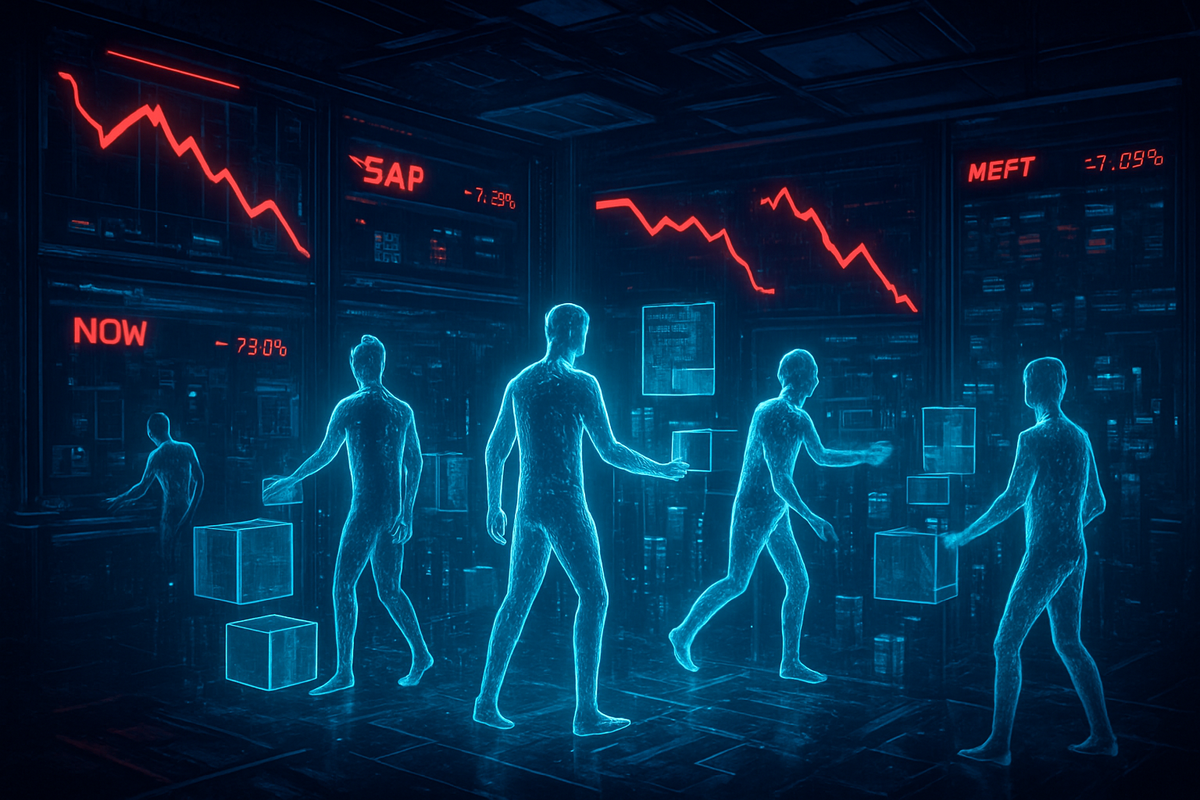
The B2B software sector, long the darling of Wall Street for its predictable, recurring revenue, has entered a period of existential volatility. In a staggering opening to the year, the broader software universe plummeted by more than 10% in January 2026, marking one of the most violent rotations in the history of the enterprise technology market. What began as a cautious reassessment of valuations quickly spiraled into a sector-wide correction as investors realized that the "AI tailwind" they had bet on was, for many legacy providers, actually a disruptive gale.
This "SaaSpocalypse," as market commentators have dubbed it, was catalyzed by a fundamental shift in investor sentiment from "AI as a feature" to "AI as a replacement." As evidence surfaced that autonomous AI agents are beginning to displace traditional human-centric software workflows, the premium once afforded to "Systems of Record" like Salesforce and ServiceNow has begun to evaporate. The immediate implication is clear: the era of growth through seat-based licensing is under direct threat, forcing a brutal repricing of the world’s largest software companies.
The January Rout: A Timeline of Disruption
The volatility reached a fever pitch during the final week of January 2026, punctuated by a disastrous trading session on January 29. On that day, ServiceNow (NYSE: NOW) reported fourth-quarter earnings that, while beating headline estimates, revealed a troubling deceleration in Remaining Performance Obligations (RPO). Shares of the IT service giant plummeted nearly 11% as management issued a conservative 2026 guidance, citing longer sales cycles as enterprises paused to evaluate "agentic" alternatives. This sentiment spread rapidly to Europe, where SAP (NYSE: SAP) saw its shares plunge 15% after missing cloud backlog targets, raising alarms that the multi-year ERP migration cycle was being disrupted by leaner, AI-native architectures.
The shockwaves culminated in the earnings report from Microsoft (NASDAQ: MSFT). Despite the company's dominance, Azure’s cloud growth decelerated more than the market had anticipated, and investors were particularly spooked by record-high capital expenditures—rumored to exceed $100 billion for the fiscal year—allocated to AI infrastructure. The market’s reaction was swift and unforgiving: Microsoft shares slid 10%, as the narrative shifted from "Azure is the AI winner" to "Azure is spending too much to keep up with the agentic shift."
By the time "Black Tuesday" arrived on February 3, 2026, the S&P North American Software Index had fallen 15% from its December highs. Key stakeholders, including major institutional funds like Vanguard and BlackRock, began a massive rotation out of application software and into hardware and energy. Analyst reports from firms like J.P. Morgan and Morgan Stanley confirmed the grim reality: the traditional "seat-count" model—where software companies charge per human user—was facing its first structural decline as AI agents began performing tasks that previously required dozens of human licenses.
Winners and Losers in the Agentic Shift
The primary victims of this January correction were the legacy SaaS giants that rely on massive human workforces to justify their software deployments. Salesforce (NYSE: CRM) saw its valuation slashed by nearly 30% as investors questioned whether its new "Agentforce" initiative could compensate for the loss of core seat-based revenue. Similarly, companies like Atlassian (NASDAQ: TEAM) and Monday.com (NASDAQ: MNDY) were hit hard after reports surfaced that enterprises were using autonomous "coding agents" like Cognition AI’s Devin and Cursor (Anysphere) to automate project management and development tasks, rendering traditional collaboration dashboards redundant.
Conversely, a new class of "Systems of Action" has emerged as the clear winners of this transition. Palantir Technologies (NYSE: PLTR) stood out as a beacon of resilience, with its stock outperforming the broader software index by 40% in the first two months of the year. Investors have flocked to Palantir’s Artificial Intelligence Platform (AIP), viewing it as a platform that facilitates autonomous execution rather than mere data entry. Oracle (NYSE: ORCL) also managed to weather the storm, largely due to its massive infrastructure partnerships with OpenAI and Anthropic, positioning itself as the "landlord" for the very agents that are disrupting its software peers.
The rotation has also benefited companies outside the traditional software silo. As "bits" became commoditized by AI, capital flowed into "atoms." Hardware providers like Micron (NASDAQ: MU) saw a surge in demand for high-speed memory needed to power agentic "swarms," while logistics giant FedEx (NYSE: FDX) hit all-time highs as investors sought refuge in companies with tangible physical assets and visible cash flows. Even utilities like NextEra Energy (NYSE: NEE) were re-rated as "AI plays" due to the immense power demands of the next-generation data centers required to run Claude and GPT-5 agents.
Broader Industry Trends and Historical Precedents
This event represents more than just a market dip; it signifies the end of the 20-year SaaS era. The trend is shifting toward "Outcome-Based Pricing," where software providers charge for the completion of a task (e.g., "closing a legal contract") rather than for access to a tool. This fits into a broader industry trend where the "UI" (User Interface) is becoming less relevant than the "API" (Application Programming Interface). When an AI agent from Anthropic or OpenAI can interact directly with a database, the need for a colorful, expensive dashboard—the bread and butter of traditional B2B software—simply disappears.
Historically, this parallels the transition from on-premise software to the Cloud in the late 2000s. Just as incumbents like Oracle and Microsoft had to cannibalize their lucrative maintenance fees to survive the cloud era, today’s giants must cannibalize their seat-based revenue to embrace an agentic future. However, the speed of the current disruption is unprecedented. While the cloud transition took a decade, the "agentic" transition appears to be happening in a matter of quarters, leaving little room for strategic pivots.
The regulatory implications are also beginning to surface. As AI agents start replacing thousands of administrative jobs, governments are eyeing "robot taxes" or stricter reporting requirements for AI-driven layoffs. This adds a layer of political risk to the software sector that was non-existent during the previous decade of growth. Competitors who do not have a clear "agent-first" strategy are findng themselves excluded from enterprise budgets as CTOs prioritize tools that can demonstrate immediate "headcount efficiency."
What Comes Next: The Strategic Pivot
In the short term, expect a wave of consolidation. Legacy software companies with deep pockets will likely go on a "defensive" M&A spree, attempting to acquire the very agentic startups that are threatening them. We may see companies like Workday (NASDAQ: WDAY) or Salesforce attempt to buy leaders in the autonomous agent space, such as Sierra or Glean, at massive premiums. However, the challenge remains whether these legacy platforms can successfully integrate autonomous agents without destroying their existing business models.
Over the long term, the B2B software sector will likely bifurcate. There will be "Intelligence Providers" who own the models and the compute infrastructure, and "Vertical Specialists" who own the proprietary data and the workflows. The middle-ground—horizontal software that provides generic tools for human users—is at risk of total commoditization. Companies will need to transition their pricing models toward "value-based" or "usage-based" metrics almost immediately to survive the continued contraction of human seat counts.
Market opportunities will emerge in the "Agent Orchestration" layer. As enterprises deploy hundreds of specialized AI agents, the new "Operating System" will be the platform that can manage, audit, and secure these autonomous workers. Companies that can provide transparency into what an AI agent is doing—and ensure it is doing it safely—will become the new pillars of the enterprise tech stack.
Summary and Investor Outlook
The 10% decline in the B2B software sector this January was a "shot across the bow" for the entire technology industry. It signaled that the market is no longer willing to pay a premium for "AI potential" and is now demanding "AI proof." The decline of giants like ServiceNow and SAP, contrasted with the resilience of Palantir and the infrastructure plays, highlights a permanent shift in how software is valued. The "SaaSpocalypse" has fundamentally changed the math for enterprise technology, moving the focus from human productivity to autonomous execution.
Moving forward, the market will likely remain volatile as companies report their first-quarter 2026 results. Investors should brace for further "seat-count" revisions and look closely at RPO growth figures. The "winners" of tomorrow will not be the companies with the most users, but the companies whose software can successfully "fire" its users by automating their functions.
Investors should keep a close eye on the "Agentic Premium"—the valuation gap between companies that are mere data repositories and those that are active "Systems of Action." The coming months will be a period of intense Darwinism in the software space; those who cannot adapt their pricing and product to the agentic reality risk becoming the next generation’s "legacy" providers.
This content is intended for informational purposes only and is not financial advice.