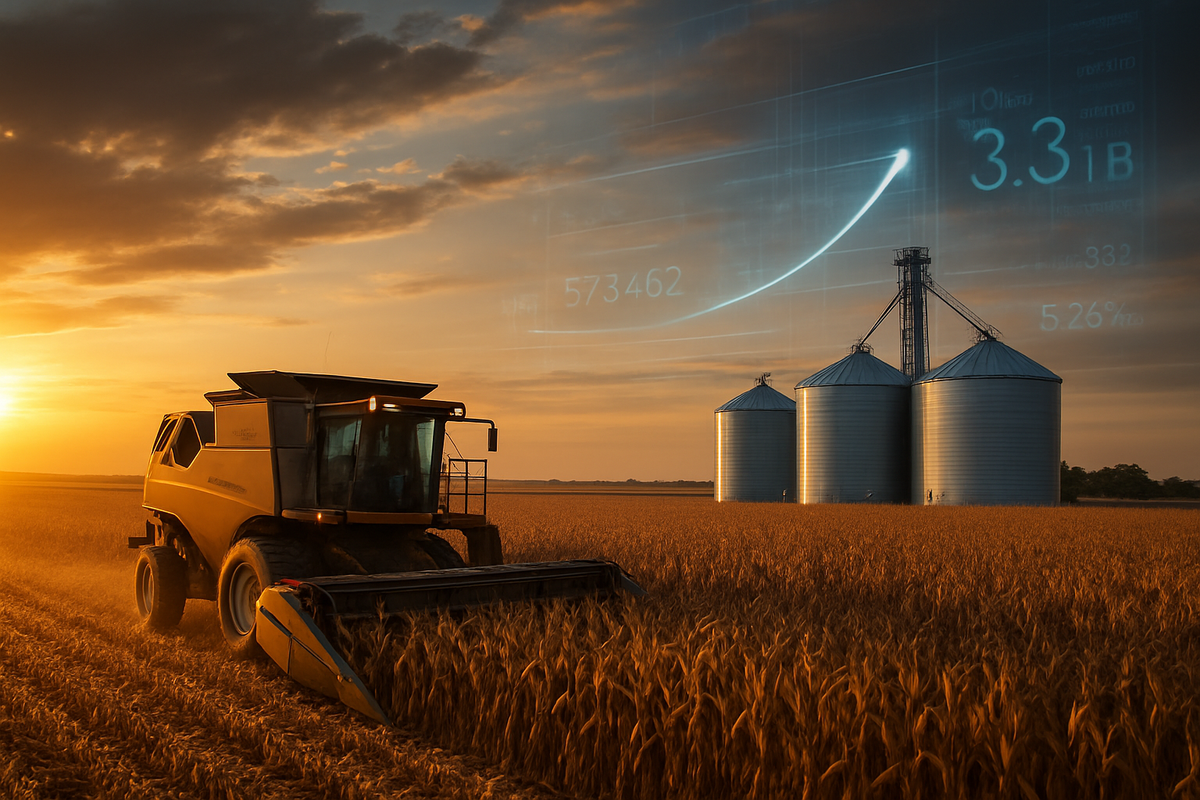
The February 2026 World Agricultural Supply and Demand Estimates (WASDE) report has sent a clear signal to global commodity markets: the world’s appetite for American corn is currently insatiable. Despite a staggering record harvest of 17.02 billion bushels, the U.S. Department of Agriculture (USDA) has significantly tightened the balance sheet, slashing projected ending stocks to 2.127 billion bushels. This downward revision, which caught many analysts by surprise, is fueled by an unprecedented spike in export demand, now forecasted at a record-breaking 3.3 billion bushels for the 2025/26 marketing year.
This "hungry world" narrative is fundamentally altering the price dynamics of the agricultural sector. Usually, a harvest of 17.02 billion bushels—bolstered by a record average yield of 186.5 bushels per acre—would lead to a supply glut and plummeting prices. However, the surge in international demand, coupled with steady domestic industrial use, has effectively established a firm price floor. As of late February 2026, the market is no longer asking how low prices can go under the weight of the harvest, but rather how high they must rise to ration a supply that is being liquidated at a historic pace.
The WASDE Shock: Breaking Down the Numbers
The February 10, 2026, WASDE report acted as a pivot point for the 2026 trading year. Entering the month, grain traders expected a comfortable cushion of supply, but the USDA’s 100-million-bushel cut to ending stocks shattered that complacency. The primary engine of this change is the export market. The revision to a 3.3 billion-bushel export forecast represents a massive logistical undertaking, reflecting a global recovery in livestock feed demand and strategic stockpiling by major importers in East Asia and North Africa.
The timeline leading to this moment began in the fall of 2025, when ideal weather conditions across the I-80 corridor led to the most productive harvest in American history. While initial market reactions in November and December focused on the sheer volume of grain, the narrative shifted in January 2026 as weekly export inspections began consistently exceeding trade expectations. By the time the February report was released, it was clear that the U.S. had become the "supplier of last resort" for a world facing production shortfalls in other key regions, including parts of South America and Eastern Europe.
Key stakeholders, from multinational grain merchants to family farms in the Corn Belt, are now navigating a "high-volume, high-stakes" environment. Market participants noted that the initial reaction to the report saw corn futures jump as the stocks-to-use ratio tightened significantly. This rally has been sustained through the second half of February, as the USDA maintained its season-average farm price at $4.10 per bushel, a figure that many now view as a conservative baseline rather than a ceiling.
Winners and Losers in the New Corn Economy
The most immediate beneficiaries of this high-volume environment are the global grain integrators. Archer-Daniels-Midland (NYSE: ADM) and Bunge Global (NYSE: BG) are positioned to thrive as they manage the logistics of moving a record 3.3 billion bushels of exports. Their vast networks of river terminals and export elevators are operating at near-total capacity, generating significant handling and merchandising margins. Similarly, The Andersons (NASDAQ: ANDE) stands to gain from both increased grain merchanting and its significant footprint in the domestic ethanol and fertilizer sectors.
On the equipment and technology side, Deere & Company (NYSE: DE) and Corteva (NYSE: CTVA) are seeing the fruits of a high-yield era. The 186.5 bushels-per-acre record is a testament to the precision agriculture and seed technology provided by these firms. While high production often pressures farmer income, the "export floor" on prices ensures that growers remain profitable enough to continue investing in high-end machinery and premium genetics for the 2026 planting season.
However, the outlook is more nuanced for the energy and refining sector. Pure-play ethanol producers like Green Plains (NASDAQ: GPRE) are caught in a tug-of-war. While high corn availability is a plus, the "hungry world" narrative keeps input costs higher than they would be in a typical "glut" year. Furthermore, petroleum refiners such as Valero Energy (NYSE: VLO) and PBF Energy (NYSE: PBF) are closely monitoring the situation, as the cost of Renewable Identification Numbers (RINs) and blending mandates are sensitive to the volatile corn-to-ethanol price spread.
E15 Debates and Global Ripple Effects
A critical domestic factor influencing the corn market is the ongoing debate over year-round E15 (15% ethanol blend) sales. As of late February 2026, a specialized congressional task force has missed its February 15 deadline to deliver a permanent legislative solution for year-round E15. This delay has created a "demand shadow" over the market. If year-round sales are codified into law before the summer driving season begins on June 1, it could add an additional 200 to 300 million bushels of domestic demand, further tightening the ending stocks that the USDA already slashed.
This domestic policy tension is playing out against a backdrop of global food security concerns. The record 3.3 billion bushels in exports highlights a shifting geopolitical landscape where the U.S. is increasingly relied upon to offset climate-related crop failures elsewhere. This trend mirrors the "Great Grain Robbery" of the 1970s, though today’s market is characterized by diversified global buyers rather than a single large purchaser. The regulatory pressure on carbon intensity is also beginning to bifurcate the market, with "low-carbon" corn intended for Sustainable Aviation Fuel (SAF) starting to command a premium over standard export grades.
Historically, a 17-billion-bushel harvest would have been a "death knell" for prices. The fact that the market is holding firm in February 2026 suggests a structural change in global demand. The "Hungry World" is not just a catchphrase; it is a fundamental shift where the industrial and international utility of corn has finally caught up to the incredible productivity of the American farmer.
The Path to the 2026 Planting Season
As the market looks toward the spring of 2026, the focus is shifting from the 2025 bin-busting harvest to the upcoming planting intentions. With ending stocks revised downward to 2.127 billion bushels, the "safety margin" for the 2026 crop has narrowed. Any significant weather disruption during the 2026 planting window in April and May could trigger a violent upward price correction, as there is now less of a buffer than previously thought.
Strategic pivots are already underway. Farmers are likely to maintain high corn acreage in 2026, potentially at the expense of soybeans, given the strong export signals. For investors, the opportunity lies in the intersection of ag-tech and logistics. Companies that can maximize yield while minimizing the carbon footprint of the grain will be the long-term winners in a market that is increasingly valuing "sustainability" alongside "volume." The short-term challenge remains the E15 legislative bottleneck, which remains the single largest "wild card" for domestic price discovery.
Summary and Investor Outlook
The February 2026 USDA WASDE report has redefined the 2025/26 marketing year. By slashing ending stocks to 2.127 billion bushels in the face of a record 17.02 billion-bushel harvest, the USDA has validated the "hungry world" narrative. Record exports of 3.3 billion bushels are providing a robust price floor that is shielding the market from the traditional bearishness associated with oversupply.
Moving forward, the market will be hyper-sensitive to two factors: the resolution of the E15 year-round sales debate and the early weather patterns for the 2026 planting season. Investors should keep a close eye on the weekly export sales reports; if the current pace continues, the USDA may be forced to lower ending stocks even further in the March and April reports. For now, the agricultural sector is proving that in a world of growing populations and industrial needs, there is no such thing as "too much corn."
This content is intended for informational purposes only and is not financial advice.