In a move that fundamentally reshapes the balance of power in the semiconductor industry, Advanced Micro Devices, Inc. (Nasdaq: AMD) and Meta Platforms, Inc. (Nasdaq: META) have announced a staggering multi-year agreement valued at upwards of $60 billion. The deal centers on the deployment of a massive 6-gigawatt (6GW) AI infrastructure powered by a custom variant of AMD’s next-generation Instinct MI450-based GPUs. Announced earlier this week on February 24, 2026, the partnership represents the largest single hardware procurement in the history of the "Magnificent Seven" tech giants, positioning AMD as a formidable and structural alternative to current market leader NVIDIA Corporation (Nasdaq: NVDA).
The immediate implications of this alliance are profound, signaling that the "AI arms race" has entered a new phase defined by unprecedented scale and energy consumption. By securing 6GW of compute capacity—enough to power millions of homes—Meta is signaling its intent to dominate the nascent field of "Personal Superintelligence." For AMD, the deal provides not only a massive revenue floor but also a validation of its high-end silicon roadmap, effectively breaking the near-monopoly previously held by Nvidia in the hyperscale AI training and inference markets.
The Mechanics of a $60 Billion Strategic Alliance
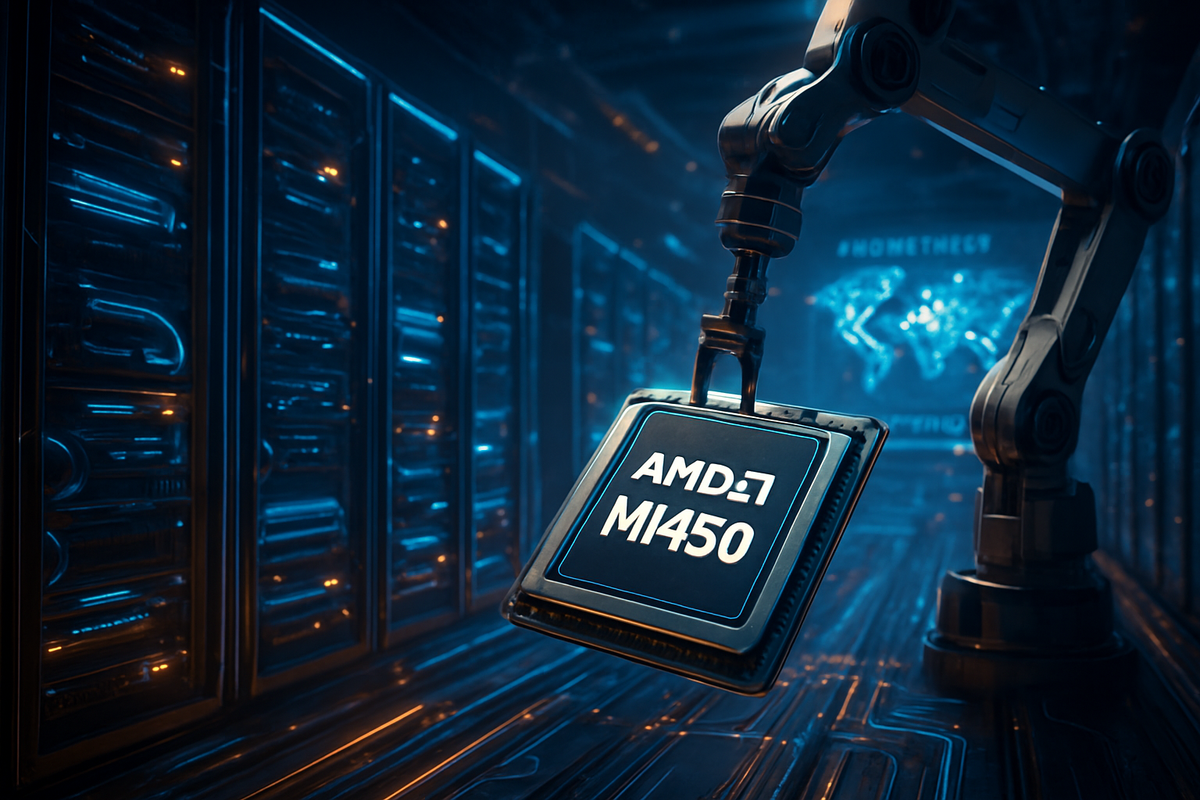
The partnership, which began taking shape in late 2025 following a similar but smaller pact between AMD and OpenAI, is built on a "multi-generational" commitment. At its core is the AMD Instinct MI450, a GPU built on the new CDNA 5 architecture and manufactured using the 2nm-class node from Taiwan Semiconductor Manufacturing Company Limited (NYSE: TSM). This custom silicon is designed specifically for Meta’s Llama-5 and future Llama-6 models, featuring a massive 432GB of HBM4 memory and delivering nearly 40 PFLOPs of FP4 compute performance—double the capability of the previous MI350 generation.
Beyond the hardware, the financial structure of the deal is equally historic. To align interests, AMD has issued Meta performance-based warrants to acquire up to 160 million shares of AMD stock (representing roughly 10% of the company). These warrants vest as Meta takes delivery of the hardware, with the first tranche scheduled for late 2026 when the first gigawatt of capacity goes online. This equity-linked structure ensures that Meta is not just a customer but a primary stakeholder in AMD’s continued innovation and stock performance, which has recently trended toward the $600 mark.
Initial industry reaction has been electric. Analysts from major Wall Street firms have noted that this deal effectively "de-risks" AMD’s long-term growth trajectory. The deployment will utilize the newly unveiled "Helios" rack-scale architecture, an Open Compute Project (OCP) standard that integrates 72 MI450 GPUs per rack. This standardized approach allows Meta to rapidly scale its "Prometheus" and "Hyperion" data center campuses in Ohio and beyond, which are being constructed specifically to house these high-density, 2,000-watt processors.
Market Implications: A New Era of Competition and Silicon Sovereignty
The clear winner in this transaction is AMD, which has successfully transitioned from a "budget alternative" to a co-engineering partner for the world’s largest AI workloads. By securing such a massive share of Meta’s projected $115 billion to $135 billion capital expenditure budget for 2026, AMD has proven it can compete at the highest tier of the data center market. The inclusion of its 6th Gen EPYC "Venice" CPUs as part of the total infrastructure package further cements AMD’s role as a full-stack provider of AI compute.
For Meta, the victory lies in "silicon sovereignty" and cost optimization. While Meta continues to utilize Nvidia’s Blackwell and Rubin architectures for heavy-duty training, the 6GW deal with AMD provides a critical hedge against supply chain bottlenecks and high margins associated with a single-vendor strategy. Furthermore, the custom MI450 allows Meta to optimize for its specific agentic AI workloads, potentially achieving higher efficiency and lower total cost of ownership (TCO) compared to off-the-shelf solutions.
NVIDIA Corporation (Nasdaq: NVDA), while still the undisputed leader in AI training, faces a new reality where its largest customers are actively financing its primary competitor’s R&D through massive multi-year commitments. While Nvidia’s roadmap remains aggressive, the AMD-Meta deal suggests that the market is shifting toward a multi-vendor environment where hyperscalers demand more influence over silicon design. Meanwhile, TSMC continues to benefit as the sole foundry capable of producing the advanced 2nm nodes required for both companies' high-end chips.
The Shift Toward Multi-Gigawatt Computing and Custom Silicon
This event marks a significant departure from how AI infrastructure has historically been measured. The industry is moving away from counting "thousands of chips" toward "gigawatts of power." A 6GW commitment is a geopolitical-scale event, requiring Meta to work directly with energy providers and governments to secure the necessary power grid capacity. This highlights a broader trend where energy availability, rather than just chip production, has become the primary bottleneck for AI expansion.
Furthermore, the deal exemplifies the trend of "co-designed silicon." The MI450 variant for Meta is not a generic product; it is a bespoke version of the CDNA 5 architecture tailored to Meta's internal networking protocols and memory requirements. This level of collaboration suggests that the future of the semiconductor industry lies in deep partnerships rather than transactional sales. We are seeing a repeat of the "custom silicon" trend that began with internal ASICs like Meta’s MTIA, but now applied to the high-performance GPU space.
The regulatory implications are also coming into focus. With Meta effectively owning a 10% stake in its primary chip supplier, antitrust regulators may begin to scrutinize the vertical integration occurring within the AI supply chain. However, for now, the primary concern for policymakers is ensuring that the massive power demands of 6GW AI campuses do not destabilize local energy grids, leading to a new wave of policy debates around "AI zones" and energy priority.
Roadmap to 2027: What Lies Ahead for the AI Arms Race
As we look toward the second half of 2026, the focus will shift from the announcement to execution. AMD must prove it can meet the aggressive delivery milestones required to vest Meta’s stock warrants. If the H2 2026 rollout of the MI450 is successful, it is highly likely that other hyperscalers, such as Microsoft Corporation (Nasdaq: MSFT) or Alphabet Inc. (Nasdaq: GOOGL), will pursue similar custom-silicon partnerships with AMD to balance their own dependencies on Nvidia.
The short-term challenge for both companies will be managing the sheer physical scale of the deployment. Building 6GW of capacity requires an unprecedented logistical effort involving liquid cooling systems, advanced power distribution, and the manufacturing of millions of HBM4 memory modules. Any delay in the 2nm ramp-up at TSMC or issues with the new CDNA 5 architecture could result in significant market volatility for both AMD and Meta.
In the long term, this deal sets the stage for the next generation of AI hardware—the MI500 series—already rumored for a 2027 release. This future silicon is expected to focus even more heavily on "agentic" AI, where models act as autonomous assistants rather than just text generators. The success of the current 6GW deal will determine whether the "Personal Superintelligence" Meta envisions becomes a reality or if the industry will face a "compute bubble" as energy and infrastructure costs continue to escalate.
Final Analysis: A Watershed Moment for the Semiconductor Industry
The $60 billion, 6GW agreement between AMD and Meta is more than just a large purchase order; it is a declaration of independence for the world’s largest AI consumers. It solidifies AMD’s position as a structural pillar of the global AI infrastructure and proves that the market is large enough—and the demand for innovation high enough—to support multiple titan-class chip designers. The era of Nvidia’s total dominance is evolving into a more complex, multi-polar ecosystem.
For investors, the key takeaways are twofold. First, the metric of success in the AI sector is shifting toward "power-secured capacity" and "custom-silicon partnerships." Second, the equity-linked nature of this deal suggests that the largest tech companies are willing to bet their own balance sheets on the success of their hardware partners. In the coming months, watchers should keep a close eye on AMD’s production yields at the 2nm node and Meta’s progress in bringing its "Prometheus" data centers online.
As the first gigawatt of MI450 power prepares to fire up in late 2026, the industry stands at a threshold. The partnership between AMD and Meta has not only raised the stakes for AI competition but has also provided a blueprint for how the next decade of computing will be built: through massive scale, deep integration, and an insatiable hunger for power.
This content is intended for informational purposes only and is not financial advice.