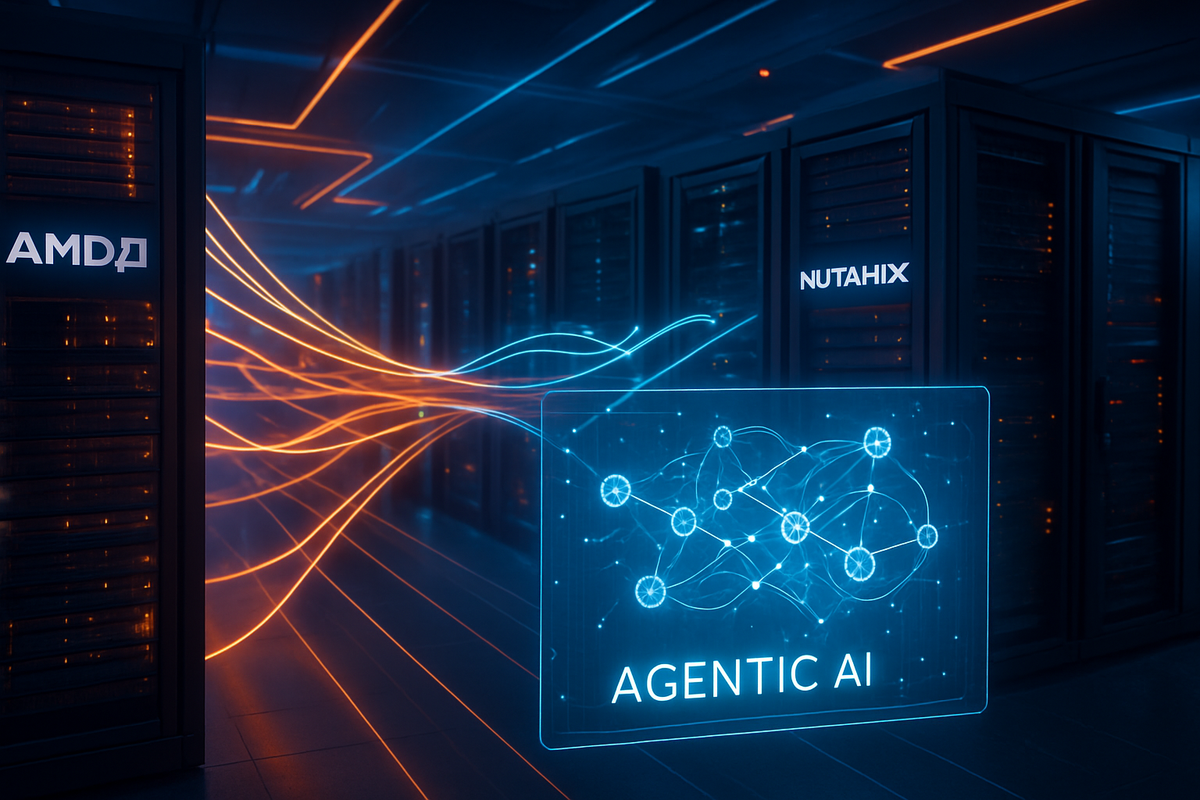
In a move designed to break the stranglehold of vertically integrated AI stacks, Advanced Micro Devices, Inc. (NASDAQ: AMD) and Nutanix (NASDAQ: NTNX) have announced a landmark $250 million strategic partnership. The collaboration aims to deliver a production-ready, "open" enterprise AI platform specifically optimized for agentic AI—autonomous systems capable of executing complex, multi-step workflows. This aggressive maneuver signals a shift in the AI arms race, moving beyond raw compute power toward integrated software-and-hardware ecosystems that prioritize flexibility and cost-efficiency for the enterprise.
The deal, unveiled alongside Nutanix’s impressive second-quarter fiscal 2026 earnings, features a multi-layered financial commitment. AMD will make a $150 million direct equity investment in Nutanix common stock at a price of $36.26 per share, signaling deep institutional confidence in Nutanix’s hybrid cloud leadership. Supplementing this is a $100 million joint research and development (R&D) and go-to-market (GTM) fund. Together, the two tech giants intend to provide a high-performance alternative to the "closed" ecosystems currently dominated by industry titans like NVIDIA, offering businesses a path to AI deployment without the risk of long-term vendor lock-in.
A Blue-Chip Bet on Open Infrastructure
The partnership is structured to ensure that AMD’s hardware and Nutanix’s software are essentially "bolted together" at the engineering level. Of the $250 million total, the $150 million equity stake represents a roughly 1% dilution for Nutanix shareholders, but it secures AMD a seat at the table during the next phase of enterprise cloud evolution. The investment is expected to close in the second quarter of 2026. Meanwhile, the $100 million R&D commitment will focus on optimizing the Nutanix Cloud Platform and Nutanix Kubernetes Platform for AMD’s EPYC CPUs and Instinct GPUs.
The technical core of the agreement is the integration of the AMD ROCm™ software stack and AMD Enterprise AI software directly into the Nutanix environment. This eliminates the "software gap" that has historically hindered AMD’s ability to compete with NVIDIA’s CUDA ecosystem. By making AMD hardware "plug-and-play" within the Nutanix management layer—which is already used by thousands of global enterprises—the duo hopes to capture the burgeoning market for on-premises AI inference. Industry reaction has been swift, with analysts noting that the timing of the announcement—coming just 24 hours after AMD’s reported $100 billion GPU deal with Meta Platforms (NASDAQ: META)—suggests a coordinated blitz by AMD to dominate both the hyperscale and enterprise sectors.
Identifying the Beneficiaries and the Disrupted
Nutanix (NASDAQ: NTNX) stands as the clearest immediate winner. The $150 million injection and the technical endorsement from AMD provide the company with significant ammunition to defend its turf against Broadcom (NASDAQ: AVGO), which has faced customer pushback following its acquisition of VMware. For AMD (NASDAQ: AMD), the partnership provides a guaranteed software vehicle for its Instinct MI350 and MI400 series GPUs, ensuring that its hardware isn't just powerful on paper but accessible in practice for the average Fortune 500 IT department. Enterprise customers also win, as the "open" nature of the platform allows them to swap models and hardware more freely, potentially driving down the total cost of ownership for AI projects.
On the other side of the ledger, NVIDIA (NASDAQ: NVDA) faces its first truly organized challenge to its full-stack hegemony. While NVIDIA remains the gold standard for AI training, the AMD-Nutanix alliance targets the "inference" market—where AI models are actually put to work. If successful, this partnership could siphon off enterprise budgets that were previously earmarked for NVIDIA’s proprietary DGX systems. Furthermore, Broadcom’s VMware division may find itself under renewed pressure as Nutanix cements its status as the preferred "AI-ready" private cloud alternative.
The Shift Toward Agentic AI and Open Ecosystems
This event marks a critical turning point in the broader AI industry trend: the transition from "Chatbot AI" to "Agentic AI." While early AI implementations focused on generating text or images, agentic AI refers to autonomous agents that can use tools, access databases, and make decisions to complete business processes. These workloads require a sophisticated orchestration layer that can manage data across hybrid environments—a specialty of Nutanix. By building a "full-stack agentic AI infrastructure," AMD and Nutanix are betting that the future of business isn't just about large language models (LLMs), but about the autonomous systems that run on them.
The move also highlights a growing industry backlash against proprietary "black box" solutions. Much like the rise of Linux challenged proprietary Unix systems in the 1990s, the AMD-Nutanix "open stack" is being positioned as a democratic alternative to the high-margin, restricted-access models of the early AI boom. This strategy mirrors historical precedents where hardware-software alliances—like the "Wintel" (Windows and Intel) partnership of the PC era—defined the dominant architecture of the day. AMD and Nutanix are essentially attempting to create the "Wintel" of the AI era, but with an emphasis on open-source compatibility.
Roadmap to 2027: Integration and Implementation
Looking ahead, the short-term focus will be on the closing of the equity deal in Q2 2026 and the initial engineering sprints required to marry the ROCm software stack with Nutanix’s hyperconverged infrastructure. The companies have stated that the first jointly developed "Agentic AI" platforms are expected to hit the market in late 2026. This timeline suggests that while the strategic impact is immediate, the financial impact on revenue won't be fully realized until fiscal year 2027.
For investors, the primary challenge will be monitoring the speed of adoption. AMD must prove that its software integration can truly match the ease of use provided by NVIDIA, while Nutanix must demonstrate that its platform can handle the massive power and cooling demands of high-end AI clusters. If the duo can successfully onboard early adopters in the financial services and healthcare sectors—industries with high security needs and a preference for on-premises control—the partnership could serve as a blueprint for a series of similar "anti-lock-in" alliances across the tech sector.
Assessing the Long-Term Market Impact
The $250 million partnership between AMD and Nutanix is more than just a financial transaction; it is a strategic declaration of independence for the enterprise AI market. By combining AMD’s hardware prowess with Nutanix’s software agility, the two companies are providing a credible roadmap for businesses that want to participate in the AI revolution without surrendering their autonomy to a single provider. The focus on agentic AI demonstrates a forward-thinking approach that looks past today’s generative AI hype toward the practical, autonomous workflows of tomorrow.
As the market moves forward, investors should keep a close eye on the Q2 2026 deal closure and subsequent "early access" performance benchmarks of the integrated stack. The ultimate success of this venture will depend on whether the "open" message resonates with CIOs who are increasingly weary of escalating licensing costs and proprietary constraints. If AMD and Nutanix can deliver on their promise of a full-stack, open alternative, the landscape of enterprise computing may be permanently reshaped, ending the era of the AI monolith.
This content is intended for informational purposes only and is not financial advice