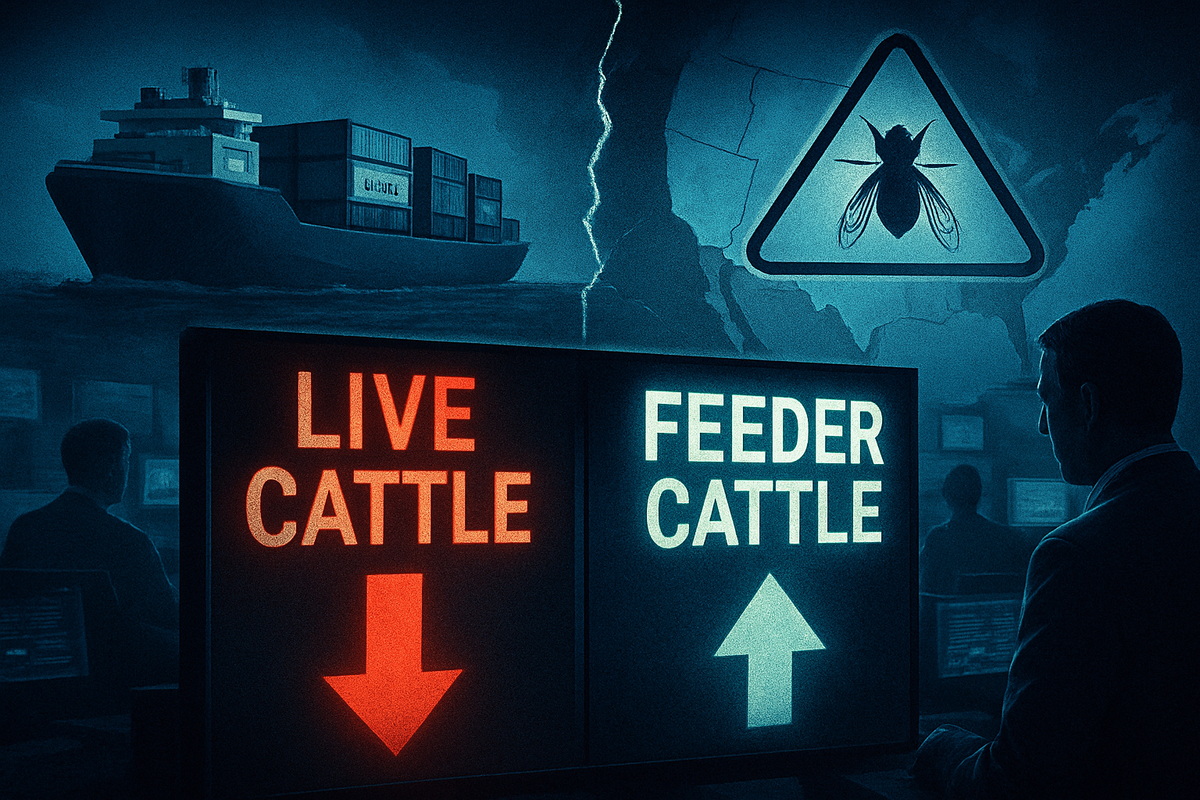
The domestic livestock market is grappling with a "perfect storm" of geopolitical and biological disruptions this February, leading to extreme volatility in live cattle futures. In a move aimed at curbing rampant grocery inflation, President Trump recently announced that beef import quotas from Argentina would double, effective immediately. The news sent shockwaves through the Chicago Mercantile Exchange, where live cattle futures experienced a sharp and sudden decline as traders braced for an influx of cheaper foreign supply.
The market’s anxiety is being further compounded by a dire biosecurity threat emerging from the south. The USDA’s Animal and Plant Health Inspection Service (APHIS) recently confirmed new cases of the New World screwworm in Tamaulipas, Mexico, a critical region for cattle trade. This biological threat has led to a total cessation of live cattle imports across the southern border, creating a paradoxical scenario where the market is simultaneously fearing a glut of imported processed beef and a severe shortage of live feeder cattle.
The volatility began in earnest on February 6, 2026, when the White House issued an executive order to double the existing tariff-rate quota (TRQ) for Argentine beef. This policy shift is a direct response to ground beef prices, which reached a staggering average of $6.69 per pound in late 2025. By increasing the quota for lean beef trimmings—essential for the production of domestic ground beef—the administration hopes to flood the market with lower-cost alternatives to ease the burden on American consumers.
However, the supply side of the equation was hit by a second blow just days later. APHIS confirmed 11 active cases of the flesh-eating New World screwworm in Tamaulipas, Mexico, with some detections occurring within 200 miles of the Texas border. In response, the U.S. government has indefinitely suspended all live cattle imports from Mexico to prevent the parasite from devastating the U.S. national herd. This move effectively removes an estimated 1.2 million head of feeder cattle from the annual supply chain, sending the CME Feeder Cattle Index to record highs near $377.37/cwt, even as live cattle futures for near-term delivery faced downward pressure from the Argentina announcement.
The divergence in the market has created a complex landscape for the "Big Four" meat processors. Tyson Foods, Inc. (NYSE: TSN) has found itself in a particularly precarious position; the company reported a $319 million operating loss in its beef division for the first quarter of 2026. The high cost of domestic cattle, coupled with the closure of its Lexington, Nebraska plant, has squeezed margins to the breaking point. While the influx of Argentine beef might offer some relief in procurement costs for ground beef production, it does little to offset the lack of domestic throughput.
Similarly, JBS S.A. (OTCMKTS: JBSAY) has reported losses nearing $293 million in its North American operations. The company is currently navigating a dual-fronted challenge: a DOJ antitrust probe into pricing practices and a shrinking supply of slaughter-ready cattle. Conversely, Hormel Foods Corporation (NYSE: HRL) has seen its stock remain relatively resilient, rising approximately 3% this month. Hormel’s focus on "branded stability" and value-added products has allowed it to pass higher costs to consumers more effectively than pure-play processors. Meanwhile, Marfrig Global Foods S.A. (OTCMKTS: MRRTY) may find an advantage in the current climate, as its significant operations in South America position it to benefit directly from the expanded Argentine export quotas.
This period of volatility highlights a significant shift in U.S. agricultural policy and consumer behavior. For years, the U.S. has maintained strict quotas to protect domestic producers, but the current administration’s pivot toward prioritizing retail price relief marks a potential turning point in trade relations. Historically, such quota increases are rare and usually met with fierce opposition from domestic ranching groups, who argue that the long-term damage to the U.S. cattle cycle outweighs short-term consumer savings.
Furthermore, the screwworm outbreak in Mexico serves as a grim reminder of the vulnerability of the global food supply chain. A similar outbreak in the mid-20th century cost the U.S. livestock industry billions of dollars before it was eradicated. The current sterile fly buffer zone—releasing 100 million sterile flies per week—is a desperate attempt to avoid a repeat of that history. Despite these supply-side nightmares and the resulting record-high retail prices, U.S. consumer demand remains bafflingly strong. The USDA now forecasts that beef consumption will actually grow to 59.5 pounds per person in 2026, up from 59.2 pounds in 2025, suggesting that beef remains a staple that Americans are unwilling to trade away, regardless of the cost.
Looking ahead, the livestock market must navigate a narrow path between biological risks and shifting trade winds. In the short term, the market will likely remain in a state of high-intensity fluctuation as traders digest weekly APHIS reports from the Mexican border. If the screwworm is detected on U.S. soil, we could see a complete freeze on domestic cattle movement, which would send prices for both producers and consumers into uncharted territory.
In the longer term, the doubling of Argentine quotas may be the first of several "emergency" trade measures. If retail prices do not stabilize by the second half of 2026, the administration may look to other major producers like Brazil or Uruguay for similar quota expansions. Strategic pivots are already underway among the major packers, who are increasingly looking toward automation and diversified protein sources (such as poultry and pork) to hedge against the volatility and high labor costs associated with the shrinking U.S. beef herd.
The current state of the livestock market is a study in contradictions. On one hand, we see a government aggressively expanding imports to lower prices; on the other, a biosecurity crisis is choking off the supply of the very cattle needed to sustain domestic production. The result is a market where futures are erratic, and the financial health of industry giants like Tyson Foods and JBS is under severe strain.
Investors should closely monitor the quarterly tranches of Argentine beef as they hit the market, as well as the "Cattle on Feed" reports which will indicate how quickly the domestic herd is contracting. Most importantly, the success or failure of the APHIS "sterile fly" buffer in Mexico will be the ultimate pivot point for the market in 2026. If the screwworm stays south of the border, the market may find a floor; if it crosses, the current volatility is only the beginning.
This content is intended for informational purposes only and is not financial advice.