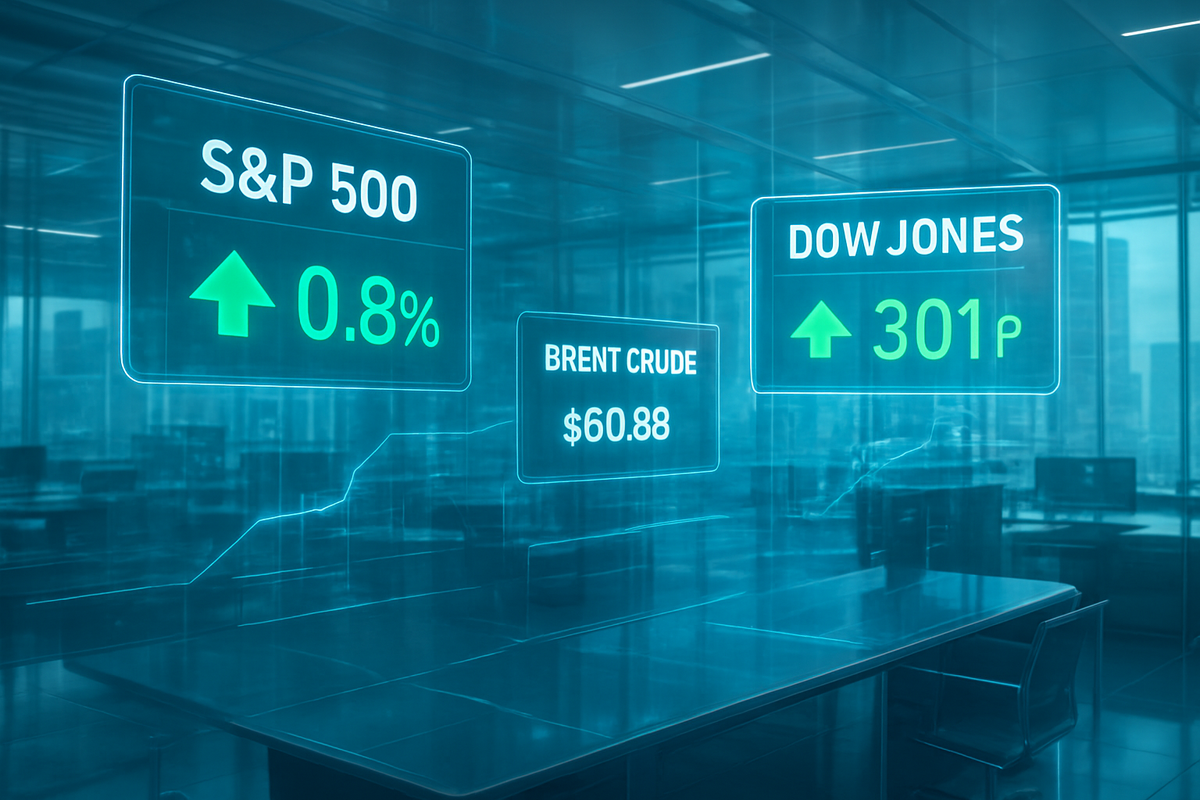
Wall Street staged a decisive comeback on Wednesday, March 4, 2026, as investors shook off a two-day rout that had rattled global markets. The S&P 500 (NYSEARCA:VOO) climbed 0.8%, while the Dow Jones Industrial Average (INDEXDJX:.DJI) surged by 301 points, marking a significant reversal of the downward momentum that dominated the start of the week.
The rebound was largely fueled by a cooling in the energy sector and a suite of domestic economic reports that suggested the U.S. consumer remains on solid ground despite a backdrop of geopolitical tension. Brent crude oil, which had briefly spiked toward $83 earlier in the week due to friction in the Middle East, eased back to approximately $80.88 per barrel. This minor relief in energy costs provided the necessary breathing room for equity markets to pivot back toward growth.
Relief After a Stormy Start to March
The gains on Wednesday followed 48 hours of "punishing swings" that saw the Dow shed nearly 700 points between Monday and Tuesday. This volatility was primarily driven by fears that a prolonged spike in oil prices would force the Federal Reserve to keep interest rates in their current 3.50%–3.75% range for longer than anticipated. However, by Wednesday morning, a stabilizing oil market and encouraging labor data helped recalibrate investor expectations. The shift in sentiment was palpable as trading floors moved from defensive posturing to selective buying in oversold sectors.
The timeline leading to this rebound is rooted in a volatile early 2026. The market has been navigating the aftermath of a 43-day federal government shutdown that occurred in late 2025, which had initially clouded economic visibility for the first quarter of the new year. As federal agencies resumed full operations and deferred spending finally hit the economy, today's data suggested a "V-shaped" recovery in business activity. Stakeholders, ranging from institutional asset managers to retail investors, have been closely watching the $80-per-barrel mark for Brent crude as a psychological threshold for market stability.
Initial reactions from the trading floor were cautiously optimistic. Analysts noted that the "low-hire, low-fire" equilibrium of the current labor market—with unemployment holding steady at 4.4%—has created a floor for consumer spending. While hiring has slowed to its lowest non-recession pace on record, the absence of mass layoffs has prevented a broader economic contraction, allowing the market to recover quickly once immediate catalysts like the oil spike began to fade.
Winners and Losers: Transport and Tech Lead the Charge
The most immediate beneficiaries of the easing oil prices were the major carriers and transportation giants. Delta Air Lines (NYSE: DAL) and United Airlines (NASDAQ: UAL) both saw gains of over 2.5% on the day, as lower jet fuel costs directly impact their bottom-line projections for the busy spring travel season. Similarly, logistics behemoths like United Parcel Service (NYSE: UPS) found favor with investors who had previously feared that sustained $80+ oil would eat into profit margins and force further surcharges on consumers.
In the technology sector, the "AI-driven supercycle" showed signs of renewed life after a week of skepticism. Apple Inc. (NASDAQ: AAPL) and Microsoft Corp. (NASDAQ: MSFT) both ended the day in the green, providing the heavy-lifting required to pull the S&P 500 upward. Investors appear to be rotating back into large-cap tech as a "safe haven" of sorts, banking on the massive cash reserves of these companies to weather any further macroeconomic turbulence. Nvidia Corp. (NASDAQ: NVDA) also saw a modest bounce as fears regarding supply chain disruptions in the Middle East marginally subsided.
Conversely, the energy sector faced a slight cooling period. Exxon Mobil (NYSE: XOM) and Chevron (NYSE: CVX) traded lower or flat as the risk premium associated with the Strait of Hormuz conflict began to settle. While these companies remain highly profitable at $80 oil, the momentum shifted away from "inflation hedges" and back toward cyclical growth. Retailers like Walmart (NYSE: WMT) and Amazon (NASDAQ: AMZN) also saw a boost, benefiting from the dual tailwinds of lower potential delivery costs and a consumer base that feels slightly less pinched at the gas pump.
Navigating the 'Higher-for-Longer' Reality
The significance of today's rebound lies in its demonstration of market resilience in a high-interest-rate environment. With the Federal Reserve maintaining a "cautious maintenance" stance, the 3.50%–3.75% federal funds rate represents a significant departure from the near-zero rates of the previous decade. Today’s rally suggests that the market has finally begun to decouple from "Fed dependency," focusing instead on organic earnings growth and industrial productivity rather than just the prospect of rate cuts.
This event fits into a broader trend of "geopolitical normalization" where markets learn to price in conflict risk without entering a state of permanent panic. The historical precedent of the 1970s oil shocks often haunts modern investors, but the 2026 market is vastly different, supported by a diverse energy mix and a tech-heavy economy that is less sensitive to raw energy inputs than in decades past. Furthermore, the resilience shown today helps mitigate fears that the late-2025 government shutdown caused permanent structural damage to the U.S. GDP.
However, regulatory and policy implications remain on the horizon. The reinstated "Section 122" tariffs continue to put upward pressure on shipping costs, meaning the Fed's battle with "sticky" inflation is far from over. Headline PCE inflation is still averaging 2.7%, well above the 2% target. Analysts warn that while the market is celebrating a return to $80 oil, any further escalation in the Middle East could quickly undo today’s gains and bring the $100-per-barrel scenario back to the forefront of the conversation.
The Road to the March FOMC Meeting
As the dust settles on today's session, all eyes turn toward the upcoming Federal Open Market Committee (FOMC) meeting scheduled for March 17–18. While a rate hike is virtually off the table, the market is looking for signals that a rate cut might finally be on the horizon for June 2026. The short-term outlook remains a "wait-and-see" game, with volatility expected to persist as new inflation and jobs data trickle in over the next fortnight.
Strategic pivots may be required for investors who have been overweight in energy or defensive havens like gold. If the current stabilization holds, we could see a continued rotation into small-cap stocks, which have already begun to outperform large-caps in early 2026. However, the potential for a "bull trap" remains if oil prices reverse course. Market participants must remain agile, balancing the optimism of a rebounding GDP with the reality of a geopolitical landscape that remains highly unpredictable.
The next few months will likely see the emergence of "quality" as the primary investment theme. Companies with low debt-to-equity ratios and high pricing power will be best positioned to handle the 4.2%–4.3% yields on the 10-year Treasury. As the AI hype cycle matures into a phase of actual implementation and profitability, the "winners" of 2026 will be those that can prove they are using technology to drive efficiency in a high-cost world.
A Fragile but Formidable Recovery
Today’s 301-point climb for the Dow and the 0.8% rise in the S&P 500 offer a much-needed reprieve for investors who had begun to fear the worst. The move back toward $80.88 for Brent crude acted as the primary catalyst, proving once again that energy prices remain the most influential "swing factor" for global market sentiment. While the volatility of the past two days was punishing, the speed of the recovery speaks to the underlying strength of the 2026 economy.
Moving forward, the market appears to be in a state of fragile equilibrium. Investors have shown they are willing to buy the dip, but their confidence is closely tied to the Federal Reserve's ability to navigate a "soft landing" amidst geopolitical storms. The key takeaway from today is that while risks are abundant—ranging from tariffs to Middle Eastern tensions—the U.S. market continues to find reasons for optimism in the face of adversity.
In the coming months, investors should watch for two major indicators: the stability of the Strait of Hormuz and the "stickiness" of service-sector inflation. If oil can remain below $85 and the labor market avoids a sharp downturn, the March 4 rebound may be remembered as the moment Wall Street reclaimed its footing in a year defined by transition.
This content is intended for informational purposes only and is not financial advice.