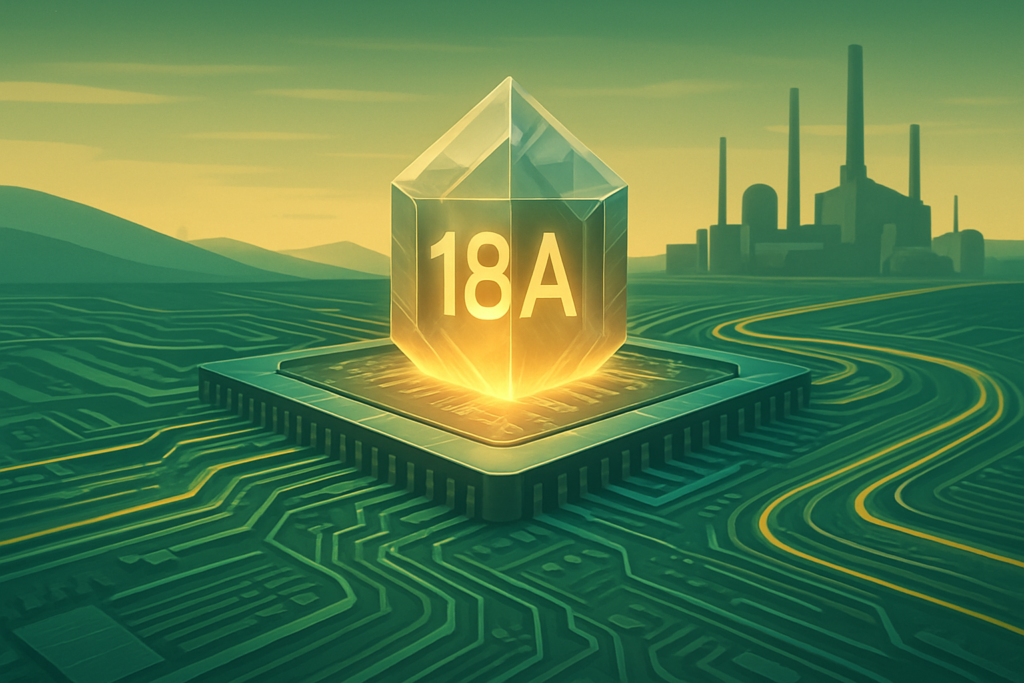
As of January 1, 2026, Intel Corporation (NASDAQ: INTC) stands at the most critical juncture in its 58-year history. Once the undisputed king of the semiconductor world, the Silicon Valley giant spent the early 2020s in a high-stakes battle for relevance, nearly succumbing to manufacturing delays and the rise of fabless competitors. However, following a dramatic leadership change and a fundamental restructuring in 2025, Intel has emerged as the "National Champion" of the Western semiconductor industry. With its revolutionary Intel 18A process now in high-volume manufacturing and a strategic pivot toward the AI PC market, Intel is no longer just a chipmaker; it is a geopolitical lynchpin and a symbol of the U.S. effort to reclaim manufacturing sovereignty.
Historical Background
Founded in 1968 by Gordon Moore and Robert Noyce, Intel was the architect of the microprocessor revolution. From the Intel 4004 to the ubiquitous x86 architecture, the company defined the personal computing era through its "Intel Inside" marketing and the relentless pursuit of Moore’s Law. However, the 2010s were marked by "complacency through dominance." The company missed the mobile transition, losing out to ARM-based architectures, and suffered catastrophic delays in transitioning to 10nm and 7nm process nodes.
The appointment of Pat Gelsinger in 2021 launched the ambitious "IDM 2.0" strategy, aimed at regaining process leadership by delivering "five nodes in four years." While Gelsinger laid the groundwork, the financial strain of this expansion led to a period of extreme volatility. In March 2025, the board transitioned leadership to Lip-Bu Tan, the former Cadence Design Systems CEO, who shifted the company's focus from Gelsinger’s broad expansionism to a "back-to-basics" execution-first culture that has defined Intel’s recent resurgence.
Business Model
Intel operates as an Integrated Device Manufacturer (IDM), though it underwent a structural metamorphosis in 2025. Today, the company is split into two distinct but synergistic organizations: Intel Product and Intel Foundry.
- Client Computing Group (CCG): Intel’s largest revenue engine, focused on CPUs for desktops and laptops. It is currently capitalizing on the "AI PC" replacement cycle.
- Data Center and AI (DCAI): This segment provides Xeon processors and Gaudi accelerators. While facing stiff competition from NVIDIA, it remains a critical provider for enterprise hybrid-cloud environments.
- Network and Edge (NEX): A segment dedicated to edge computing and networking infrastructure, which Intel decided to retain in late 2025 to bolster its "AI at the Edge" strategy.
- Intel Foundry: Now a wholly-owned independent subsidiary, this arm manufactures chips for internal use and external "foundry" customers, competing directly with TSMC.
- Mobileye (NASDAQ: MBLY): Intel maintains a majority stake (~94%) in this autonomous driving leader, which serves as a long-term play on the future of mobility.
Stock Performance Overview
The journey for Intel shareholders has been a rollercoaster of "lost decades" followed by a sudden, sharp recovery.
- 1-Year Performance: As of January 1, 2026, INTC has gained approximately 84% over the trailing 12 months. The stock bottomed near $20 in late 2024 and surged to $37 by the end of 2025 as manufacturing milestones were met.
- 5-Year Performance: The stock remains down roughly 15% over a five-year horizon. This reflects the deep "valley of death" the company navigated between 2022 and 2024.
- 10-Year Performance: Intel has delivered a total return of approximately 35% over the last decade, significantly underperforming the PHLX Semiconductor Index (SOX). For long-term investors, the recent 2025 rally represents the first sign of a potential multi-year breakout.
Financial Performance
Intel’s FY2025 financial results signaled the end of its "cash-burn era."
- Revenue: Stabilized at approximately $54.5 billion in 2025, halting a multi-year decline.
- Margins: Non-GAAP gross margins recovered to 40.2% in late 2025, up from the sub-30% levels seen during the height of the 2024 restructuring.
- Balance Sheet: Total debt stands at $46.6 billion, but liquidity has improved drastically. Intel ended 2025 with $30.9 billion in cash and cash equivalents, aided by a $5 billion equity investment from NVIDIA and a $2 billion infusion from SoftBank to secure future manufacturing capacity.
- Valuation: Trading at roughly 18x forward earnings, Intel is now valued as a "turnaround growth" story rather than a value trap.
Leadership and Management
In March 2025, Lip-Bu Tan assumed the role of CEO. Tan’s leadership has been characterized by "clinical execution." Unlike his predecessor’s visionary but expensive rhetoric, Tan has focused on narrowing the product portfolio and slashing operational expenses. Under his tenure, Intel reduced annual OpEx to $17 billion in 2025, with a goal of $16 billion for 2026. This financial discipline has restored investor confidence, while the retention of key engineering talent has kept the "five nodes in four years" roadmap on track.
Products, Services, and Innovations
The crown jewel of Intel’s current portfolio is the Intel 18A (1.8nm) process node. This technology introduced PowerVia (backside power delivery) to the industry, a year ahead of competitors.
- Panther Lake: These 18A-based mobile processors are the flagship of the 2026 "AI PC" lineup, offering integrated NPU (Neural Processing Unit) performance that rivals specialized AI chips.
- Gaudi 3: Intel’s AI accelerator has found a niche in the "value AI" market, offering a cost-effective alternative to NVIDIA’s Blackwell architecture for enterprise inference tasks.
- High-NA EUV: Intel is the first in the world to deploy ASML’s high-numerical aperture extreme ultraviolet lithography machines for its future Intel 14A node, slated for 2027.
Competitive Landscape
Intel operates on two battlefronts. In the Product space, it faces Advanced Micro Devices (NASDAQ: AMD), which has successfully captured significant market share in data centers. While Intel has stabilized its desktop share, it is in a fierce battle with AMD for the premium laptop market. In the Foundry space, the rival is Taiwan Semiconductor Manufacturing Company (NYSE: TSM). TSMC remains the efficiency leader, but Intel’s 18A node has narrowed the technical gap to its smallest margin in a decade. Furthermore, NVIDIA (NASDAQ: NVDA), once a pure rival, has become a "frenemy," investing in Intel to ensure a diversified, U.S.-based supply chain for its own GPUs.
Industry and Market Trends
The semiconductor industry in 2026 is dominated by two themes: AI Ubiquity and Sovereign Silicon.
- AI PCs: The industry is transitioning from cloud-based AI to "Edge AI." Intel’s strategy assumes that by 2026, 60% of new PCs will feature dedicated AI hardware.
- De-globalization: Geopolitical tensions have made "domestic supply" a premium product. Intel is the primary beneficiary of the global shift toward on-shoring chip fabrication to mitigate risks associated with Taiwan-China relations.
Risks and Challenges
Despite the 2025 recovery, Intel faces substantial risks:
- Foundry Yields: While 18A is in manufacturing, maintaining high yields (the percentage of usable chips per wafer) is difficult. Any drop in yields could crater gross margins in 2026.
- Customer Concentration: The Foundry business needs a "Mega-Whale" customer—such as Apple or Qualcomm—to commit to long-term 18A orders. Without such a commitment by late 2026, the Foundry’s path to profitability remains uncertain.
- Macroeconomic Headwinds: A global DRAM and HBM shortage in early 2026 has inflated PC prices, potentially slowing the upgrade cycle Intel is counting on.
Opportunities and Catalysts
- CHIPS Act Funding: Intel is the largest recipient of U.S. government support, having secured $8.9 billion in direct grants and equity deals.
- U.S. Defense Contracts: Through the "Secure Enclave" program, Intel has a $3 billion award to produce specialized chips for the Department of Defense, a high-margin, "sticky" revenue stream.
- The "NVIDIA Hedge": If NVIDIA continues to shift manufacturing to Intel Foundry to appease U.S. regulators, Intel could see a massive surge in high-margin manufacturing revenue.
Investor Sentiment and Analyst Coverage
Wall Street sentiment on Intel has shifted from "Sell/Underperform" in 2024 to a "Cautious Buy" in 2026.
- Analyst Ratings: The consensus price target sits at $45, representing a ~20% upside. Bulls point to the successful 18A ramp, while bears remain concerned about the Foundry’s $9.5B operating loss in 2025.
- Institutional Activity: SoftBank and NVIDIA's strategic stakes have served as a "floor" for the stock. Large asset managers like Vanguard and BlackRock have modestly increased their positions, signaling a return to favor for the "National Champion."
Regulatory, Policy, and Geopolitical Factors
Intel is now inextricably linked to U.S. foreign policy. The U.S. Treasury holds a 10% non-voting equity stake in Intel as part of the 2025 "National Resilience" deal. This provides a government backstop but also subjects Intel to strict oversight regarding its operations in China. Ongoing trade tensions and high tariffs (reaching 125% on certain categories) have forced Intel to accelerate the relocation of its assembly and test facilities from Chengdu to new sites in Ohio and Poland.
Conclusion
Intel enters 2026 as a transformed entity. The "Lip-Bu Tan era" has replaced ambitious promises with technical milestones and fiscal sobriety. By successfully reaching the 18A milestone and securing the backing of the U.S. government and industry peers like NVIDIA, Intel has moved from the brink of obsolescence to the center of the global technology stage. For investors, the "low-hanging fruit" of the initial recovery has likely been picked, and the next phase of growth will depend entirely on the Foundry division’s ability to sign external customers and turn a profit by 2027. Intel is no longer the safe "widows and orphans" stock of the 1990s; it is a high-conviction bet on the future of American manufacturing and the decentralized AI economy.
This content is intended for informational purposes only and is not financial advice.