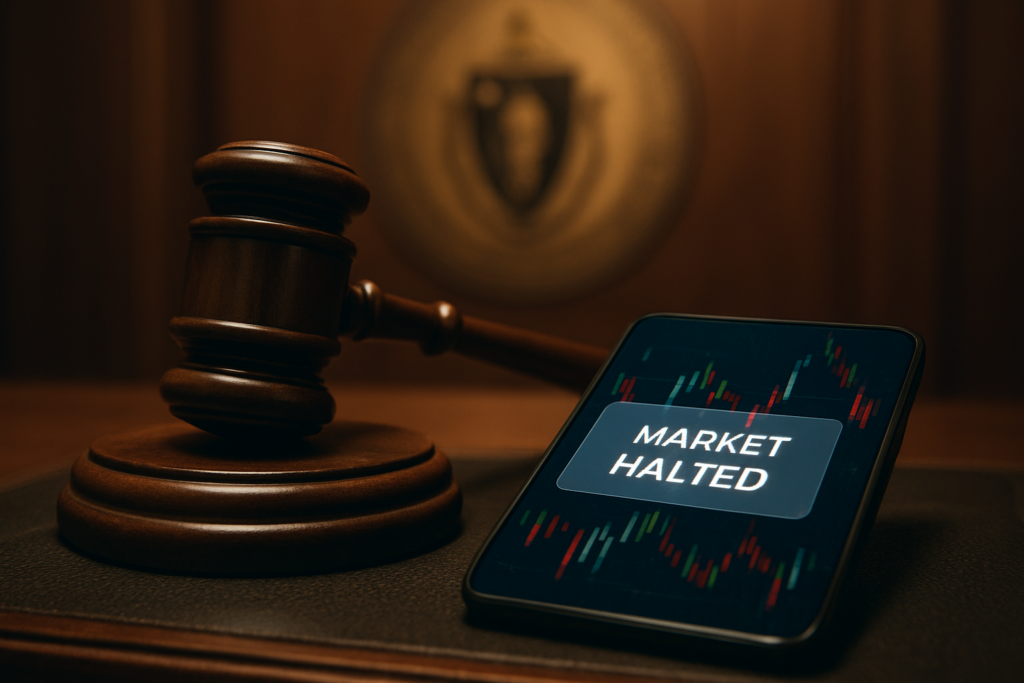
In a decision that has sent shockwaves through the prediction market and sports betting industries, Judge Christopher Barry-Smith of the Suffolk County Superior Court ruled on January 20, 2026, that the platform Kalshi must halt its sports-related "event contracts" in Massachusetts. The preliminary injunction represents a massive victory for Massachusetts Attorney General Andrea Joy Campbell, who argued that Kalshi’s offerings—despite being regulated as commodities at the federal level—functionally constitute unlicensed sports wagering under state law.
The news has immediately trickled into the prediction markets themselves. On Polymarket, a contract asking if Kalshi will stop offering sports contracts in Massachusetts by January 31 is currently trading at just 4 cents (4%). This low probability for an immediate exit is not a sign of Kalshi’s legal strength, but rather a reflection of a tactical delay: on January 23, Judge Barry-Smith "kicked the can down the road" by staying the enforcement of his own injunction. This maneuver effectively allows Kalshi to remain operational through the 2026 Super Bowl while the court considers a longer-term stay pending appeal.
The Market: What's Being Predicted
The central conflict involves Kalshi’s suite of sports-themed event contracts, including "Moneyline," "Point Spread," and "Over/Under" predictions. While traditional sportsbooks like DraftKings Inc. (NASDAQ: DKNG) and Flutter Entertainment (NYSE: FLUT)—the parent company of FanDuel—operate under the Massachusetts Sports Wagering Law (G.L. c. 23N), Kalshi has long maintained that its products are binary options or "swaps" regulated by the Commodity Futures Trading Commission (CFTC).
The specific market in question is whether Kalshi will be forced to "geofence" Massachusetts, effectively blocking residents from accessing these specific sports contracts. Since the January 20 ruling, trading volume on the "legal outcome" markets has spiked. Analysts are watching two key fronts:
- The Immediate Exit: Traders on Polymarket are betting on the specific date Kalshi will flip the switch to "off" for Massachusetts users.
- The Appellate Survival: On platforms like Manifold Markets, traders are pricing in a roughly 35% chance that Kalshi successfully overturns this injunction in the Massachusetts Appeals Court by the end of Q2 2026.
Resolution of these markets depends on the next set of court filings due on January 30 and February 4, which will determine if Kalshi gets to keep its "open for business" sign hanging through the spring.
Why Traders Are Betting
The volatility in these legal prediction markets is driven by the judge’s explicit rejection of "federal preemption." Kalshi’s primary defense—that its status as a federal Designated Contract Market (DCM) shields it from state gambling laws—was described by Judge Barry-Smith as "overly broad." Traders are betting on whether this judicial skepticism will spread to other jurisdictions.
Recent news of a "domino effect" has heavily influenced market sentiment. Following the Massachusetts ruling, gaming commissions in New York, Ohio, and Nevada filed the Barry-Smith decision as "supplemental authority" in their own ongoing legal battles against Kalshi. Whale activity on Polymarket has notably shifted toward "Yes" positions for a Massachusetts exit, as the judge's comments about Kalshi’s "self-inflicted" harm suggest a lack of sympathy for the platform's business model.
Strategic traders are also eyeing the 2026 Super Bowl as a pivot point. The court’s decision to delay the injunction’s enforcement until early February suggests a "last hurrah" for Kalshi’s sports volume in the state. Those betting on the "4-cent" Polymarket contract are banking on the legal bureaucracy moving slower than the NFL playoff calendar.
Broader Context and Implications
This injunction is the first of its kind in the United States. While other states have issued cease-and-desist letters, this is the first time a U.S. court has granted a preliminary injunction specifically targeting a CFTC-regulated platform’s sports offerings. It draws a stark line in the "event contract vs. sports betting" debate, with Judge Barry-Smith ruling that if a product "mirrors digital gambling experiences," it must be regulated as such.
The real-world implications are significant for the broader prediction market ecosystem. If Massachusetts successfully forces Kalshi to obtain a gaming license, it sets a precedent that federal oversight does not equal a "blanket shield" for all products. This could force prediction markets to:
- Raise the minimum age from 18 to 21 for certain contracts.
- Pay state taxes on "handle" similar to traditional sportsbooks.
- Implement strict geofencing, fragmenting the national liquidity that makes prediction markets efficient.
This case reveals a growing tension between the "innovate first, ask permission later" ethos of fintech and the "historic police powers" of states to regulate vice and gambling.
What to Watch Next
The most critical date on the horizon is February 4, 2026, when the court is expected to issue a final ruling on whether the injunction will be stayed during the entirety of Kalshi’s appeal. If the stay is denied, Kalshi will have to immediately block Massachusetts users from sports markets, likely causing the Polymarket "Yes" shares to moon.
Investors should also monitor the Massachusetts Gaming Commission (MGC). If Kalshi decides to apply for a license rather than fight, it would represent a total surrender of its "not gambling" legal thesis. Additionally, keep an eye on federal movements; if the CFTC issues new guidance in response to this state-level encroachment, it could provide Kalshi with the federal "hook" it needs to revive its preemption argument in the Appeals Court.
Bottom Line
The Massachusetts ruling is a watershed moment that challenges the very identity of prediction markets. By labeling sports-based event contracts as "wagers," Judge Barry-Smith has stripped away the linguistic armor Kalshi used to differentiate itself from the likes of DraftKings.
As a tool, these prediction markets on the case itself show that while the legal community is divided, traders are increasingly pessimistic about Kalshi’s ability to maintain a "one-size-fits-all" federal regulatory approach. If the injunction holds, 2026 may be remembered as the year the "Wild West" of prediction markets was finally fenced in by the traditional boundaries of state gaming law.
The ultimate outcome will likely depend on whether the Massachusetts Appeals Court views these contracts as legitimate hedging tools for the "knowledge economy" or simply a clever way to bypass the high taxes and strict rules of the sportsbook industry.
This article is for informational purposes only and does not constitute financial or betting advice. Prediction market participation may be subject to legal restrictions in your jurisdiction.
PredictStreet focuses on covering the latest developments in prediction markets. Visit the PredictStreet website at https://www.predictstreet.ai/.