As of January 8, 2026, Angi Inc. (NASDAQ: ANGI) finds itself at a critical crossroads. Long the dominant name in the fragmented U.S. home services market, the company has spent the last decade navigating a complex merger, a multi-year brand consolidation, and most recently, a full spin-off from its former parent, IAC Inc. (NASDAQ: IAC). However, the most significant headline currently defining the company is its aggressive pivot toward artificial intelligence.
Just yesterday, Angi announced a 12% reduction in its global workforce, a move explicitly attributed to "AI-driven efficiency gains." This decision marks a pivotal moment in the gig economy and digital marketplace sectors, signaling a shift from human-intensive lead management to an automated, AI-first architecture. For investors, the central question is whether these cost-cutting measures represent a desperate defensive maneuver or a lean, high-tech evolution that will finally unlock the company’s long-dormant profitability.
Historical Background
The story of Angi is one of consolidation and transformation. The company’s roots date back to 1995 with the founding of Angie’s List by Angie Hicks and William S. Oesterle, which began as a call-center-based referral service for home repairs. Simultaneously, ServiceMagic (founded in 1998 and later rebranded as HomeAdvisor) was building a digital lead-generation engine.
In 2017, IAC merged the two rivals to form ANGI Homeservices. Over the subsequent years, the company integrated various smaller acquisitions, including the gig-work platform Handy. In 2021, the company officially rebranded as Angi, unifying its disparate brands under a single banner. A watershed moment occurred on April 1, 2025, when IAC completed a full spin-off of Angi, allowing the company to operate as an independent entity for the first time in nearly a decade. This independence has allowed management to pursue more radical restructuring, culminating in the current AI-centric strategy.
Business Model
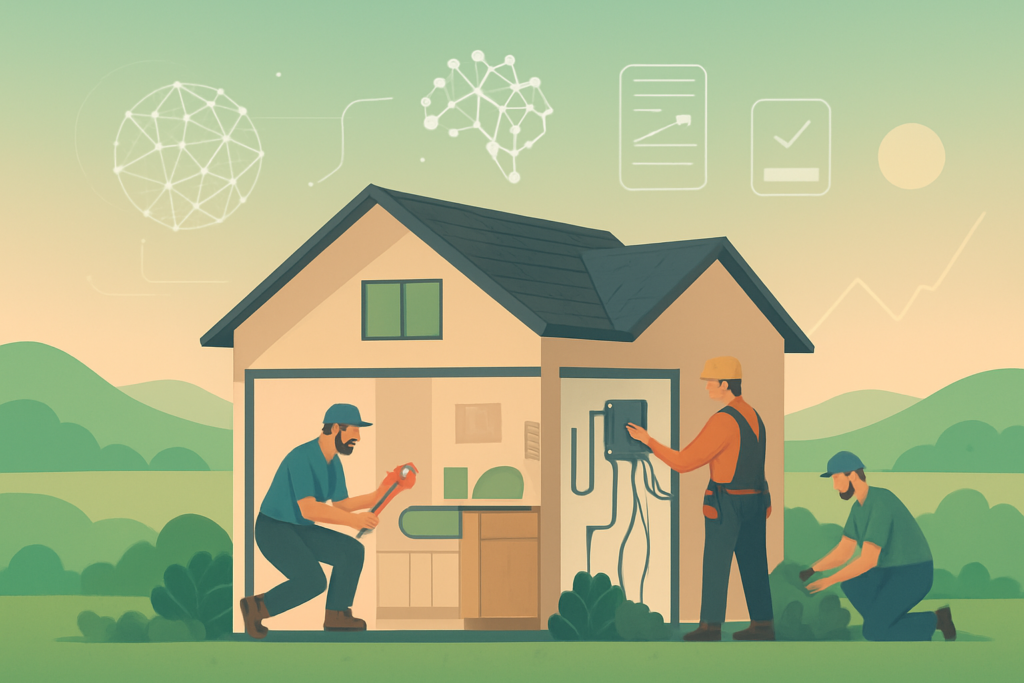
Angi operates a two-sided digital marketplace connecting homeowners with local service professionals (Pros). Its revenue is generated through three primary segments:
- Ads and Leads: Pros pay to be listed on the platform or for specific leads (homeowner inquiries). This has historically been the company’s largest revenue driver.
- Services (Angi Services): A "pre-priced" model where Angi acts as the general contractor, setting the price for the consumer and hiring a pro to fulfill the job.
- International: A collection of marketplaces in Europe and Canada that mimic the domestic lead-generation model.
Under the leadership of CEO Jeff Kip, the company has transitioned toward a "Homeowner Choice" model. Instead of automatically distributing leads to multiple pros, the platform now allows homeowners to browse and select pros directly, a move intended to improve the quality of matches and long-term customer retention.
Stock Performance Overview
Angi's stock performance has been a saga of volatility. Over the last 10 years, the stock has fluctuated wildly, peaking during the 2020-2021 pandemic "home improvement boom" before retreating significantly as interest rates rose and consumer spending shifted.
Over a 5-year horizon, the stock has struggled, losing a significant portion of its market capitalization as the IAC spin-off process created technical selling pressure and the company navigated a "reset year" in 2025. However, the 1-year performance through early 2026 has shown signs of stabilization. Following the April 2025 spin-off and the recent announcement of AI-driven cost reductions, the stock has traded in the $12 to $15 range, off its historic lows as the market begins to price in a leaner operating structure and the potential for a return to top-line growth.
Financial Performance
Financial results in the lead-up to 2026 have been a study in "margin over volume." In its most recent quarterly report (Q3 2025), Angi reported a 10.5% year-over-year decline in revenue to $265.6 million. However, the underlying profitability told a different story:
- Operating Income: Grew by 179% to $21.8 million.
- Adjusted EBITDA: Rose to $39.7 million, representing significant margin expansion.
- Cash Flow: The company has remained free cash flow positive, which is critical as it operates independently from IAC.
The 12% workforce reduction announced in January 2026 is expected to save the company between $70 million and $80 million annually. This is a clear signal that management is prioritizing EBITDA growth and self-funding its AI migration.
Leadership and Management
Jeff Kip, who took the helm as CEO in April 2024, is the primary architect of the current strategy. A former CFO of IAC and CEO of HomeAdvisor International, Kip has a reputation for operational discipline. He is supported by Joey Levin, who transitioned from IAC CEO to Angi’s Executive Chairman during the 2025 spin-off to provide strategic continuity.
Angie Hicks, the co-founder, remains the Chief Customer Officer and the public face of the brand, ensuring that the company’s "consumer-first" reputation remains intact despite the radical shifts in backend technology. The board is currently focused on navigating the "independence era," with a heavy emphasis on technology-led scaling.
Products, Services, and Innovations
The centerpiece of Angi’s innovation pipeline is its "Single, AI-First Global Platform," targeted for full completion by 2027. Key innovations include:
- AI Helper: An LLM-powered assistant that helps homeowners accurately describe complex projects (like a roof replacement vs. a simple repair), ensuring that Pros receive high-intent, well-defined leads.
- Automated Verification: AI is now used to vet professional licenses and insurance certificates, a task that previously required hundreds of manual reviewers.
- Smart Matching: The "Homeowner Choice" algorithm now uses machine learning to predict which pro is most likely to respond and complete a job based on real-time availability and historical performance.
The January 2026 workforce cuts are a direct result of these tools reaching maturity, particularly in customer support and administrative verification departments.
Competitive Landscape
Angi faces a dual-front war. On one side are specialized rivals like Thumbtack and Houzz, which offer highly polished user experiences in specific niches (like design or small gig tasks). On the other side are tech giants like Alphabet Inc. (NASDAQ: GOOGL) via Google Local Services Ads and Amazon.com Inc. (NASDAQ: AMZN), which continue to dominate the "top of the funnel" search results.
Additionally, smaller players like Porch Group (NASDAQ: PRCH) focus on the software-as-a-service (SaaS) side for contractors, while Yelp Inc. (NASDAQ: YELP) remains a formidable competitor for local reviews and lead generation. Angi’s competitive edge relies on its massive database of proprietary reviews and its deep, pre-existing relationships with over 200,000 active service professionals.
Industry and Market Trends
The home services industry is undergoing three major shifts:
- Digitization of Labor: Only a small fraction of the $500 billion home services market is currently booked online, representing a massive tailwind for marketplaces.
- The AI Transformation: AI is being used to bridge the communication gap between technical contractors and non-technical homeowners.
- Cyclical Pressures: While high interest rates in 2024-2025 slowed home sales, they often increased the demand for home "maintenance and repair" as owners opted to stay put and renovate.
Risks and Challenges
The primary risk for Angi is revenue contraction. While AI is improving margins, the total volume of leads has declined as the company moves away from low-quality, automated lead selling. If Angi cannot return to top-line growth by mid-2026, the market may view it as a "shrinking to profitability" story rather than a growth story.
Other risks include:
- AI Hallucination: Inaccurate AI-generated project descriptions could alienate professional contractors.
- Disintermediation: Homeowners often take their business "off-platform" after the first match to avoid Angi’s fees.
- Labor Shortage: A chronic shortage of skilled tradespeople (plumbers, electricians) limits the supply side of the marketplace.
Opportunities and Catalysts
- Operating Leverage: If revenue begins to grow on the new, AI-optimized cost base, the earnings per share (EPS) growth could be explosive.
- M&A Potential: Now that Angi is independent, it could be a target for a larger tech company or a private equity firm looking to capitalize on its improved margins.
- Monetizing Data: Angi sits on decades of home repair data that could be valuable to insurance companies or real estate platforms.
Investor Sentiment and Analyst Coverage
Wall Street sentiment is currently "cautiously optimistic." Most analysts maintain a "Hold" or "Moderate Buy" rating, waiting for proof that the 2025 "reset" has reached its floor. The consensus 12-month price target as of early 2026 ranges from $16 to $20.
Institutional ownership remains high, though some hedge funds exited during the IAC spin-off. Retail chatter on platforms like X and Reddit is focused on the "AI efficiency" narrative, with some traders viewing the 12% layoff as a signal that the company is finally getting serious about its bottom line.
Regulatory, Policy, and Geopolitical Factors
Angi is largely shielded from geopolitical tension but remains sensitive to U.S. labor laws. Potential "gig worker" reclassification laws (similar to those affecting Uber or Lyft) could impact the Angi Services segment, where the company exerts more control over the worker's schedule and pay. Furthermore, privacy laws regarding lead generation and data sharing (like the CCPA in California) require constant compliance investment.
Conclusion
Angi Inc. is currently executing one of the most significant tech-driven pivots in the home services sector. The 12% workforce reduction announced in January 2026 is the clearest evidence yet that management is betting the company’s future on AI-driven automation rather than human-intensive operations.
For the patient investor, Angi represents a play on the "industrialization" of home services—a lean, AI-optimized marketplace that is finally shedding the baggage of its legacy corporate structure. However, the company must prove that it can grow its revenue while maintaining these new, higher margins. Investors should watch the next two quarters of earnings closely; if top-line growth returns while the AI efficiency gains hold, Angi could be poised for a significant re-rating in the market.
This content is intended for informational purposes only and is not financial advice.