Is it the Beginning of the End for Social Media? A new research brief examining a key shift in the attention economy: global time spent on social media is no longer rising uniformly, and may be declining at scale. Plus an interactive Screen Time & Scroll Calculator.
(PRUnderground) February 23rd, 2026
The new brief argues that one plausible driver behind this shift is an “authenticity squeeze”: people don’t just want more content—they want content that feels real, human, and worth their attention. When feeds feel increasingly automated, repetitive, ad-heavy, or saturated with AI-generated content (or perceived as such), stepping back can be a rational way to regain control of attention.
A key datapoint from global usage tracking helps frame the story: average daily time spent on social media worldwide peaked in 2023 at 151 minutes per day and, by 2025, eased to 141 minutes per day—down 6.6% and back to levels last seen in 2018.
Read the coverage and use the tool.
- Try the Screen Time & Scroll Calculator: Screen Time Calculator: Visualize Scroll Distance & Days Spent
- Read the research brief: Research: AI Slop Backlash
- Read the explainer article: Has Social Media Peaked? Screen Time Is Reducing
Brief Highlights (At a Glance)
- Social media time may be past its “uniform growth” phase, with measurable reductions possible at the global scale.
- Perceived authenticity is emerging as a plausible driver: when content feels automated, users may step back to regain control.
- “Digital detox” can be interpreted as a control-restoration response—not simply willpower—especially when feeds feel less authentic due to perceived AI saturation and ad clutter.
What the brief argues (in simple terms)
The framework connects three ideas into one chain:
1) Authenticity operates as a consumer goal tied to identity benefits like control, connection, and virtue.
2) When people believe AI-authored content is widespread, they may become more skeptical of what they see—negativity can generalize beyond individual posts.
3) Digital detox can function as control restoration: users reduce exposure to realign attention and habits with personal goals.
From AI saturation to “control restoration.”
The research brief connects three ideas into a simple chain:
Authenticity goals → Perceived AI authorship / Saturation → Overload & Skepticism → Detox → Analog Revival
1) Authenticity as a consumer goal
Authenticity isn’t only about whether something is “real.” People pursue authenticity because it supports identity benefits—like control, connection, and virtue. When content feels authentic, it tends to feel more meaningful.
2) Perceived AI authorship and perceived AI saturation can erode authenticity
The brief emphasizes that perception matters: when users believe AI-generated content is widespread, skepticism can generalize beyond individual posts. The result is a broader sense of overload and diminished meaning—even when any single item isn’t the issue.
3) Digital detox can function as a practical reset
When the feed feels less authentic—whether due to perceived AI saturation, suspected automation, or escalating ad clutter—reducing exposure can be a rational strategy to restore agency and realign habits with personal goals. The brief describes detox as a “journey” with different outcomes: some people rebound, while others shift toward more selective, intentional use.
Digital detox is often framed as willpower; we’re framing it as control restoration. If a feed feels less authentic—whether due to perceived AI saturation, perceived AI authorship, or escalating ad clutter—reducing exposure can be a rational way to regain agency.
A practical tool for readers
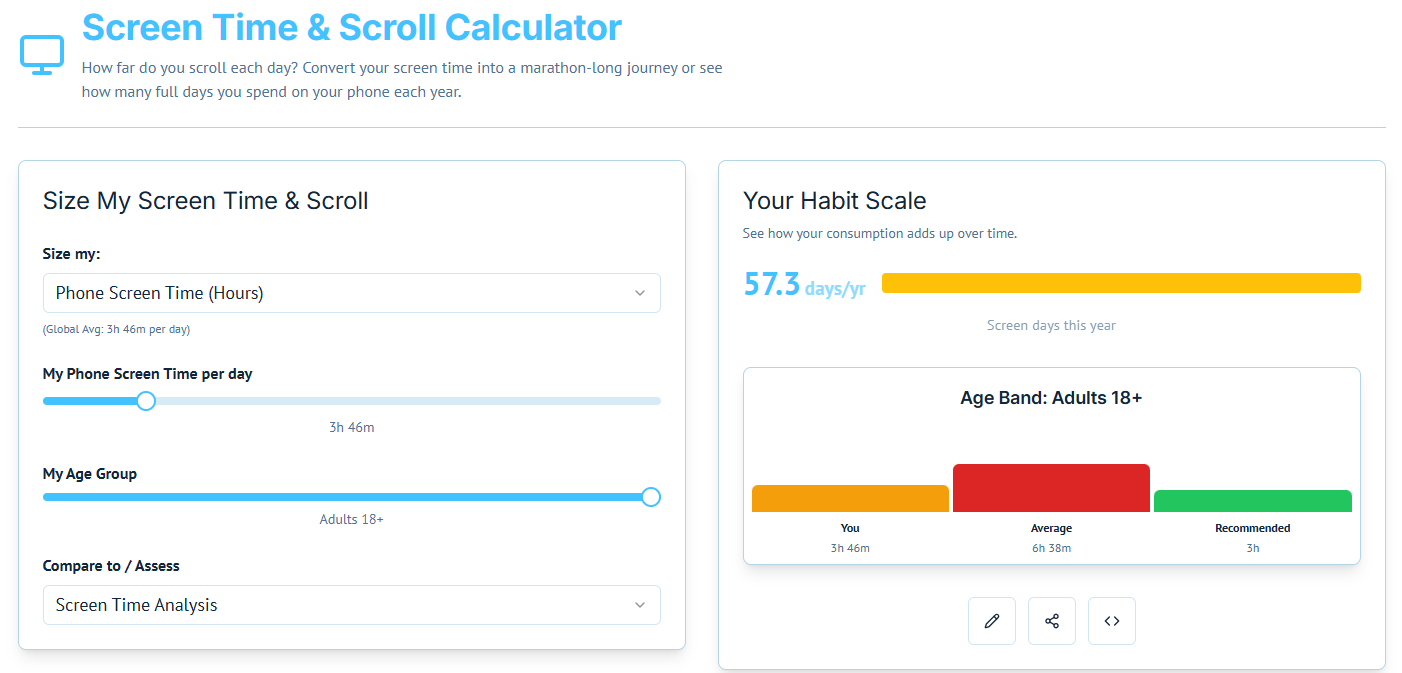
To make the trend instantly tangible, the release points to the free SizeMyHabit Screen Time & Scroll Calculator, which turns everyday screen time into full days per year and memorable scroll-distance comparisons (from marathons to moon trips). The goal is to make an abstract habit feel real—without shame.
GreatWorkLife complements the research with practical, research-informed guidance for reducing screen time in a productivity- and wellbeing-friendly way, framing digital detox as a form of control restoration when feeds feel less authentic due to perceived AI saturation, authorship, or ad clutter.
Important note on scope
This brief is descriptive and framework-building. It does not claim to prove causality. It treats “AI slop” as a perception (not an objective claim about quality) and notes that the causal link between saturation beliefs and disengagement requires direct testing.
SizeMyHabit helps people visualize everyday habits—screen time, steps, food, sleep, and more—by translating them into memorable comparisons that make abstract behaviors feel concrete.
GreatWorkLife publishes practical, research-informed guidance on habits, productivity, and wellbeing—helping readers build routines that reclaim time and attention.
About GreatWorkLife.com & SizeMyHabit.com
Media for Good
To inform smarter decisions—whether you’re investing capital or investing in yourself. We combine rigorous data‑driven research, real‑world applicability, and trusted educational content to help institutional and individual audiences excel.
The post Research Suggests Social Media Time Has Peaked as “Authenticity Fatigue Grows”: 3Wise Media GmbH first appeared on
Original Press Release.