As we approach the end of 2025, a seismic shift in the educational landscape has sparked a fierce national debate: is the human teacher becoming obsolete in the face of algorithmic precision? Recent data from pilot programs across the United States and the United Kingdom suggest that students taught by specialized AI systems are not only keeping pace with their peers but are significantly outperforming them in core subjects like physics, mathematics, and literacy. This "performance gap" has ignited a firestorm among educators, parents, and policymakers who question whether these higher grades represent a breakthrough in cognitive science or a dangerous shortcut toward the dehumanization of learning.
The immediate significance of these findings cannot be overstated. With schools facing chronic teacher shortages and ballooning classroom sizes, the promise of a "1-to-1 tutor for every child" is no longer a futuristic dream but a data-backed reality. However, as the controversial claim that AI instruction produces better grades gains traction, it forces a fundamental reckoning with the purpose of education. If a machine can deliver a 65% rise in test scores, as some 2025 reports suggest, the traditional role of the educator as the primary source of knowledge is being systematically dismantled.
The Technical Edge: Precision Pedagogy and the "2x" Learning Effect
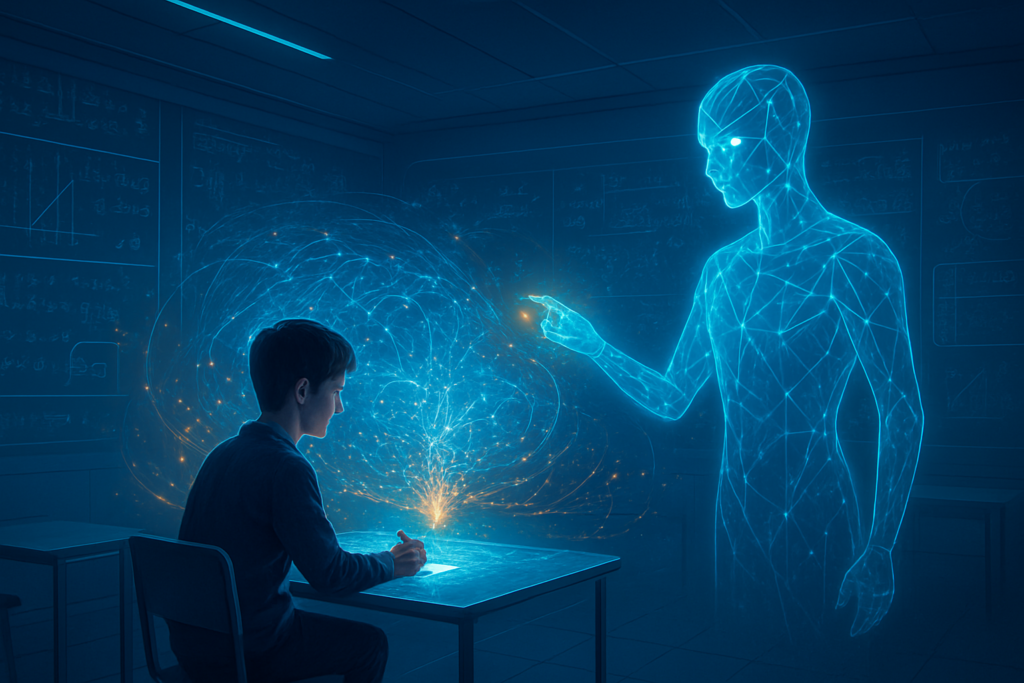
The technological backbone of this shift lies in the evolution of Large Language Models (LLMs) into specialized "tutors" capable of real-time pedagogical adjustment. In late 2024, a landmark study at Harvard University utilized a custom bot named "PS2 Pal," powered by OpenAI’s GPT-4, to teach physics. The results were staggering: students using the AI tutor learned twice as much in 20% less time compared to those in traditional active-learning classrooms. Unlike previous generations of "educational software" that relied on static branching logic, these new systems use sophisticated "Chain-of-Thought" reasoning to diagnose a student's specific misunderstanding and pivot their explanation style instantly.
In Newark Public Schools, the implementation of Khanmigo, an AI tool developed by Khan Academy and supported by Microsoft (NASDAQ: MSFT), has demonstrated the power of "precision pedagogy." In a pilot involving 8,000 students, Newark reported that learners using the AI achieved three times the state average increase in math proficiency. The technical advantage here is the AI’s ability to monitor every keystroke and provide "micro-interventions" that a human teacher, managing 30 students at once, simply cannot provide. These systems do not just give answers; they are programmed to "scaffold" learning—asking leading questions that force the student to arrive at the solution themselves.
However, the AI research community remains divided on the "logic" behind these grades. A May 2025 study from the University of Georgia’s AI4STEM Education Center found that while AI (specifically models like Mixtral) can grade assignments with lightning speed, its underlying reasoning is often flawed. Without strict human-designed rubrics, the AI was found to use "shortcuts," such as identifying key vocabulary words rather than evaluating the logical flow of an argument. This suggests that while the AI is highly effective at optimizing for specific test metrics, its ability to foster deep, conceptual understanding remains a point of intense technical scrutiny.
The EdTech Arms Race: Market Disruption and the "Elite AI" Tier
The commercial implications of AI outperforming human instruction have triggered a massive realignment in the technology sector. Alphabet Inc. (NASDAQ: GOOGL) has responded by integrating "Gems" and "Guided Learning" features into Google Workspace for Education, positioning itself as the primary infrastructure for "AI-first" school districts. Meanwhile, established educational publishers like Pearson (NYSE: PSO) are pivoting from textbooks to "Intelligence-as-a-Service," fearing that their traditional content libraries will be rendered irrelevant by generative models that can create personalized curriculum on the fly.
This development has created a strategic advantage for companies that can bridge the gap between "raw AI" and "pedagogical safety." Startups that focus on "explainable AI" for education are seeing record-breaking venture capital rounds, as school boards demand transparency in how grades are being calculated. The competitive landscape is no longer about who has the largest LLM, but who has the most "teacher-aligned" model. Major AI labs are now competing to sign exclusive partnerships with state departments of education, effectively turning the classroom into the next great frontier for data acquisition and model training.
There is also a growing concern regarding the emergence of a "digital divide" in educational quality. In London, David Game College launched a "teacherless" GCSE program with a tuition fee of approximately £27,000 ($35,000) per year. This "Elite AI" tier offers highly optimized, bespoke instruction that guarantees high grades, while under-funded public schools may be forced to use lower-tier, automated systems that lack human oversight. Critics argue that this market positioning could lead to a two-tiered society where the wealthy pay for human mentorship and the poor are relegated to "algorithmic instruction."
The Ethical Quandary: Grade Inflation or Genuine Intelligence?
The wider significance of AI-led instruction touches on the very heart of the human experience. Critics, including Rose Luckin, a professor at University College London, argue that the "precision and accuracy" touted by AI proponents risk "dehumanizing the process of learning." Education is not merely the transfer of data; it is a social process involving empathy, mentorship, and the development of interpersonal skills. By optimizing for grades, we may be inadvertently stripping away the "human touch" that inspires curiosity and resilience.
Furthermore, the controversy over "grade inflation" looms large. Many educators worry that the higher grades produced by AI are a result of "hand-holding." If an AI tutor provides just enough hints to get a student through a problem, the student may achieve a high score on a standardized test but fail to retain the knowledge long-term. This mirrors previous milestones in AI, such as the emergence of calculators or Wikipedia, but at a far more profound level. We are no longer just automating a task; we are automating the process of thinking.
There are also significant concerns regarding the "black box" nature of AI grading. If a student receives a lower grade from an algorithm, the lack of transparency in how that decision was reached can lead to a breakdown in trust between students and the educational system. The Center for Democracy and Technology reported in October 2025 that 70% of teachers worry AI is weakening critical thinking, while 50% of students feel "less connected" to their learning environment. The trade-off for higher grades may be a profound sense of intellectual alienation.
The Future of Education: The Hybrid "Teacher-Architect"
Looking ahead, the consensus among forward-thinking researchers like Ethan Mollick of Wharton is that the future will not be "AI vs. Human" but a hybrid model. In this "Human-in-the-Loop" system, AI handles the rote tasks—grading, basic instruction, and personalized drills—while human teachers are elevated to the role of "architects of learning." This shift would allow educators to focus on high-level mentorship, social-emotional learning, and complex project-based work that AI still struggles to facilitate.
In the near term, we can expect to see the "National Academy of AI Instruction"—a joint venture between teachers' unions and tech giants—establish new standards for how AI and humans interact in the classroom. The challenge will be ensuring that AI remains a tool for empowerment rather than a replacement for human judgment. Potential applications on the horizon include AI-powered "learning VR" environments where students can interact with historical figures or simulate complex scientific experiments, all guided by an AI that knows their specific learning style.
However, several challenges remain. Data privacy, the risk of algorithmic bias, and the potential for "learning loss" during the transition period are all hurdles that must be addressed. Experts predict that the next three years will see a "great sorting" of educational philosophies, as some schools double down on traditional human-led models while others fully embrace the "automated classroom."
A New Chapter in Human Learning
The claim that AI instruction produces better grades than human teachers is more than just a statistical anomaly; it is a signal that the industrial model of education is reaching its end. While the data from Harvard and Newark provides a compelling case for the efficiency of AI, the controversy surrounding these findings reminds us that education is a deeply human endeavor. The "Grade Gap" is a wake-up call for society to define what we truly value: the "A" on the report card, or the mind behind it.
As we move into 2026, the significance of this development in AI history will likely be viewed as the moment the technology moved from being a "tool" to being a "participant" in human development. The long-term impact will depend on our ability to integrate these powerful systems without losing the mentorship and inspiration that only a human teacher can provide. For now, the world will be watching the next round of state assessment scores to see if the AI-led "performance gap" continues to widen, and what it means for the next generation of learners.
This content is intended for informational purposes only and represents analysis of current AI developments.
TokenRing AI delivers enterprise-grade solutions for multi-agent AI workflow orchestration, AI-powered development tools, and seamless remote collaboration platforms.
For more information, visit https://www.tokenring.ai/.