In a move that marks a significant pivot in the ongoing "chip wars," the United States government has authorized NVIDIA (NASDAQ: NVDA) to export its high-performance H200 Tensor Core GPUs to select Chinese technology firms. This shift, effective as of mid-January 2026, replaces the previous "presumption of denial" with a transactional, case-by-case licensing framework dubbed the "Trump Cut" by industry analysts. The decision comes at a time when the global artificial intelligence landscape is increasingly split between Western and Eastern hardware stacks, with Washington seeking to monetize Chinese demand while maintaining a strict "technological leash" on Beijing's compute capabilities.
The immediate significance of this development is underscored by reports that Chinese tech giants, led by ByteDance (Private), are preparing orders totaling upwards of $14 billion for 2026. For NVIDIA, the move offers a lifeline to a market where its dominance has been rapidly eroding due to domestic competition and previous trade restrictions. However, the approval is far from an open door; it arrives tethered to a 25% revenue tariff and a mandatory 50% volume cap, ensuring that for every chip sent to China, the U.S. treasury profits and the domestic U.S. supply remains the priority.
Technical Guardrails and the "TPP Ceiling"
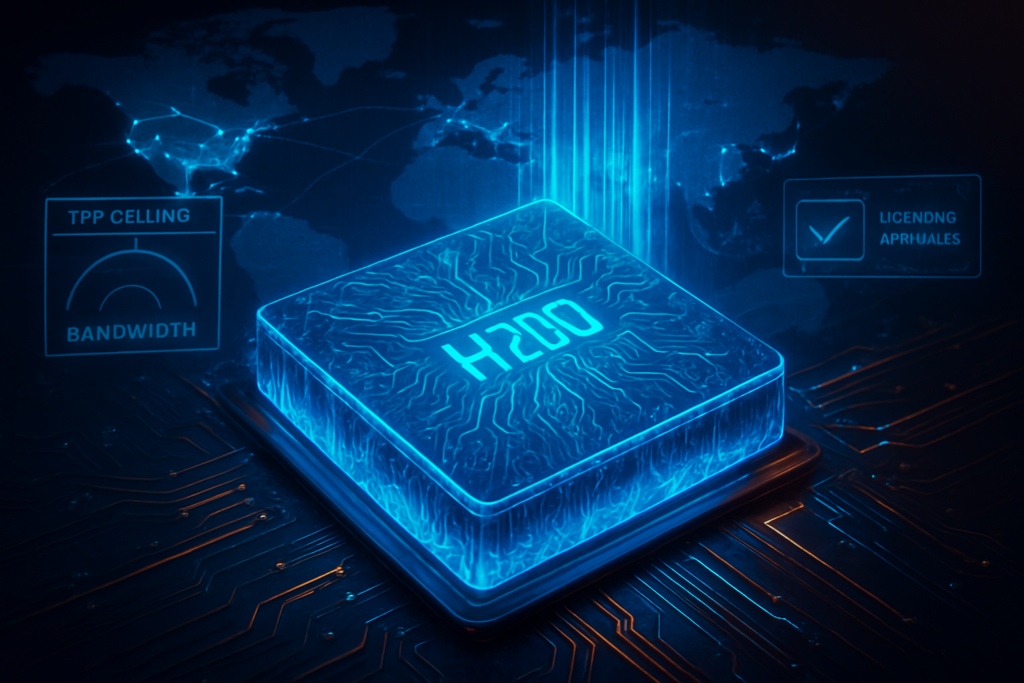
The technical specifications of the H200 are central to its status as a licensed commodity. Under the new Bureau of Industry and Security (BIS) rules, the "technological ceiling" for exports is defined by a Total Processing Performance (TPP) limit of 21,000 and a DRAM bandwidth cap of 6,500 GB/s. The NVIDIA H200, which features 141GB of HBM3e memory and a bandwidth of approximately 4,800 GB/s, falls safely under these thresholds. This allows it to be exported, while NVIDIA’s more advanced Blackwell (B200) and upcoming Rubin (R100) architectures—both of which shatter these limits—remain strictly prohibited for sale to Chinese entities.
To enforce these boundaries, the 2026 policy introduces a rigorous "Mandatory U.S. Testing" phase. Before any H200 units can be shipped to mainland China, they must pass through third-party laboratories within the United States for verification. This ensures that the chips have not been "over-specced" or modified to bypass performance caps. This differs from previous years where "Lite" versions of chips (like the H20) were designed specifically for China; now, the H200 itself is permitted, but its availability is throttled by logistics and political oversight rather than just hardware throttling.
Initial reactions from the AI research community have been mixed. While some experts view the H200 export as a necessary valve to prevent a total "black market" explosion, others warn that even slightly older high-end hardware remains potent for large-scale model training. Industry analysts at the Silicon Valley Policy Institute noted that while the H200 is no longer the "bleeding edge" in the U.S., it remains a massive upgrade over the domestic 7nm chips currently being produced by Chinese foundries like SMIC (HKG:0981).
Market Impact and the $14 Billion ByteDance Bet
The primary beneficiaries of this licensing shift are the "Big Three" of Chinese cloud computing: Alibaba (NYSE: BABA), Tencent (OTC:TCEHY), and ByteDance. These companies have spent the last 24 months attempting to bridge the compute gap with domestic alternatives, but the reliability and software maturity of NVIDIA’s CUDA platform remain difficult to replace. ByteDance, in particular, has reportedly pivoted its 2026 infrastructure strategy to prioritize the acquisition of H200 clusters, aiming to stabilize its massive recommendation engines and generative AI research labs.
For NVIDIA, the move represents a strategic victory in the face of a shrinking market share. Analysts predict that without this licensing shift, NVIDIA’s share of the Chinese AI chip market could have plummeted below 10% by the end of 2026. By securing these licenses, NVIDIA maintains its foothold in the region, even if the 25% tariff makes its products significantly more expensive than domestic rivals. However, the "Priority Clause" in the new rules means NVIDIA must prove that all domestic U.S. demand is met before a single H200 can be shipped to an approved Chinese partner, potentially leading to long lead times.
The competitive landscape for major AI labs is also shifting. With official channels for H200s opening, the "grey market" premium—which saw H200 servers trading at nearly $330,000 per node in late 2025—is expected to stabilize. This provides a more predictable, albeit highly taxed, roadmap for Chinese AI development. Conversely, it puts pressure on domestic Chinese chipmakers who were banking on a total ban to force the industry onto their platforms.
Geopolitical Bifurcation and the AI Overwatch Act
The wider significance of this development lies in the formalization of a bifurcated global AI ecosystem. We are now witnessing the emergence of two distinct technology stacks: a Western stack built on Blackwell/Rubin architectures and CUDA, and a Chinese stack centered on Huawei’s Ascend and Moore Threads’ (SSE:688000) MUSA platforms. The U.S. strategy appears to be one of "controlled dependency"—allowing China just enough access to U.S. hardware to maintain a revenue stream and technical oversight, but not enough to achieve parity in AI training speeds.
However, this "transactional" approach has faced internal resistance in Washington. The "AI Overwatch Act," which passed a key House committee on January 22, 2026, introduces a 30-day congressional veto power over any semiconductor export license. This creates a permanent state of uncertainty for the global supply chain, as licenses granted by the Commerce Department could be revoked by the legislature at any time. This friction has already prompted many Chinese firms to continue their "compute offshoring" strategies, leasing GPU capacity in data centers across Singapore and Malaysia to access banned Blackwell-class chips through international cloud subsidiaries.
Comparatively, this milestone echoes the Cold War era's export controls on supercomputers, but at a vastly larger scale and with much higher financial stakes. The 25% tariff on H200 sales effectively turns the semiconductor trade into a direct funding mechanism for U.S. domestic chip subsidies, a move that Beijing has decried as "economic coercion" while simultaneously granting in-principle approval for the purchases to keep its tech industry competitive.
Future Outlook: The Rise of Silicon Sovereignty
Looking ahead, the next 12 to 18 months will be defined by China’s drive for "silicon sovereignty." While the H200 provides a temporary reprieve for Chinese AI labs, the domestic industry is not standing still. Huawei is expected to release its Ascend 910D in Q2 2026, which rumors suggest will feature a quad-die design specifically intended to rival the H200’s performance without the geopolitical strings. If successful, the 910D could render the U.S. licensing regime obsolete by late 2027.
Furthermore, the integration of HBM3e (High Bandwidth Memory) remains a critical bottleneck. As the U.S. moves to restrict the specialized equipment used to package HBM memory, Chinese firms like Biren Technology (HKG:2100) are forced to innovate with "chiplet" designs and alternative interconnects. The coming months will likely see a surge in domestic "interconnect" startups in China, focusing on linking disparate, lower-power chips together to mimic the performance of a single large GPU like the H200.
Experts predict that the "leash" will continue to tighten. As NVIDIA moves toward the Rubin architecture later this year, the gap between what is allowed in China and what is available in the West will widen from one generation to two. This "compute gap" will be the defining metric of geopolitical power in the late 2020s, with the H200 acting as the final bridge between two increasingly isolated technological worlds.
Summary of Semiconductor Diplomacy in 2026
The approval of NVIDIA H200 exports to China marks a high-water mark for semiconductor diplomacy. By balancing the financial interests of U.S. tech giants with the security requirements of the Department of Defense, the "Trump Cut" policy attempts a difficult middle ground. Key takeaways include the implementation of performance-based "TPP ceilings," the use of high tariffs as a trade weapon, and the mandatory verification of hardware on U.S. soil.
This development is a pivotal chapter in AI history, signaling that advanced compute is no longer just a commercial product but a highly regulated strategic asset. For the tech industry, the focus now shifts to the "AI Overwatch Act" and whether congressional intervention will disrupt the newly established trade routes. Investors and policy analysts should watch for the Q2 release of Huawei’s next-generation hardware and any changes in "offshore" cloud leasing regulations, as these will determine whether the H200 "leash" effectively holds or if China finds a way to break free of the U.S. silicon ecosystem entirely.
This content is intended for informational purposes only and represents analysis of current AI developments.
TokenRing AI delivers enterprise-grade solutions for multi-agent AI workflow orchestration, AI-powered development tools, and seamless remote collaboration platforms.
For more information, visit https://www.tokenring.ai/.