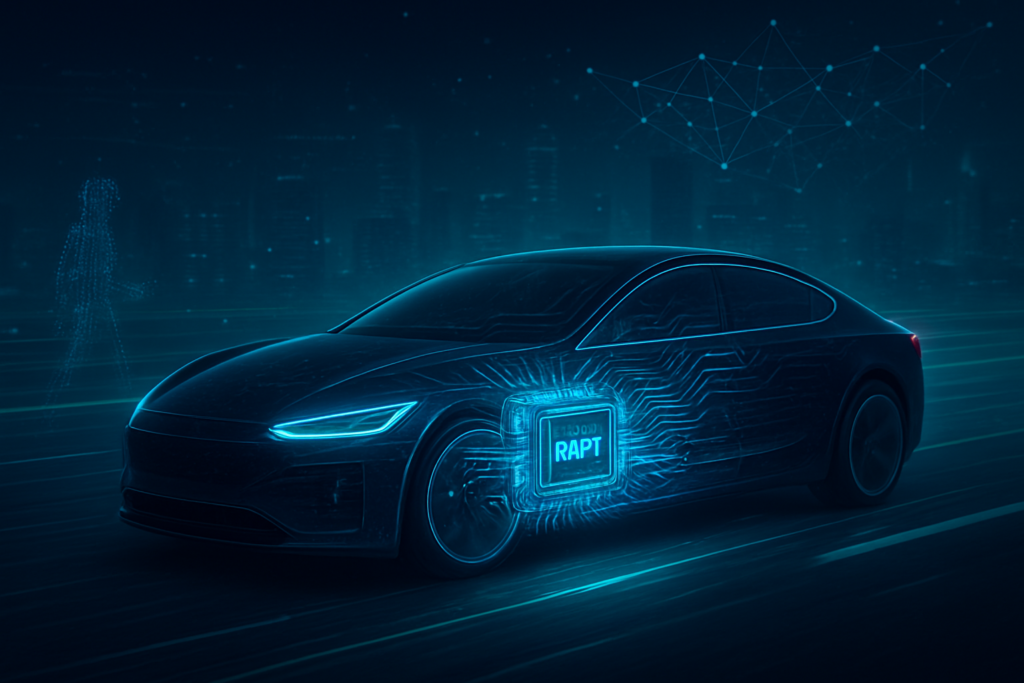
The automotive industry has officially entered the era of "Silicon Sovereignty." As of early 2026, the battle for electric vehicle (EV) dominance is no longer being fought just on factory floors or battery chemistry labs, but within the nanometer-scale architecture of custom-designed AI chips. Leading this charge is Rivian Automotive (NASDAQ: RIVN), which recently unveiled its groundbreaking Rivian Autonomy Processor 1 (RAP1). This move signals a definitive shift away from off-the-shelf hardware toward vertically integrated, bespoke silicon designed to turn vehicles into high-performance, autonomous "data centers on wheels."
The announcement of the RAP1 chip, which took place during Rivian’s Autonomy & AI Day in late December 2025, marks a pivotal moment for the company and the broader EV sector. By designing its own AI silicon, Rivian joins an elite group of "tech-first" automakers—including Tesla (NASDAQ: TSLA) and NIO (NYSE: NIO)—that are bypassing traditional semiconductor giants to build hardware optimized specifically for their own software stacks. This development is not merely a technical milestone; it is a strategic maneuver intended to unlock Level 4 autonomy while drastically improving vehicle range through unprecedented power efficiency.
The technical specifications of the RAP1 chip place it at the absolute vanguard of automotive computing. Manufactured on a cutting-edge 5nm process by TSMC (NYSE: TSM) and utilizing the Armv9 architecture from Arm Holdings (NASDAQ: ARM), the RAP1 features 14 high-performance Cortex-A720AE (Automotive Enhanced) CPU cores. In its flagship configuration, the Autonomy Compute Module 3 (ACM3), Rivian pairs two RAP1 chips to deliver a staggering 1,600 sparse INT8 TOPS (Trillion Operations Per Second). This massive computational headroom is designed to process over 5 billion pixels per second, managing inputs from 11 high-resolution cameras, five radars, and a proprietary long-range LiDAR system simultaneously.
What truly distinguishes the RAP1 from previous industry standards, such as the Nvidia (NASDAQ: NVDA) Drive Orin, is its focus on "Performance-per-Watt." Rivian claims the RAP1 is 2.5 times more power-efficient than the systems used in its second-generation vehicles. This efficiency is achieved through a specialized "RivLink" low-latency interconnect, which allows the chips to communicate with minimal overhead. The AI research community has noted that while raw TOPS were the metric of 2024, the focus in 2026 has shifted to how much intelligence can be squeezed out of every milliwatt of battery power—a critical factor for maintaining EV range during long autonomous hauls.
Industry experts have reacted with significant interest to Rivian’s "Large Driving Model" (LDM), an end-to-end AI model that runs natively on the RAP1. Unlike legacy ADAS systems that rely on hand-coded rules, the LDM uses the RAP1’s neural processing units to predict vehicle trajectories based on massive fleet datasets. This vertical integration allows Rivian to optimize its software specifically for the RAP1’s memory bandwidth and cache hierarchy, a level of tuning that is impossible when using general-purpose silicon from third-party vendors.
The rise of custom automotive silicon is creating a seismic shift in the competitive landscape of the tech and auto industries. For years, Nvidia was the undisputed king of the automotive AI hill, but as companies like Rivian, NIO, and XPeng (NYSE: XPEV) transition to in-house designs, the market for high-end "merchant silicon" is facing localized disruption. While Nvidia remains a dominant force in training the AI models in the cloud, the "inference" at the edge—the actual decision-making inside the car—is increasingly moving to custom chips. This allows automakers to capture more of the value chain and eliminate the "chip tax" paid to external suppliers, with NIO estimating that its custom Shenji NX9031 chip saves the company over $1,300 per vehicle.
Tesla remains the primary benchmark in this space, with its upcoming AI5 (Hardware 5) expected to begin sampling in early 2026. Tesla’s AI5 is rumored to be up to 40 times more performant than its predecessor, maintaining a fierce rivalry with Rivian’s RAP1 for the title of the most advanced automotive computer. Meanwhile, Chinese giants like Xiaomi (HKG: 1810) are leveraging their expertise in consumer electronics to build "Grand Convergence" platforms, where custom 3nm chips like the XRING O1 unify the car, the smartphone, and the home into a single AI-driven ecosystem.
This trend provides a significant strategic advantage to companies that can afford the massive R&D costs of chip design. Startups and legacy automakers that lack the scale or technical expertise to design their own silicon may find themselves at a permanent disadvantage, forced to rely on generic hardware that is less efficient and more expensive. For Rivian, the RAP1 is more than a chip; it is a moat that protects its software margins and ensures that its future vehicles, such as the highly anticipated R2, are "future-proofed" for the next decade of AI advancements.
The broader significance of the RAP1 chip lies in its role as the foundation for the "Data Center on Wheels." Modern EVs are no longer just transportation devices; they are mobile nodes in a global AI network, generating up to 5 terabytes of data per day. The transition to custom silicon allows for a "Zonal Architecture," where a single centralized compute node replaces dozens of smaller, inefficient Electronic Control Units (ECUs). This simplification reduces vehicle weight and complexity, but more importantly, it enables the deployment of Agentic AI—intelligent assistants that can proactively diagnose vehicle health, manage energy consumption, and provide natural language interaction for passengers.
The move toward Level 4 autonomy—defined as "eyes-off, mind-off" driving in specific environments—is the ultimate goal of this silicon race. By 2026, the industry has largely moved past the "Level 2+" plateau, and the RAP1 hardware provides the necessary redundancy and compute to make Level 4 a reality in geofenced urban and highway environments. However, this progress also brings potential concerns regarding data privacy and cybersecurity. As vehicles become more reliant on centralized AI, the "attack surface" for hackers increases, necessitating the hardware-level security features that Rivian has integrated into the RAP1’s Armv9 architecture.
Comparatively, the RAP1 represents a milestone similar to Apple’s transition to M-series silicon in its MacBooks. It is a declaration that the most important part of a modern machine is no longer the engine or the chassis, but the silicon that governs its behavior. This shift mirrors the broader AI landscape, where companies like OpenAI and Microsoft are also exploring custom silicon to optimize for specific large language models, proving that specialized hardware is the only way to keep pace with the exponential growth of AI capabilities.
Looking ahead, the near-term focus for Rivian will be the integration of the RAP1 into the Rivian R2, scheduled for mass production in late 2026. This vehicle is expected to be the first to showcase the full potential of the RAP1’s efficiency, offering advanced Level 3 highway autonomy at a mid-market price point. In the longer term, Rivian’s roadmap points toward 2027 and 2028 for the rollout of true Level 4 features, where the RAP1’s "distributed mesh network" will allow vehicles to share real-time sensor data to "see" around corners and through obstacles.
The next frontier for automotive silicon will likely involve even tighter integration with generative AI. Experts predict that by 2027, custom chips will include dedicated "Transformer Engines" designed specifically to accelerate the attention mechanisms used in Large Language Models and Vision Transformers. This will enable cars to not only navigate the world but to understand it contextually—recognizing the difference between a child chasing a ball and a pedestrian standing on a sidewalk. The challenge will be managing the thermal output of these massive processors while maintaining the ultra-low latency required for safety-critical driving decisions.
The unveiling of the Rivian RAP1 chip is a watershed moment in the history of automotive technology. It signifies the end of the era where car companies were simply assemblers of parts and the beginning of an era where they are the architects of the most sophisticated AI hardware on the planet. The RAP1 is a testament to the "data center on wheels" philosophy, proving that the path to Level 4 autonomy and maximum EV efficiency runs directly through custom silicon.
As we move through 2026, the industry will be watching closely to see how the RAP1 performs in real-world conditions and how quickly Rivian can scale its production. The success of this chip will likely determine Rivian’s standing in the high-stakes EV market and may serve as a blueprint for other manufacturers looking to reclaim their "Silicon Sovereignty." For now, the RAP1 stands as a powerful symbol of the convergence between the automotive and AI industries—a convergence that is fundamentally redefining what it means to drive.
This content is intended for informational purposes only and represents analysis of current AI developments.
TokenRing AI delivers enterprise-grade solutions for multi-agent AI workflow orchestration, AI-powered development tools, and seamless remote collaboration platforms.
For more information, visit https://www.tokenring.ai/.