Chengdu, Sichuan, China - September 10, 2026
Picking the right Fluoroelastomer base isn’t just about comparing prices; it’s a pretty complex decision that involves understanding a bunch of technical factors. When you're sourcing globally, you really need to look at things like temperature ranges, pressure levels, chemicals involved, compression cycles, and the specifics of your manufacturing process.
Dr. John Scheirs, a well-respected expert in fluoropolymers and author of Modern Fluoropolymers, sums it up pretty well with a simple rule: “Choose the polymer based on the service conditions, not just marketing hype.” And honestly, that advice still holds true in 2026.
At first glance, a base polymer might seem totally suitable just based on a supplier’s datasheet. But when it’s actually out in the field, things can be totally different. Imagine a fuel system seal—it's dealing with hot gasoline, vibration, and constant compression cycles. Or a chemical valve that’s exposed to acids, steam, or heavy cleaning chemicals. These are tough conditions that call for specific fluoroelastomer structures and curing methods.
Some of the top options available include bisphenol-cured FKM, peroxide-cured FKM, grades rich in tetrafluoroethylene, and high-performance FFKM compounds. Each one has its own mix of heat resistance, chemical stability, flexibility, and price. Big names like DuPont, Daikin, Solvay, and 3M have developed grades designed to handle even the most demanding industrial environments.
But here’s the thing—no one grade is perfect for everything.
Buyers really need to dig deeper than just the base polymer name and check the actual compound data. Things like filler choices, hardness levels, sealing designs, and post-curing processes can hugely impact how the material performs in real life. For example, a material rated to handle 250°C might still fail early if it isn’t correctly compressed or if it goes through rapid temperature changes.
This guide is here to help global buyers in 2026 understand which Fluoroelastomer bases are the best options. It also points out practical limitations, sourcing risks, and common mistakes—things that glossy brochures often gloss over but are critical when making the actual call.
 Define Fluoroelastomer Families: FKM, FFKM, FEPM, and FVMQ
For global buyers in 2026, fluoroelastomer selection starts with family definitions, not catalog temperature ratings. FKM is the broad industrial baseline. It offers strong resistance to oils, fuels, and many chemicals, with reliable sealing performance across demanding temperature ranges. However, standard FKM may swell in hot water, steam, amine-containing fluids, or certain polar chemicals. Always check the actual media and operating cycle.FFKM is a highly fluorinated option for severe chemical exposure and elevated temperatures. It can retain sealing performance where ordinary FKM fails, but its cost, processing requirements, and compression behavior need careful review. FEPM, based on tetrafluoroethylene and propylene, is useful where steam, strong bases, amines, or specialized chemical environments challenge conventional FKM. Its performance depends heavily on compound design and curing conditions. Small differences matter.FVMQ combines silicone-like temperature flexibility with improved resistance to fuels and selected oils. It suits aerospace-style fuel systems, sensors, and low-temperature seals, but it generally has lower mechanical strength and abrasion resistance than many FKM compounds. Do not select by polymer name alone. Ask for compression-set data, fluid-immersion results, hardness, pressure limits, and batch traceability. A seal tested at room temperature may behave differently after repeated heat cycles. That gap is easy to underestimate.
2026 Best Fluoroelastomer Base Types for Global Buyers?
Define Fluoroelastomer Families: FKM, FFKM, FEPM, and FVMQ
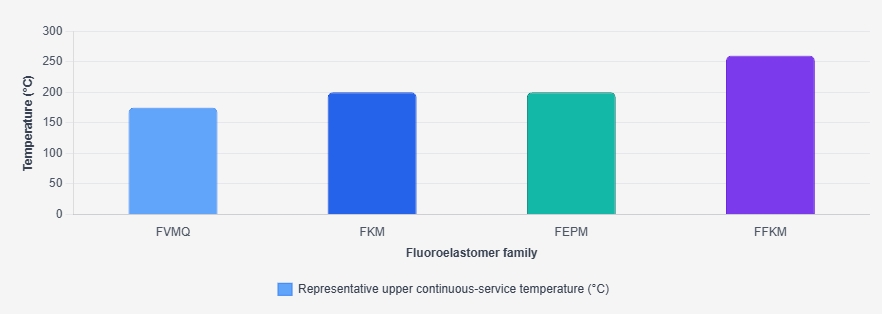
FKMBroad chemical resistance and strong performance at elevated temperatures; widely used for oils, fuels, and general industrial sealing.FFKMPerfluoroelastomer with the highest chemical resistance and the broadest high-temperature capability, usually at a higher material cost.FEPMTetrafluoroethylene-propylene elastomer offering strong resistance to bases, amines, steam, and some aggressive chemicals.FVMQFluorosilicone elastomer combining low-temperature flexibility with good resistance to fuels and mineral oils.
The chart shows representative upper continuous-service temperatures in °C. Actual limits depend on compound formulation, pressure, media, sealing design, and exposure time.
Classify FKM by ASTM D1418 and ISO 1629: A, B, F, and G Types
For global buyers, FKM type selection should begin with ASTM D1418 and ISO 1629, not color or trade descriptions. Type A commonly contains about 66% fluorine and offers balanced fuel, oil, and heat resistance. Type B, near 68% fluorine, improves chemical resistance in many sealing environments. Type F, around 70% fluorine, usually performs better against aggressive fuels and chemicals. Type G requires closer review because its formulation and cure-site chemistry can vary by supplier and compound family. ISO 1629 identifies the polymer family, while ASTM D1418 supports material classification. They are useful references, not complete buying specifications.Market context supports careful screening. Grand View Research reported a global fluoroelastomers market value of approximately USD 1.8 billion in 2023, with continued growth expected through 2030. Fortune Business Insights also projects strong demand from automotive, aerospace, and semiconductor applications. These reports show market expansion, but they do not prove that higher fluorine always means better service life. The shortcut is tempting, but it can fail. Buyers should compare compression set, hardness, temperature range, fuel immersion, and cure system data at the actual operating conditions. Request ASTM D1418 or ISO 1629 identification, test temperature, and batch traceability. Fit matters more. A technically correct FKM family can still seal poorly when shaft finish, gland design, or thermal cycling is ignored.
Compare Fluorine Levels: 66–70% FKM Versus 70–75% High-Fluorine Grades
Choosing the right FKM base begins with fluorine content, not only price. Standard 66–70% FKM usually balances oil resistance, compression set, and low-temperature flexibility. It suits fuel seals, hydraulic systems, and general industrial gaskets. ASTM D1418 and ISO 1629 classify FKM families, but neither standard fixes one universal fluorine range.High-fluorine grades, commonly listed at 70–75% F, offer stronger resistance to aggressive fuels, aromatic solvents, and sour-gas exposure. A 2024 fluoroelastomer market review by Grand View Research identifies chemical processing, automotive sealing, and energy equipment as major demand areas. These applications often require improved volume stability after prolonged fluid contact. The gain is practical. A seal can retain its shape beside a hot fuel rail.Trade-offs remain. Higher fluorine can reduce flexibility below freezing and may increase compound cost. It does not automatically improve every seal. Technical data from the Parker O-Ring Handbook shows that temperature, pressure, surface finish, and compound cure strongly affect sealing life. Buyers should request actual test results, including ASTM D471 fluid immersion, ASTM D395 compression set, and low-temperature retraction data.A cautious specification is better.One overlooked risk is confusing polymer fluorine content with finished-compound performance. Fillers, plasticizers, and curing systems can change results significantly. I would compare matched test conditions, not isolated datasheet percentages. For many global buyers, 66–70% FKM remains the sensible starting point. High-fluorine material deserves selection when fluid exposure clearly justifies it.
Match Temperature Ratings: FKM to 200°C, FFKM to 327°C, FEPM to 200°C
Selecting the right fluoroelastomer begins with temperature, not product popularity. FKM commonly supports continuous service near 200°C, making it practical for engine seals, pumps, and chemical processing equipment. However, 200°C is not a universal guarantee. Compound formulation, pressure, exposure time, and sealing design can reduce the real operating limit.
FFKM reaches temperatures up to 327°C in specialized grades. It suits demanding semiconductor, aerospace, and high-temperature chemical environments where leakage creates serious downtime. Yet, higher temperature resistance often brings higher cost and different compression behavior. Engineers should check the manufacturer’s test data, not rely only on a catalog headline. A seal exposed to 300°C for short cycles may behave differently from one held there continuously.
FEPM also reaches approximately 200°C and can perform well against strong bases, amines, steam, and selected fuels. Its chemical resistance may outperform FKM in specific service conditions, even when both share a similar temperature rating. Not always obvious. Review the actual media, shaft movement, pressure pulses, and installation clearance before choosing. Field inspections often reveal a simple issue: the temperature was acceptable, but swelling or compression set was not. Small test assemblies can expose that mistake before full-scale procurement.
Evaluate Chemical Resistance Using ASTM D471 Volume-Change Data
For global buyers, fluoroelastomer base selection should begin with service conditions, not a catalog label. Common base types include copolymers, terpolymers, and peroxide-curable grades. Their resistance can differ sharply in fuels, hydraulic fluids, acids, and aromatic solvents. ASTM D471 provides a practical comparison method through volume-change testing.
A test specimen is measured, immersed in a selected liquid, and measured again after a defined temperature and exposure period. Volume change is reported as a percentage. Small swelling may indicate good dimensional stability, while severe expansion can weaken sealing pressure. Shrinkage also deserves attention. It may create leakage paths during cooling or long-term operation. Ask for the test fluid, temperature, exposure time, specimen condition, and hardness data. Without these details, a volume-change number is incomplete.
A 5% change means little by itself. Seal geometry matters.
A buyer evaluating fuel-system seals might compare specimens after immersion at 150°C, then inspect volume, tensile strength, and hardness. ASTM D471 data helps rank materials, but it does not reproduce every field condition. Real systems may include pressure cycling, rapid decompression, mixed fluids, or contaminated media. That is where judgment becomes necessary. I have seen apparently strong laboratory results fail to predict behavior when the test liquid was too clean. Request application-specific testing when the result influences safety or extended service intervals. Allow room for uncertainty. Reliable procurement includes questioning the data, not merely collecting it.
Select Cure Systems: Bisphenol, Peroxide, and Amine for 2026 Applications
Choosing a fluoroelastomer base starts with its cure system, not only its fluorine content. Bisphenol curing remains the practical baseline for many seals, fuel systems, and dry-heat applications. It offers balanced compression set, processing stability, and broad compound design flexibility. A 2024 Grand View Research report estimated the global fluoroelastomers market at over USD 1.6 billion. Its forecast also indicated continued growth through 2030, driven by automotive, aerospace, and chemical equipment demand.
Peroxide curing deserves closer attention when steam, hot water, or aggressive chemicals dominate. Proper coagents can improve crosslink density and resistance to high-temperature fluids. However, formulation control becomes less forgiving. Amine curing can support selected specialty compounds, but it may sacrifice some long-term heat performance or compression-set stability. The choice depends on temperature cycles, media exposure, sealing pressure, and post-cure conditions. ASTM D1418 and ASTM D395 provide useful reference points for polymer identification and compression-set testing, but they cannot replace application testing.
Small details matter. A seal in hot glycol sees different stress from one in dry air. A 2023 Smithers rubber industry outlook identified rising demands for durability and reliability across high-performance elastomers. That trend is clear, yet market reports rarely reveal compound-level failures. This is the uncomfortable gap. Buyers should request batch data, cure curves, hardness records, and aging results before approving a base type. The cheapest cure system may become expensive after repeated thermal cycling. Sometimes, the “standard” choice is simply unexamined.
General Purpose Fluoroelastomer Base Polymer: Properties, Applications, and Selection Guide
General Purpose Fluoroelastomer Base Polymer
General-purpose fluoroelastomer (FKM) base polymers combine chemical resistance, low gas permeability, and reliable sealing performance across demanding temperature ranges. Industry data from Grand View Research estimates the global fluoroelastomer market at approximately USD 1.6 billion in 2023, with continued growth driven by automotive, chemical-processing, aerospace, and energy applications. This demand reflects the need for elastomers that resist fuels, oils, hydraulic fluids, and many aggressive chemicals while maintaining dimensional stability.FD 26 FKM raw gum is a copolymer of vinylidene fluoride (VDF) and hexafluoropropylene (HFP), making it a practical choice for general sealing applications such as O-rings, gaskets, and molded components. Its balanced performance supports routine service conditions where broad chemical resistance and dependable elasticity are required. For more severe environments, FD246 FKM raw gum is a terpolymer of VDF, HFP, and tetrafluoroethylene (TFE). Its higher fluorine content generally provides improved resistance to challenging chemicals, fuels, and elevated operating conditions, making it suitable for demanding industrial sealing systems.Selection should consider temperature, media compatibility, compression-set requirements, processing method, and expected service life. Both grades have a shelf life of two years when properly stored. Stock samples are free and available for evaluation, and technical inquiries or order requests can be submitted for assistance with grade selection.
Conclusion
Choosing the right Fluoroelastomer Base in 2026 requires a clear understanding of material families, performance ratings, and application conditions. FKM is a versatile option for general high-temperature and chemical-sealing needs, while FFKM provides the highest thermal and chemical resistance for severe environments. FEPM offers balanced performance around 200°C, and FVMQ is suitable when fluorinated silicone properties and flexibility are important. Within FKM, ASTM D1418 and ISO 1629 classifications, including A, B, F, and G types, help buyers compare polymer structures and expected performance.
Fluorine content also affects fuel, oil, and chemical resistance, with standard FKM grades commonly containing about 66–70% fluorine and high-fluorine grades reaching approximately 70–75%. Temperature selection should align with actual service conditions, from about 200°C for FKM and FEPM to as high as 327°C for selected FFKM compounds. ASTM D471 volume-change testing supports chemical compatibility decisions, while bisphenol, peroxide, and amine cure systems should be matched to the required heat, fluid, compression-set, and processing performance.
About Us
Established in 1998, Sichuan Fudi New Energy Co., Ltd has been specialized in production and marketing of fluoroelastomer and other fluorinated rubber materials for more than 20 years.
Media Contact
Company Name: SICHUAN FUDI NEW ENERGY CO., LTD
Contact Person: Media Relations
Email: Send Email
Country: China
Website: https://www.fudifkm.com/