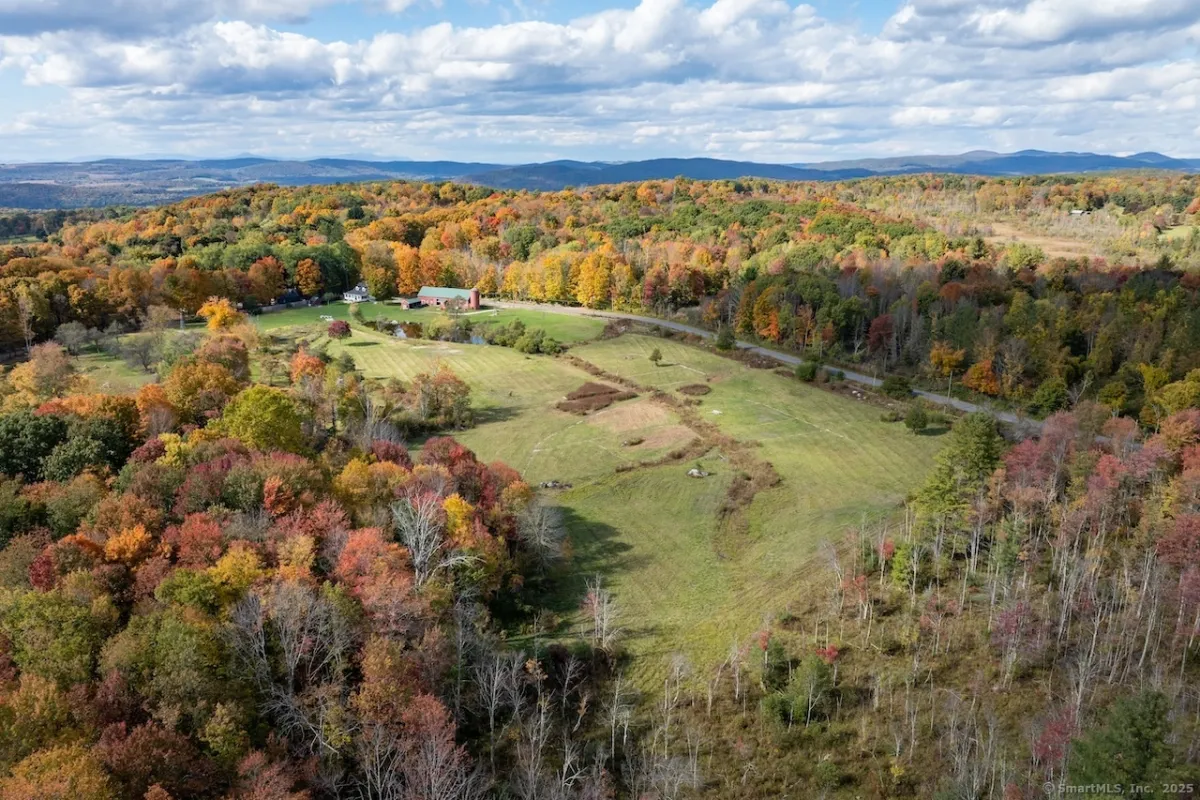
A hundred acres sounds like a straightforward asset. In Litchfield County, Connecticut’s luxury land market, it is the beginning of a more complicated conversation. Whether those hundred acres are worth $5,000 per acre or $25,000 per acre depends on a set of variables that do not appear in the listing description and are not visible on a satellite map. Understanding them is the difference between a sound land purchase and an expensive lesson.
Bill Melnick of Elyse Harney Real Estate works with land buyers across Sharon, Connecticut and the surrounding Litchfield County market, where the gap between high-value and low-value acreage is wide and consistently misunderstood by buyers coming from markets where lot size is a more reliable proxy for value.
“Not every 50 or 100 acre property is the same,” Melnick said. “There might be 100 acres that’s only worth $5,000 an acre because it has a lot of wetlands, maybe it’s wooded and not cleared, maybe it’s in a valley and not on top of a hill. But then there could be 50 or 100 acres worth $15,000, $20,000, $25,000 an acre because it has great views, the ability to parcel off another lot, and conservation land abutting it.”
The Characteristics That Define Land Value
The variables that separate high-value land from low-value land in this market fall into several distinct categories, and experienced buyers evaluate all of them before arriving at a number.
Topography is the first. Land on a ridge or hilltop, with views across protected conservation land or a valley, commands a premium over land in a low-lying area that offers no sightlines and limited building options. The view from a building site is a permanent asset. It cannot be added retroactively, and it cannot be taken away if the surrounding land is protected.
Wetlands are the second variable, and one of the most consequential. Wetland-heavy parcels limit the buildable area significantly. Connecticut regulations require a minimum setback between septic systems and wetlands, and the percolation test, which measures the soil’s ability to absorb water, determines whether a septic system can be approved and installed at all. A parcel with attractive total acreage but poor percolation results may have a buildable envelope of a fraction of its total size.
The building envelope itself is the third consideration. How much of the parcel is actually available for construction, driveway installation, and the grading required for a livable site? A large parcel with most of its acreage on steep ledge or in a flood zone may offer less practical buildability than a smaller parcel on clear, level ground with good access. Ultimately, evaluating land requires looking beyond its acreage to understand how its natural characteristics, location, and potential uses contribute to its overall value.”
Driveway cost is the fourth, and one that buyers most consistently underestimate. In Sharon and the surrounding hill towns, a long driveway up a steep site can cost hundreds of thousands of dollars. Ledge removal, which is common in this terrain, adds further cost and time. Buyers who have factored the land acquisition cost and the construction cost into their budget sometimes discover that the driveway alone meaningfully changes their financial picture.
The Conservation Adjacency Premium
Land that abuts existing conservation land carries a specific premium that reflects something beyond the immediate property. When a parcel’s neighboring land is permanently protected from development, the buyer has a structural guarantee: the views, the open fields, the ridgeline, the woodland visible from their property cannot be subdivided, cleared, or built upon. That guarantee has a dollar value, and sophisticated buyers price it into what they are willing to pay.
“Anything that will ensure the buyer that the land will continue to stay like that and be as beautiful as it is today in 20 or 40 or 50 years adds to the price of the acreage and therefore of the property in total,” Melnick said.
The Sharon Land Trust, which Melnick sits on, actively acquires and preserves land in the town, adding to the overall stock of protected parcels and strengthening the conservation adjacency premium for existing properties nearby.
The Construction Cost Reality
For buyers considering raw land with the intention of building, the current construction cost environment in Litchfield County adds a significant variable to the analysis. Custom home construction in the area is currently running between $1,000 and $1,500 per square foot, a figure that has increased substantially since before the pandemic.
The pattern Melnick sees repeatedly: a buyer purchases land, engages an architect at a cost that can run into six figures, develops detailed plans, and then sends those plans out to bid. The contractor numbers come back significantly above what the buyer had projected. At that point, the economics of purchasing and renovating or expanding an existing structure, even accounting for the architecture fees already spent, often compare favorably to building from scratch.
“Sometimes it often happens that people buy a parcel of land, spend a considerable amount of money with an architect, take their plans to be bid out to contractors, and then get sticker shock,” Melnick said. “Ultimately it’s cheaper and more economic to buy something that already exists. This does not diminish the appeal of building a custom home. For many buyers, the opportunity to create a residence tailored to their needs in an exceptional setting is worth the investment.”
In Sharon and throughout the Litchfield Hills, exceptional land remains one of the defining assets of luxury real estate. Acreage matters, but the most desirable properties offer something beyond size: a compelling landscape, privacy, beautiful views, and a setting that cannot easily be replicated. Understanding those qualities is what ultimately determines the value of the land.
Explore current listings in Litchfield County at Elyse Harney Real Estate.
About the Expert: Bill Melnick is a luxury real estate specialist with Elyse Harney Real Estate, serving Litchfield County and surrounding markets in Connecticut.
This article is based on information provided by the expert source cited above. It is intended for general informational purposes only and does not constitute legal, financial, or real estate advice. Readers should conduct their own research and consult qualified professionals before making any real estate or financial decisions.