OLED provider Universal Display (NASDAQ: OLED) missed Wall Street’s revenue expectations in Q3 2026, but revenue rose 14.9% year on year to $160.4 million. On the other hand, the company’s full-year revenue guidance of $650 million at the midpoint came in 3.1% above analysts’ consensus estimates. Its GAAP profit of $1.72 per share was 50.9% above analysts’ consensus estimates.
For more on Universal Display, read our free full research report.
Universal Display (OLED) Q3 2026 highlights:
- Revenue $160.4 million vs S&P analysts’ consensus estimates of $162.6 million (14.9% year-on-year growth, 1.3% miss)
- EPS (GAAP) $1.72 vs analysts’ consensus estimates of $1.14 (50.9% beat)
- Revenue guidance The company reconfirmed its revenue guidance for the full year of $650 million at the midpoint
- Operating margin 33.5%, up from 30.9% in the same quarter last year
- Free cash flow margin 59.8%, similar to the same quarter last year
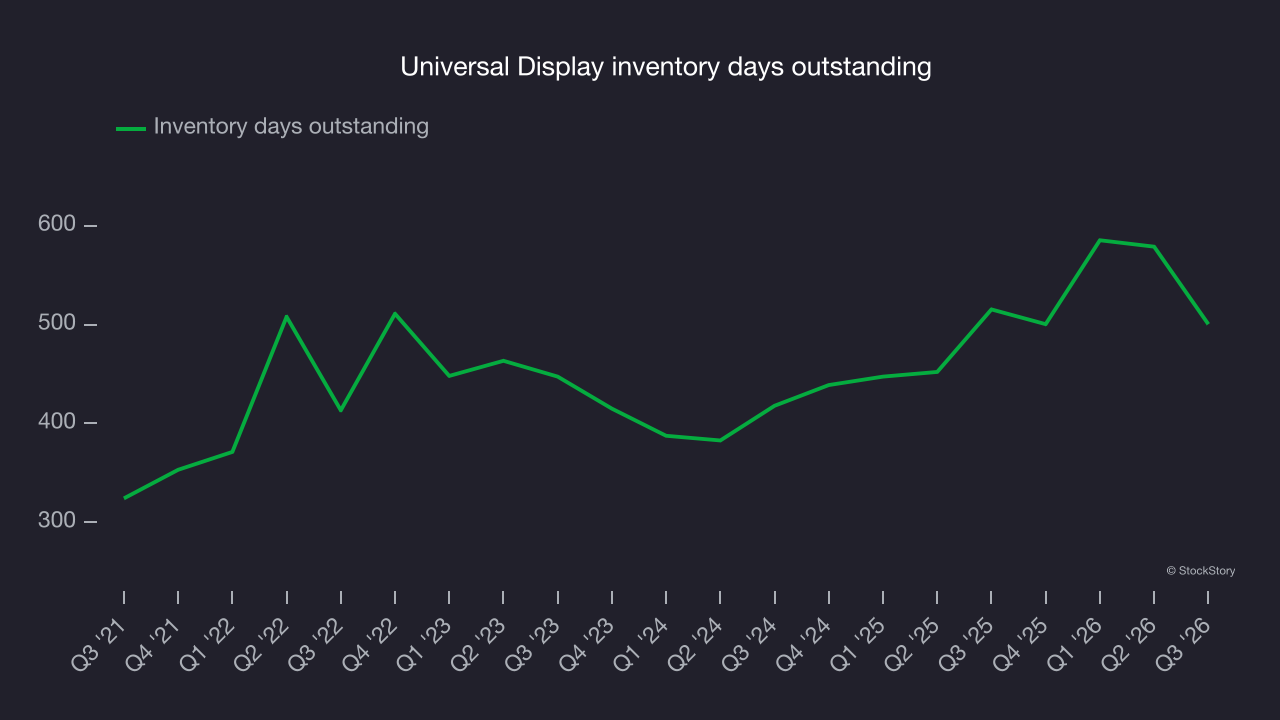
- Inventory days outstanding 500, down from 579 in the previous quarter
- Market capitalization $4.15 billion
“The third quarter saw important advancements across our innovation portfolio, in addition to continued momentum across the OLED ecosystem, from investments in new OLED capacity and the expansion of foldable and IT OLED products,” said Brian Millard, Chief Financial Officer of Universal Display Corporation. “During the quarter, we introduced OLEDX, advanced our phosphorescent blue program, expanded our AI-enabled materials discovery capabilities, and achieved a key commercialization milestone with the launch of UVJC’s first equipment platform. As OLED adoption broadens across new products, applications and form factors, we see the industry becoming increasingly focused on higher performance, greater power efficiency and enhanced user experiences. These evolving requirements align with our innovation strategy and reinforce our confidence in the long-term opportunities for our technologies and the value we believe they can create for customers and shareholders.”
Revenue growth
A company’s long-term revenue performance can indicate its overall quality. Any business can deliver a good quarter or two, but many enduring ones grow for years. Universal Display’s revenue grew at a tepid 2.7% annualized rate over the last five years, falling short of our standards. Semiconductors are a cyclical industry, and long-term investors should be prepared for periods of high growth followed by periods of revenue contractions.
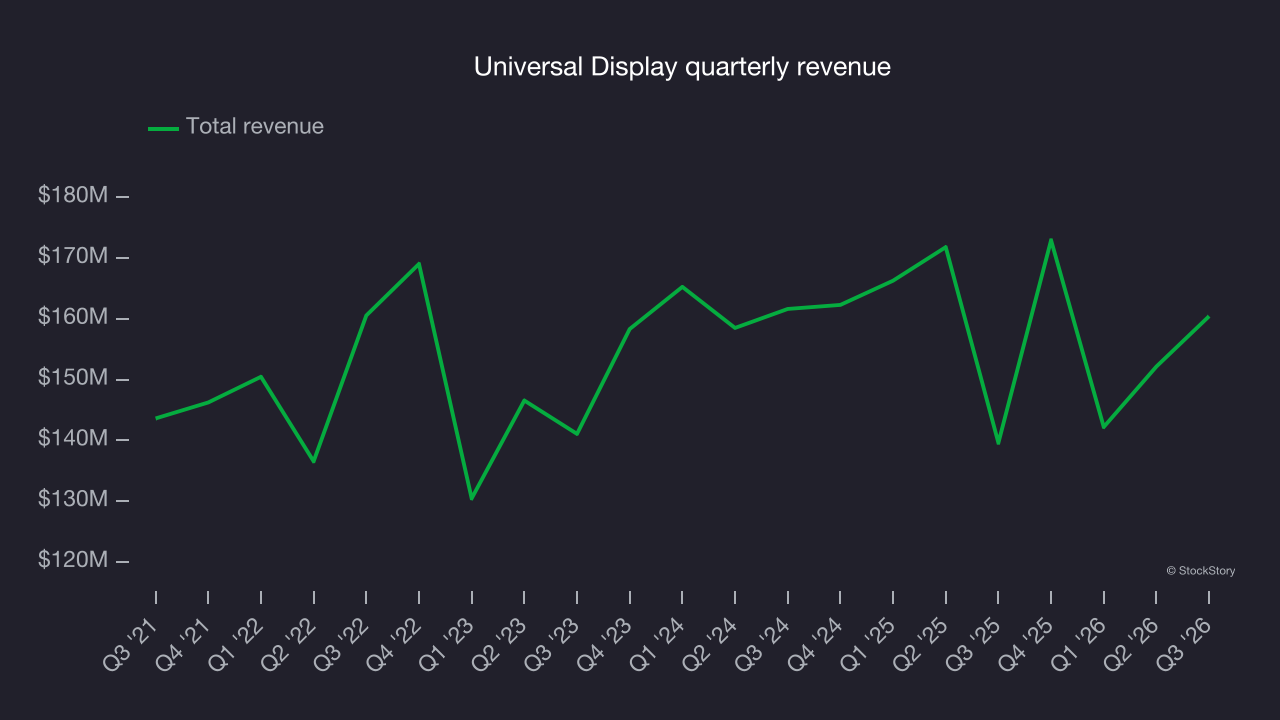
Long-term growth matters most, but within semiconductors, a half-decade historical view may miss new demand cycles or industry trends like AI. Universal Display’s performance shows it grew in the past but relinquished its gains over the last two years, as its revenue fell by 1.2% annually. 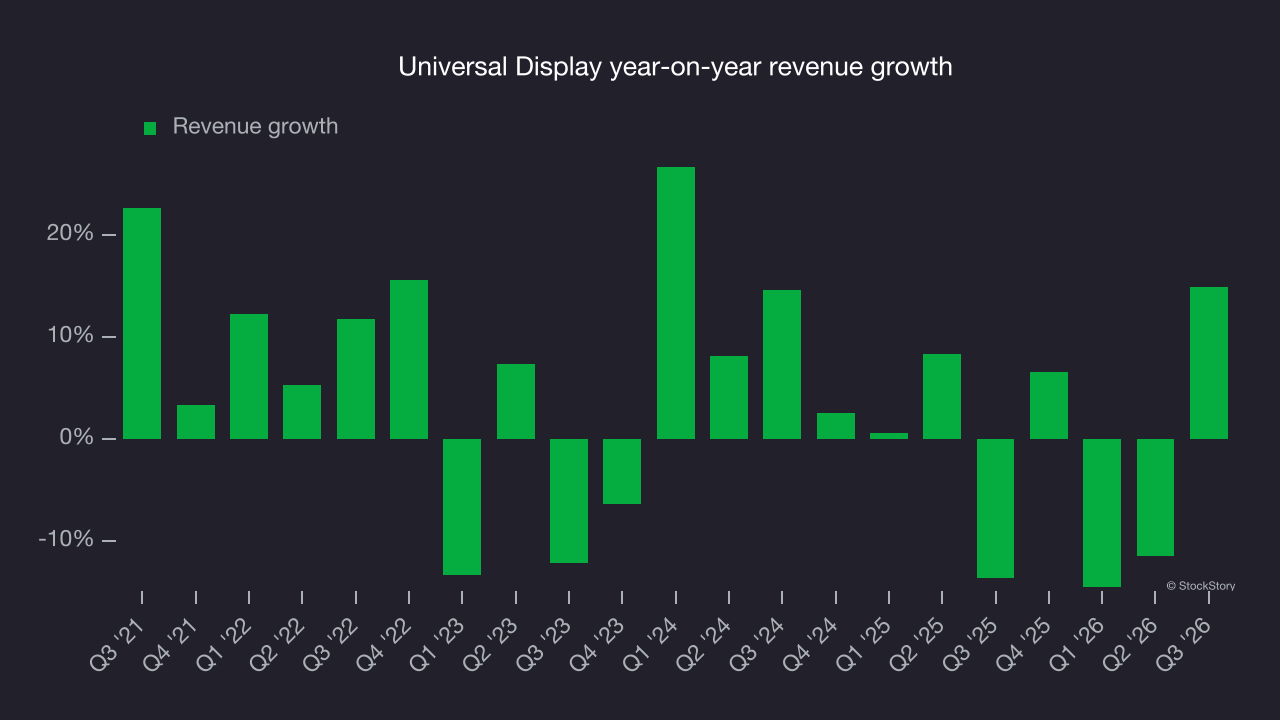
This quarter, Universal Display’s revenue grew by 14.9% year on year to $160.4 million but fell short of Wall Street’s consensus estimates. Despite the miss, Universal Display’s growth inflected positively this quarter, likely offering some encouragement to shareholders.
Looking ahead, sell-side analysts expect revenue to grow 6.5% over the next 12 months, according to S&P. Although this projection implies its newer products and services will spur better top-line performance, it is still below the sector average.
Product demand & outstanding inventory
Days Inventory Outstanding (DIO) is an important metric for chipmakers, as it reflects a business’s capital intensity and the cyclical nature of semiconductor supply and demand. In a tight supply environment, inventories tend to be stable, allowing chipmakers to exert pricing power. Steadily increasing DIO can be a warning sign that demand is weak, and if inventories continue to rise, the company may have to downsize production.
This quarter, Universal Display’s DIO came in at 500, which is 44 days above its five-year average. These numbers suggest that despite the recent decrease, the company’s inventory levels are higher than in the past.
Key takeaways from Universal Display’s Q3 results
Universal Display delivered mixed results in Q3: Inventory levels improved sharply and EPS beat Wall Street’s consensus estimates, but revenue missed slightly and operating income also fell short of consensus. Shares rose 2.5% to $92.61 immediately after the release.
Is Universal Display an attractive investment at the current price? That decision should take into account valuation, business quality and the latest earnings. For more on Universal Display, read our full research report here (it’s free).