Life sciences company Azenta (NASDAQ: AZTA) reported calendar Q3 2026 (fiscal Q4 2026) results topping the market’s revenue expectations, with revenue up 5.1% year on year to $167.1 million. Its non-GAAP profit of $0.28 per share was significantly above analysts’ consensus estimates.
For more on Azenta, read our free full research report.
Azenta (AZTA) Q3 CY2026 highlights:
- Revenue $167.1 million vs S&P analyst consensus of $160.2 million (5.1% year-on-year growth, 4.3% beat)
- Adjusted EPS $0.28 vs S&P analyst consensus of $0.11 (significant beat)
- Adjusted EBITDA $19.37 million vs analysts’ consensus estimates of $17.23 million (11.6% margin, 12.4% beat)
- Operating margin 1.5%, in line with the same quarter last year
- Free cash flow $11.86 million, up from -$5.68 million in the same quarter last year
- Market capitalization $1.79 billion
Management Comments "We closed fiscal 2026 with improving momentum, delivering stronger performance in the second half of the year. Our businesses have strong market positions and differentiated capabilities, and we are seeing progress from our efforts to improve commercial execution and operating efficiency," said Dr. Martin Madaus, Interim President and Chief Executive Officer. "We also took several actions to streamline our cost structure while advancing the strategic objective to turn Multiomics into a growth engine for Azenta."
Revenue growth
Examining a company’s long-term performance can provide clues about its quality. Even a weak business can perform well for one or two quarters, but a high-quality one grows for years. Azenta’s revenue grew at a tepid 3.9% compounded annual growth rate over the last five years, falling short of the healthcare sector standard.
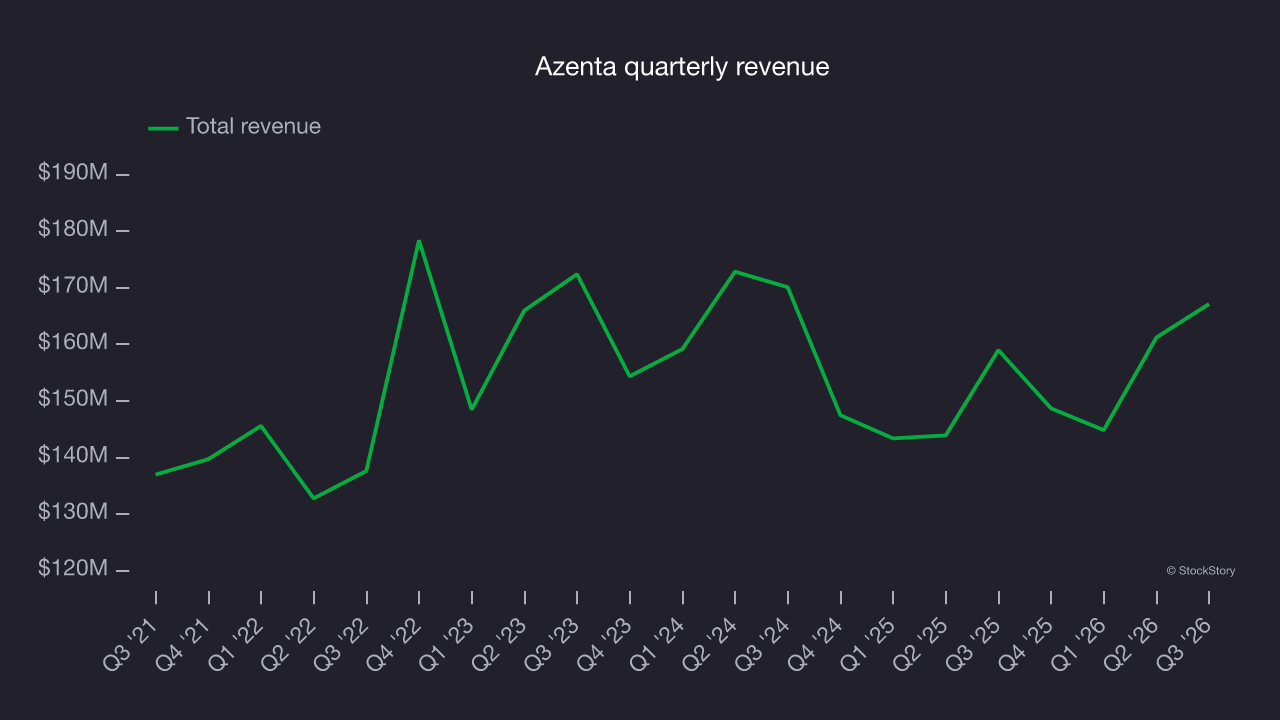
Long-term growth is the most important, but within healthcare, a half-decade historical view may miss new innovations or demand cycles. Azenta’s performance shows it grew in the past but relinquished its gains over the last two years, as its revenue fell by 2.7% annually. 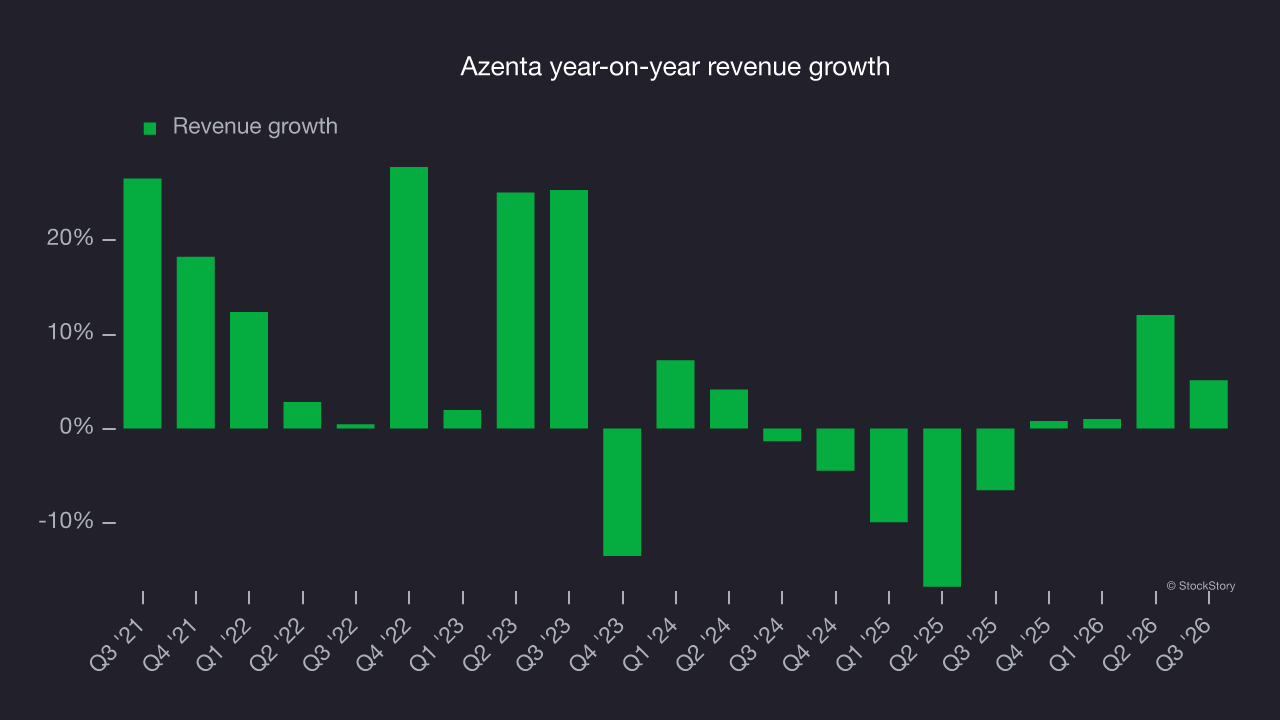
We can better understand the company’s revenue dynamics by analyzing its most important segment, Sample Management. Over the last two years, Azenta’s Sample Management revenue averaged 3.9% year-on-year growth. This segment has outperformed its total revenue during the same period, lifting the company’s performance. 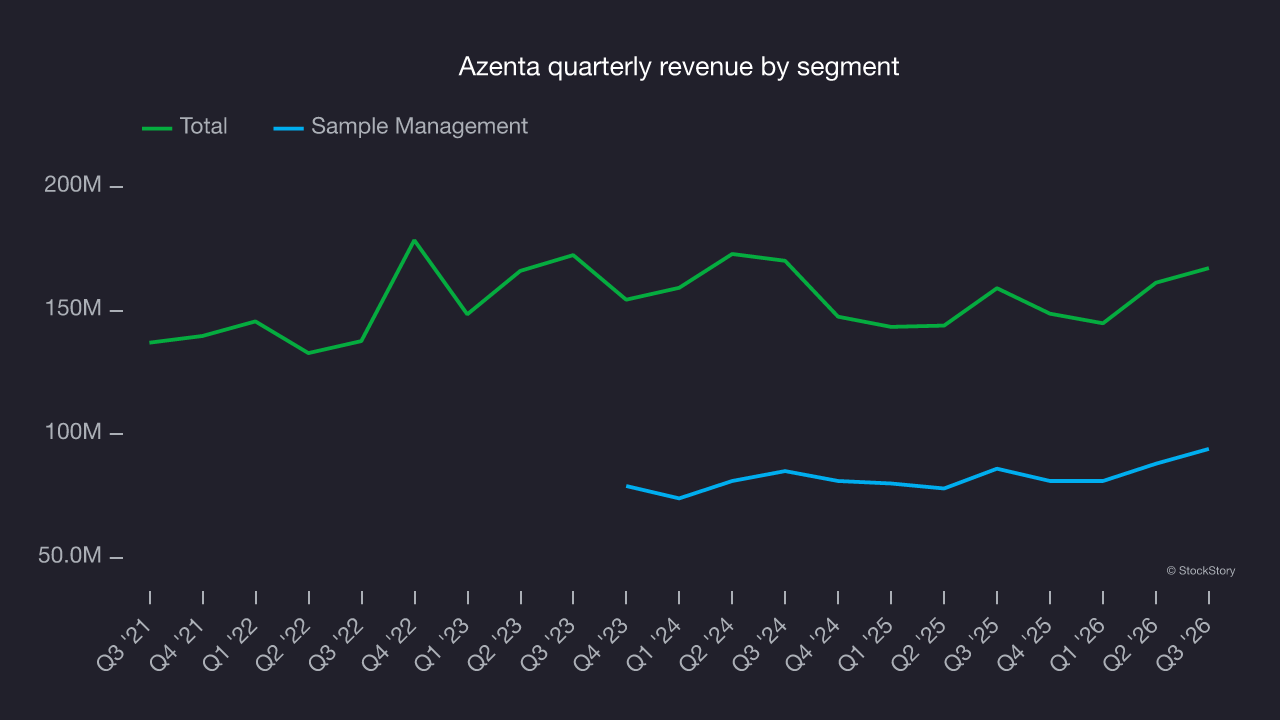
This quarter, Azenta reported year-on-year revenue growth of 5.1%, and its $167.1 million of revenue exceeded Wall Street’s consensus estimates by 4.3%.
Looking ahead, sell-side analysts expect revenue to grow 2.8% over the next 12 months, according to S&P. While this projection suggests its newer products and services will fuel better top-line performance, it is still below the sector average.
Adjusted operating margin
Adjusted operating margin is a key measure of profitability. Think of it as net income (the bottom line) excluding the impact of non-recurring expenses, taxes and interest on debt – metrics less connected to business fundamentals.
Azenta was roughly breakeven when averaging the last five years of quarterly operating profits, poor for a healthcare business.
Looking at the trend in its profitability, Azenta’s adjusted operating margin decreased by 5.4 percentage points over the last five years. This raises questions about the company’s expense base because its revenue growth should have given it leverage on its fixed costs, resulting in better economies of scale and profitability. Azenta’s performance was poor, showing that costs were rising and it couldn’t pass them on to its customers.
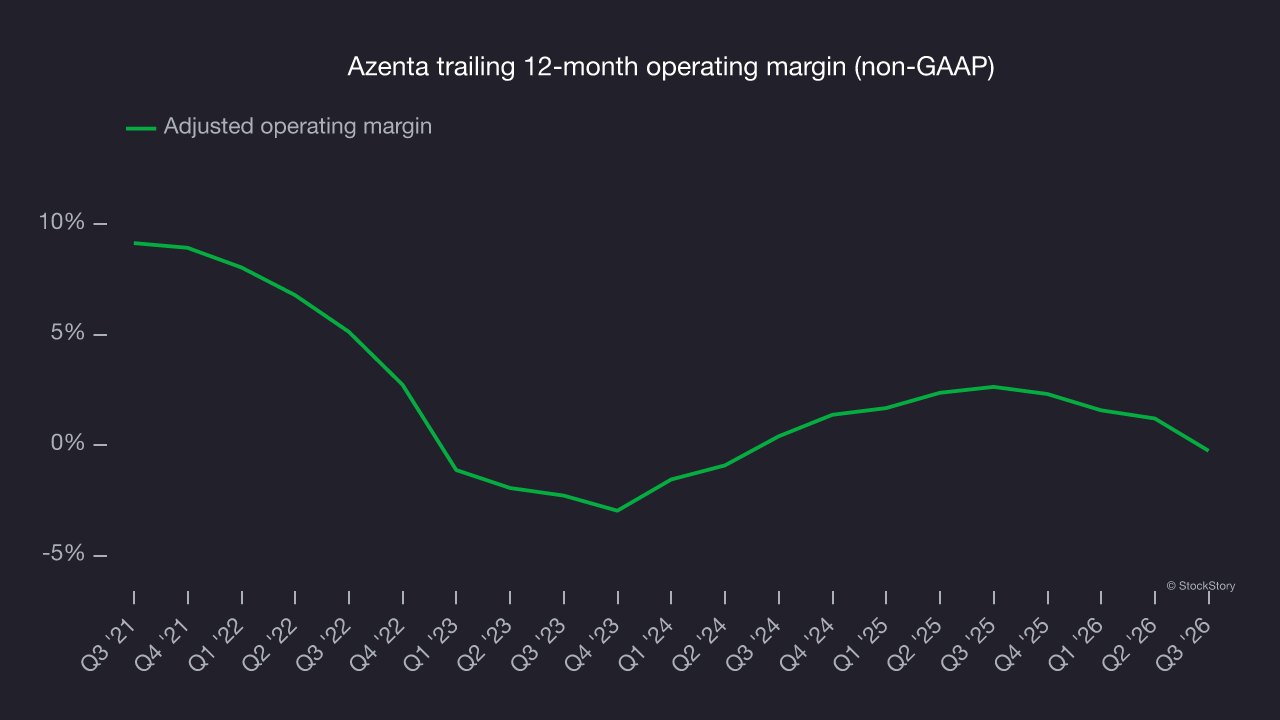
This quarter, Azenta’s breakeven margin was 0.1%, down 5.7 percentage points year on year. This contraction shows it was less efficient because its expenses grew faster than its revenue.
Earnings per share
Long-term changes in earnings per share, or EPS, matter for the same reason as long-term revenue growth. Compared to revenue, however, EPS highlights whether a company’s growth is profitable.
Azenta’s EPS declined by 28.3% annually over the last five years while its revenue grew by 3.9%. This indicates the company became less profitable on a per-share basis as it expanded due to non-fundamental factors such as interest expenses and taxes.
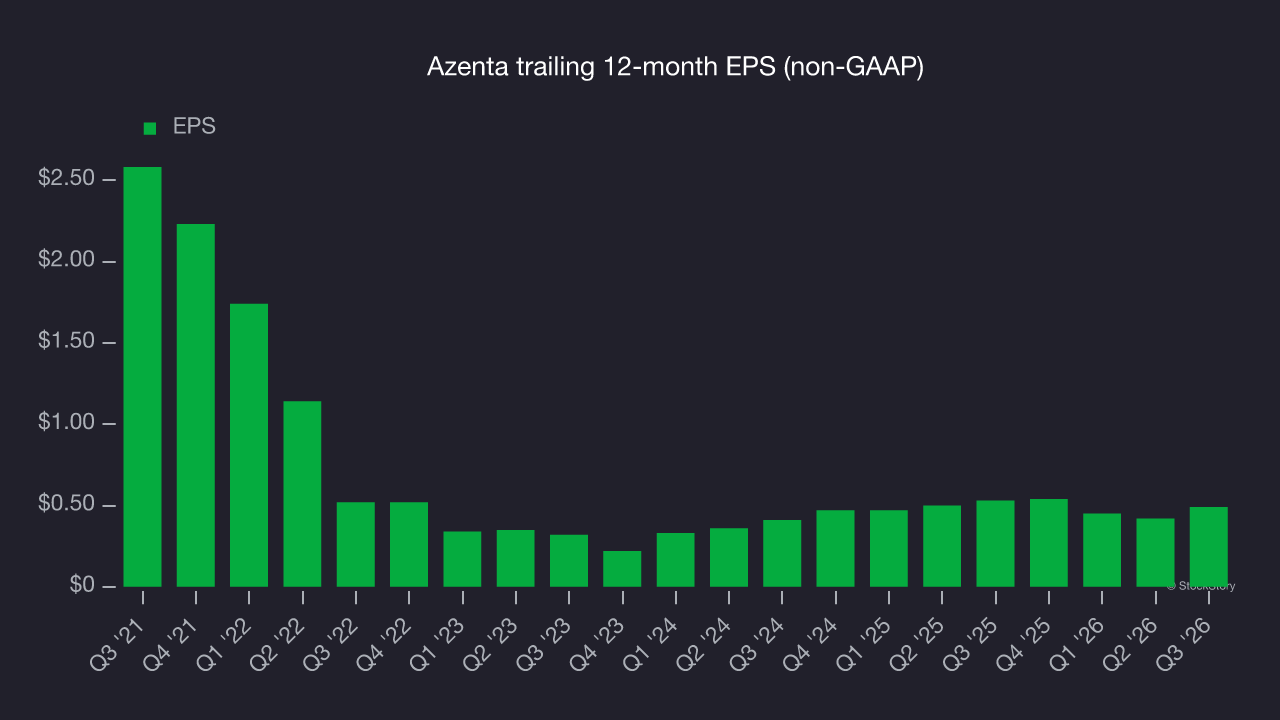
A closer look at Azenta’s earnings helps explain its performance. As noted earlier, Azenta’s adjusted operating margin declined by 5.4 percentage points over the last five years. This was the most relevant factor (aside from the revenue impact) behind its lower earnings; interest expenses and taxes can also affect EPS but reveal less about a company’s fundamentals.
In Q3, Azenta reported adjusted EPS of $0.28, up from $0.21 in the same quarter last year. EPS came in well ahead of analysts’ consensus estimates, a positive result for shareholders. Over the next 12 months, Wall Street expects Azenta’s full-year EPS to grow 18.4% from $0.49 to $0.58, according to S&P.
Key takeaways from Azenta’s Q3 results
With revenue and EPS both topping analysts’ consensus estimates, Azenta delivered a strong quarter with clear positives. Shares soared 10.3% to $44.74 immediately after the results.
Azenta had a solid quarter, but assessing whether the stock is a buy requires a broader view. That decision should take into account valuation, business quality and the latest earnings. For more on Azenta, read our full research report here (it’s free).