Insulin delivery company Insulet Corporation (NASDAQ: PODD) reported Q3 2026 results exceeding the market’s revenue expectations, with revenue up 19.2% year on year to $842 million. Its non-GAAP profit of $1.99 per share was 25.4% above analysts’ consensus estimates.
For more on Insulet, read our free full research report.
Insulet (PODD) Q3 2026 highlights:
- Revenue $842 million vs S&P analysts’ consensus estimates of $831.9 million (19.2% year-on-year growth, 1.2% beat)
- Adjusted EPS $1.99 vs S&P analysts’ consensus estimates of $1.59 (25.4% beat)
- Adjusted EBITDA $233.7 million vs analysts’ consensus estimates of $197.2 million (27.8% margin, 18.5% beat)
- Operating margin 22.5%, up from 16.7% in the same quarter last year
- Free cash flow margin 7.9%, down from 14.2% in the same quarter last year
- Constant currency revenue rose 19.6% year on year (28.2% in the same quarter last year)
- Market capitalization $10.74 billion
“Our team delivered a strong quarter, with revenue growth of nearly 20% and significant margin expansion,” said Ashley McEvoy, President and CEO. “We are making continued progress on our type 2 action plan, strengthening our commercial capabilities, expanding our customer base, increasing manufacturing scale and advancing innovation. As we look ahead, the business is well positioned for durable, profitable growth. The share repurchase we are announcing today demonstrates our confidence in the strength of the Omnipod platform and Insulet's long-term trajectory.”
Revenue growth
Examining a company’s long-term performance can provide clues about its quality. Any business can put up a good quarter or two, but many enduring ones grow for years. Over the last five years, Insulet grew its revenue at a strong 25.2% compounded annual growth rate. Its growth surpassed the average healthcare company and shows its offerings resonate with customers.
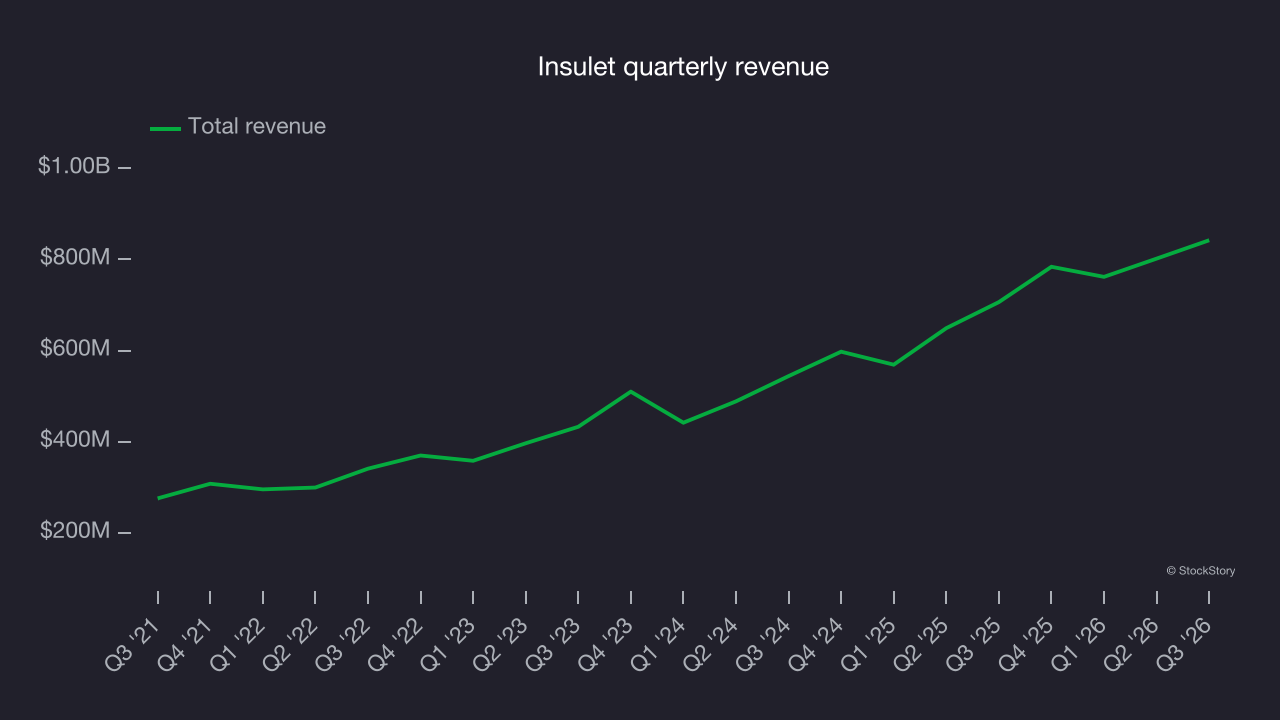
Long-term growth is the most important, but within healthcare, a half-decade historical view may miss new innovations or demand cycles. Insulet’s annualized revenue growth of 26.8% over the last two years is above its five-year trend, suggesting its demand was strong and recently accelerated. 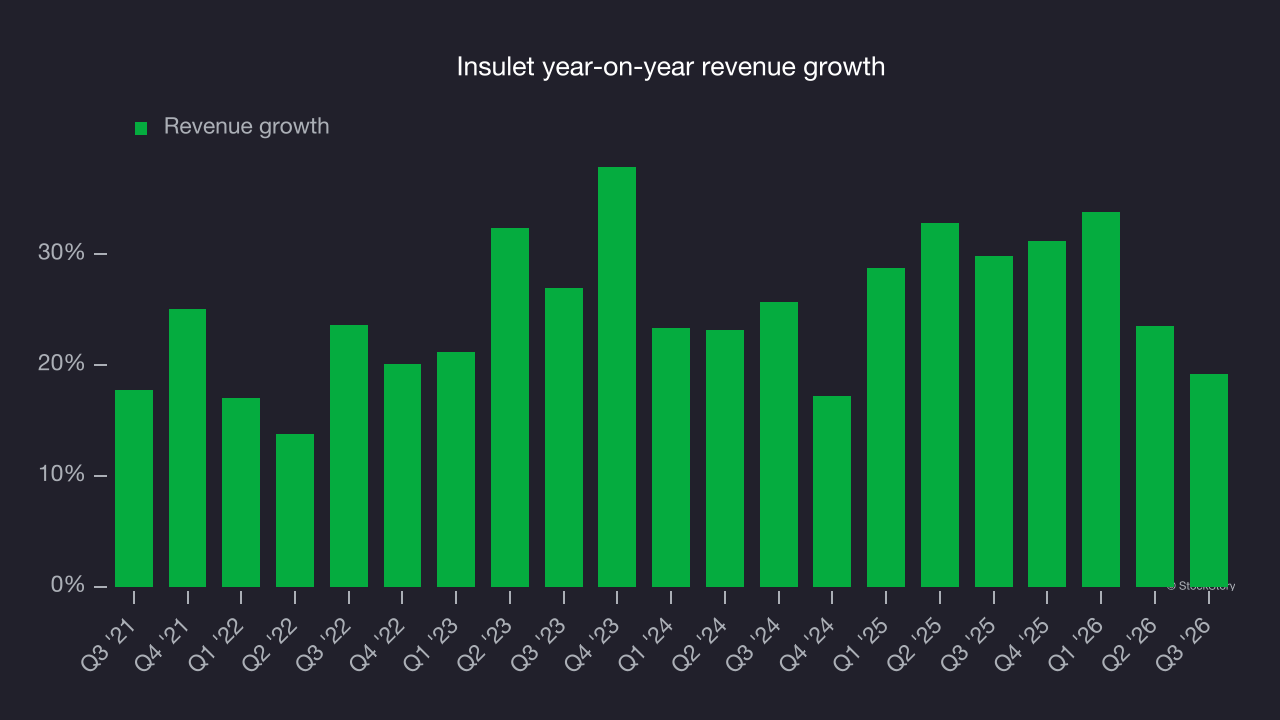
Constant currency revenue helps clarify the company’s revenue dynamics by excluding currency movements that are outside its control and not indicative of demand. Over the last two years, its constant currency revenue averaged 26% year-on-year growth. This was in line with reported revenue growth, indicating that foreign exchange has not had a meaningful impact on revenue. 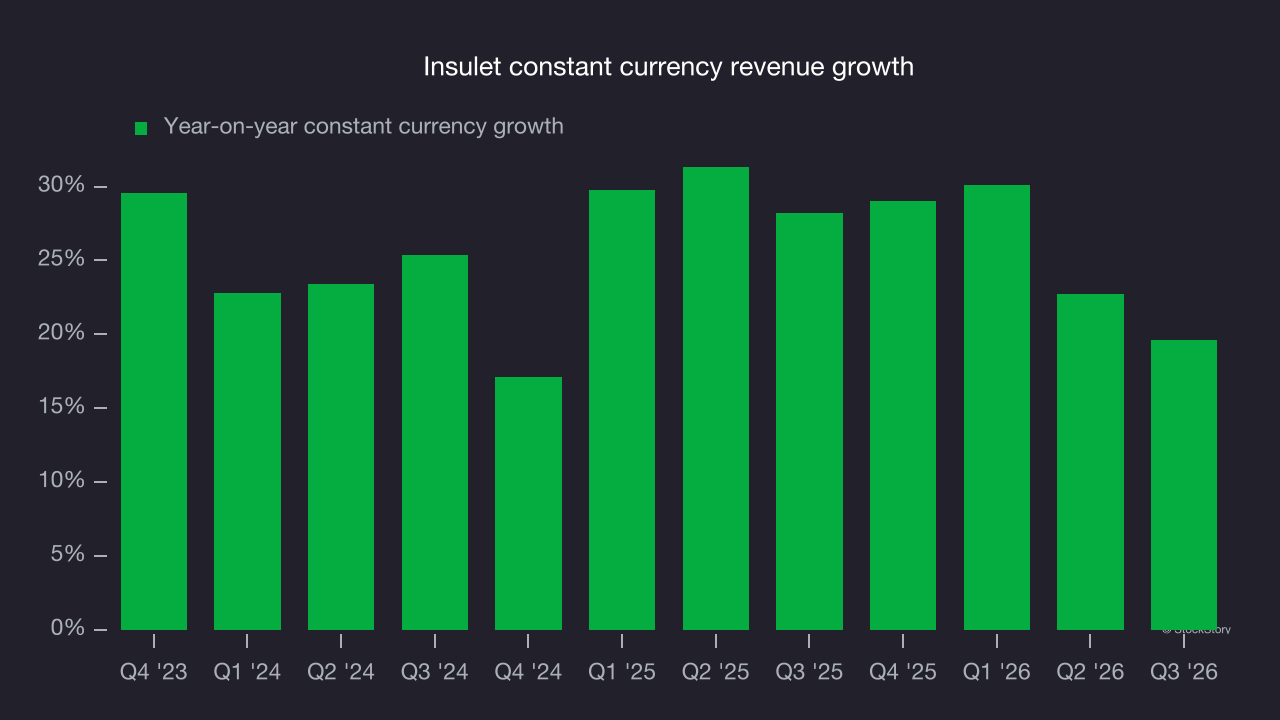
This quarter, Insulet reported year-on-year revenue growth of 19.2%, and its $842 million of revenue exceeded Wall Street’s consensus estimates by 1.2%.
Looking ahead, sell-side analysts expect revenue to grow 13.4% over the next 12 months, according to S&P, a deceleration versus the last two years. Despite the slowdown, this projection is strong and suggests the market is forecasting success for its products and services.
Adjusted operating margin
Insulet has managed its cost base well over the last five years. It demonstrated solid profitability for a healthcare business, producing an average adjusted operating margin of 15.9%.
Insulet’s adjusted operating margin rose by 9.6 percentage points over the last five years, as its revenue growth gave it operating leverage. More recently, the company’s trajectory has remained intact, with its margin increasing by 4.8 percentage points over two years. These gains are a positive sign and show continued momentum.
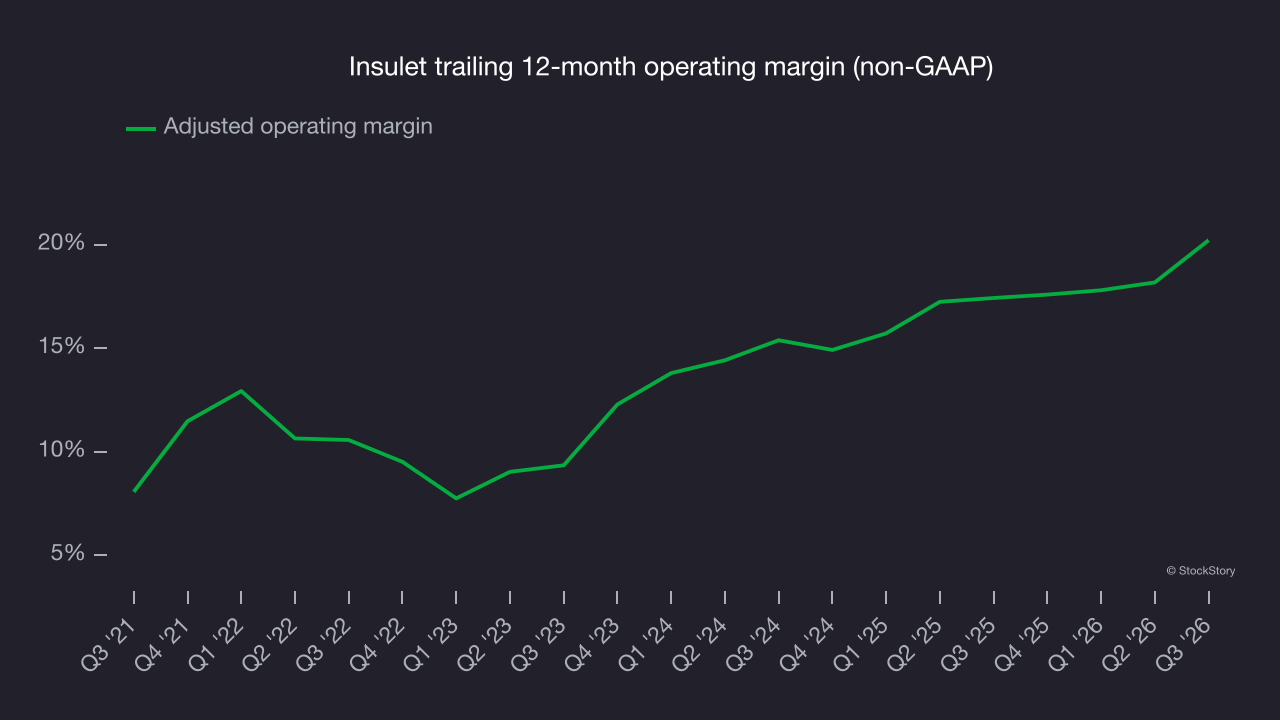
In Q3, Insulet generated an adjusted operating margin of 25%, up 7.9 percentage points year on year. This was a positive development, reflecting improved efficiency.
Earnings per share
Long-term changes in earnings per share (EPS) matter for the same reason as long-term revenue growth. Compared to revenue, however, EPS highlights whether a company’s growth is profitable.
Insulet’s EPS grew at an 85.8% compounded annual growth rate over the last five years, higher than its 25.2% annualized revenue growth. This indicates the company became more profitable on a per-share basis as it expanded.
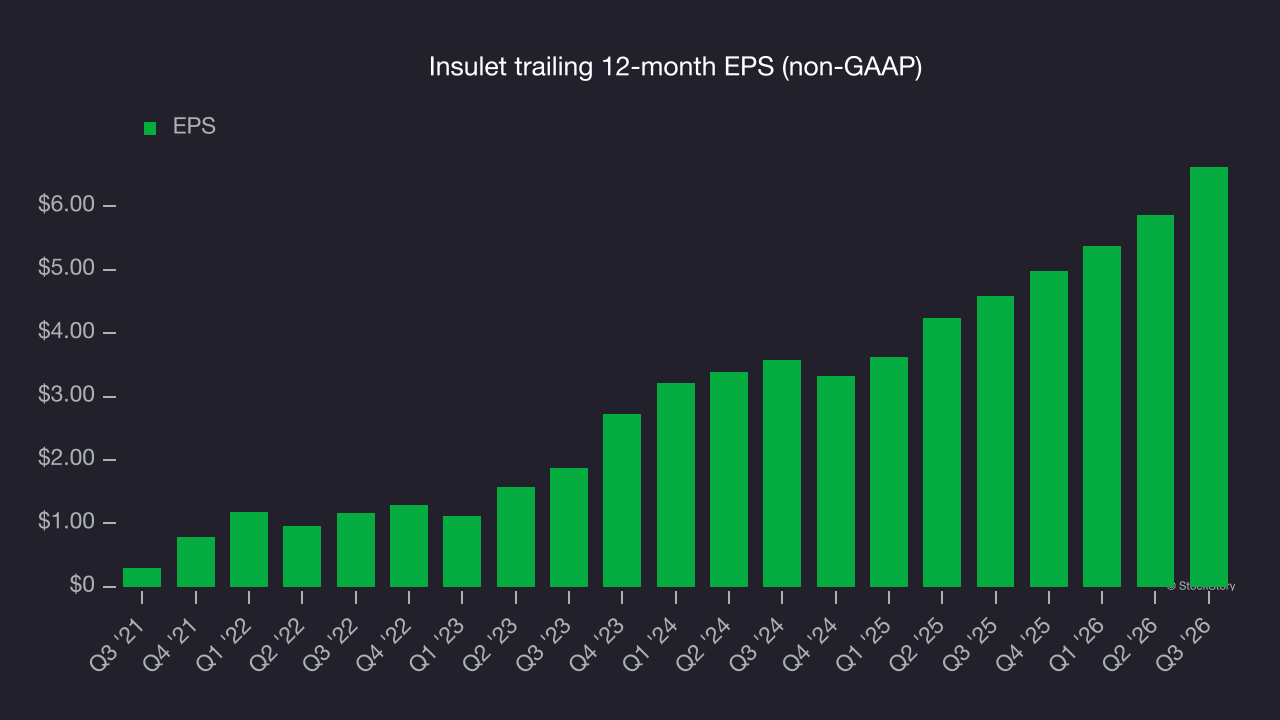
Examining Insulet’s quality of earnings helps explain its performance. As mentioned earlier, Insulet’s adjusted operating margin expanded by 9.6 percentage points over the last five years. This was the most relevant factor (aside from the revenue impact) behind its higher earnings; interest expenses and taxes can also affect EPS but don’t tell us as much about a company’s fundamentals.
In Q3, Insulet reported adjusted EPS of $1.99, up from $1.24 in the same quarter last year. This result came in well ahead of analysts’ consensus estimates. Over the next 12 months, Wall Street expects Insulet’s full-year EPS to grow 10.6% from $6.62 to $7.32, according to S&P.
Key takeaways from Insulet’s Q3 results
Insulet’s Q3 results had some clear positives: EPS beat analysts’ consensus estimates and revenue edged past Wall Street’s consensus. Shares surged 5.5% to $163.34 immediately after the release.
Insulet had a solid quarterly earnings result, but assessing the stock as an investment requires more context. It’s important to consider its valuation, business qualities and latest quarterly results. For more on Insulet, read our full research report here (it’s free).