Recreational boat manufacturer Malibu Boats (NASDAQ: MBUU) missed Wall Street’s revenue expectations in calendar Q3 2026 (fiscal Q1 2027), but revenue rose 29.9% year on year to $252.9 million. Next quarter’s revenue guidance of $242 million underwhelmed, coming in 2.4% below analysts’ consensus estimates. Its non-GAAP profit of $0.15 per share was 33.5% below analysts’ consensus estimates.
For more on Malibu Boats, read our full research report, available free.
Malibu Boats (MBUU) Q3 CY2026 highlights:
- Revenue $252.9 million vs S&P analysts’ consensus estimates of $257.2 million (29.9% year-on-year growth, 1.6% miss)
- Adjusted EPS $0.15 vs S&P analysts’ consensus estimates of $0.23 (33.5% miss)
- Adjusted EBITDA $14.35 million vs analysts’ consensus estimates of $16.79 million (5.7% margin, 14.6% miss)
- Revenue guidance $242 million at the midpoint for Q4 CY2026, below analysts’ consensus estimates of $247.9 million
- EBITDA guidance $14 million at the midpoint for Q4 CY2026, below analysts’ consensus estimates of $16.8 million
- Operating margin 5.2%, up from -0.4% in the same quarter last year
- Market capitalization $487 million
“Our results for the three months ended September 30, 2026 reflect a softer retail environment over the summer and our decision to manage wholesale shipments with discipline to protect dealer health, which kept net sales modestly below our guided range and constrained adjusted EBITDA. Cobalt and our Saltwater brands grew volume and Saxdor contributed meaningfully to growth, which was partially offset by softer demand in the ski/wake boat category, where Malibu continued to gain share amid a challenging environment,” said Steve Menneto, President and Chief Executive Officer of Malibu Boats, Inc. “We will continue to align wholesale shipments with retail demand to support our dealers through this cycle, and our outlook for the next quarter reflects that approach. At the same time, we are making tangible progress on our long-term priorities, from completing our first U.S.-built Saxdor boats at Fort Pierce to debuting new models across our brands at the Fort Lauderdale International Boat Show. We remain intentional about our outlook until we see more durable evidence of a broader recovery, but our conviction in Build, Innovate, Grow and the mid-cycle opportunity in front of us remains strong.”
Revenue growth
Examining a company’s long-term performance can provide clues about its quality. Any business can experience short-term success, but top-performing ones enjoy sustained growth for years. Malibu Boats struggled to consistently increase demand as its trailing 12-month revenue of $972.8 million was close to its revenue five years ago. This was below our standards and is a sign of poor business quality.
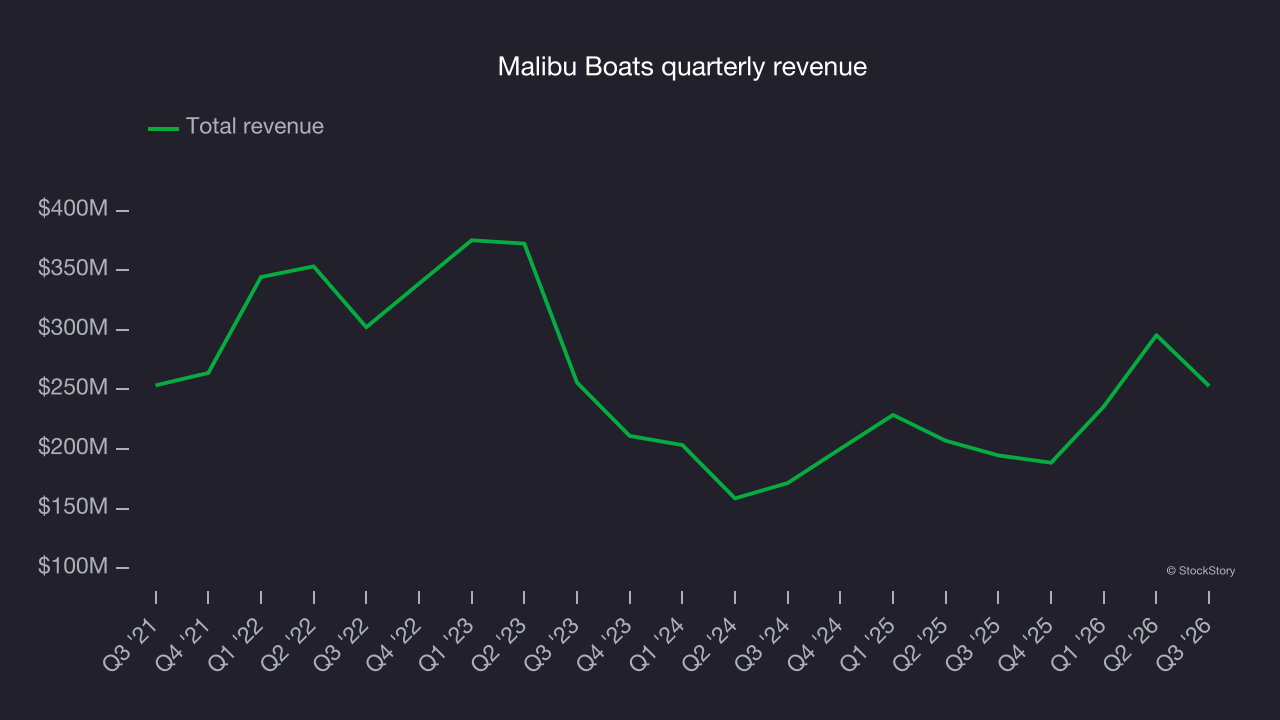
Long-term growth matters most, but within consumer discretionary, a stretched historical view may miss a company riding a successful new product or trend. Malibu Boats’s annualized revenue growth of 14.3% over the last two years is above its five-year trend, a positive sign. 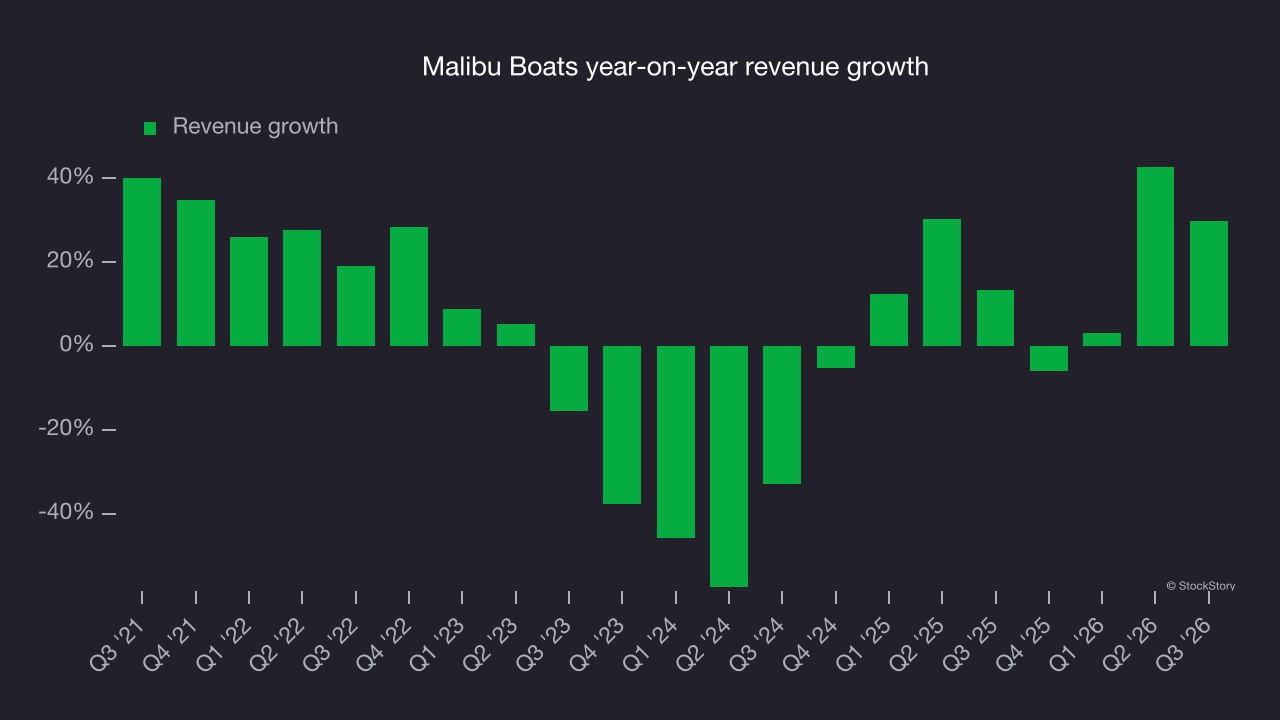
This quarter, Malibu Boats generated strong year-on-year revenue growth of 29.9%, but its $252.9 million of revenue fell short of Wall Street’s high expectations. Management is guiding for a 28.3% year-on-year increase in revenue next quarter.
Looking further ahead, sell-side analysts expect revenue to grow 17% over the next 12 months, according to S&P, an improvement versus the last two years. That favorable outlook implies its newer products and services will fuel better top-line performance.
Operating margin
Operating margin is a key measure of profitability. Think of it as net income, the bottom line, excluding the impact of taxes and interest on debt, which are less connected to business fundamentals.
Malibu Boats’s operating margin has shrunk over the last 12 months and averaged 2.4% over the last two years. The company’s profitability was mediocre for a consumer discretionary business and shows it couldn’t pass its higher operating expenses onto its customers.
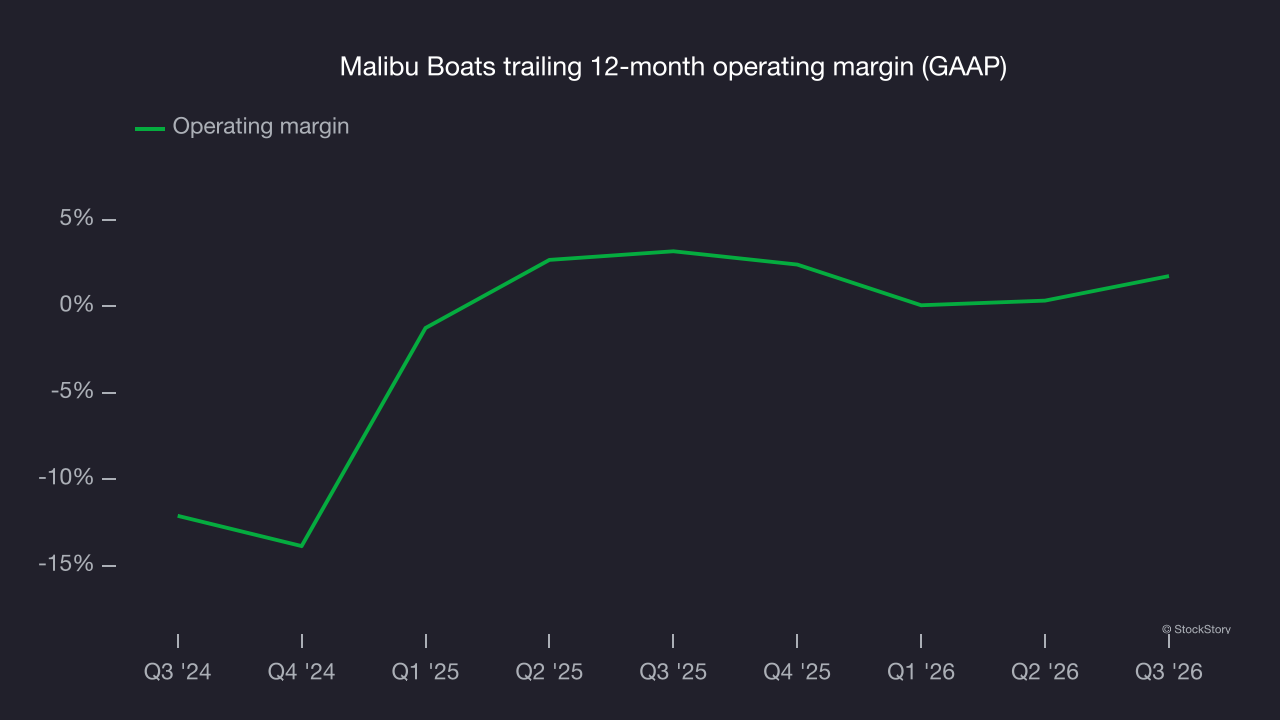
In Q3, Malibu Boats generated an operating margin of 5.2%, up 5.6 percentage points year on year. The increase was a positive development, showing improved efficiency.
Earnings per share
Long-term changes in earnings per share, or EPS, matter for the same reason as long-term revenue growth. Compared to revenue, however, EPS highlights whether a company’s growth is profitable.
Malibu Boats’ EPS declined by 23.8% annually over the last five years while its revenue was flat. The company struggled because its fixed cost base made it difficult to adjust to choppy demand.
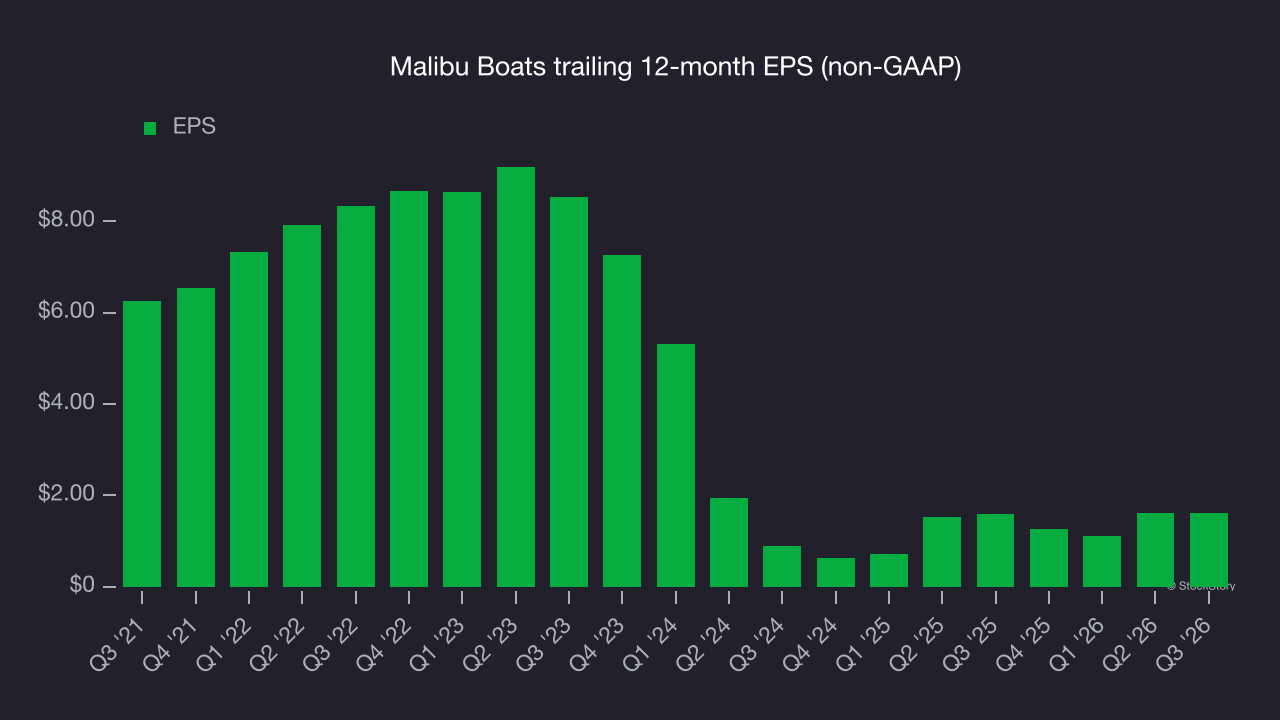
In Q3, Malibu Boats reported adjusted EPS of $0.15, in line with the same quarter last year. This result missed analysts’ consensus estimates. Over the next 12 months, Wall Street expects Malibu Boats’s full-year EPS to grow 61.8% from $1.61 to $2.61, according to S&P.
Key takeaways from Malibu Boats’s Q3 results
Malibu Boats delivered a weaker quarter with few positives: EPS missed expectations, and its EBITDA guidance for next quarter fell short of Wall Street’s consensus. Shares plunged 11.1% to $22 immediately after the results.
Malibu Boats’s latest earnings report disappointed. One quarter doesn’t define a company’s quality, so assessing whether the stock is a buy at the current price requires a broader view. The latest quarter is only one piece of the longer-term business quality puzzle. Quality, combined with valuation, can help determine whether the stock is a buy. For more on Malibu Boats, read our free full research report here.