Fast-food pizza chain Papa John’s (NASDAQ: PZZA) missed Wall Street’s revenue expectations in Q3 2026, with revenue falling 10.5% year on year to $454.8 million. Its non-GAAP profit of $0.16 per share was in line with analysts’ consensus estimates.
For more on Papa John's, read our full research report for free.
Papa John's (PZZA) Q3 2026 highlights:
- Revenue $454.8 million vs S&P analysts’ consensus estimates of $459.8 million (10.5% year-on-year decline, 1.1% miss)
- Adjusted EPS $0.16 vs S&P analysts’ consensus estimates of $0.15 (in line)
- Adjusted EBITDA $38.09 million vs analysts’ consensus estimates of $38.11 million (8.4% margin, in line)
- EBITDA guidance $175 million at the midpoint for the full year, below analysts’ consensus estimates of $180.5 million
- Operating margin 3.1%, in line with the same quarter last year
- Free cash flow margin 2.1%, down from 4.5% in the same quarter last year
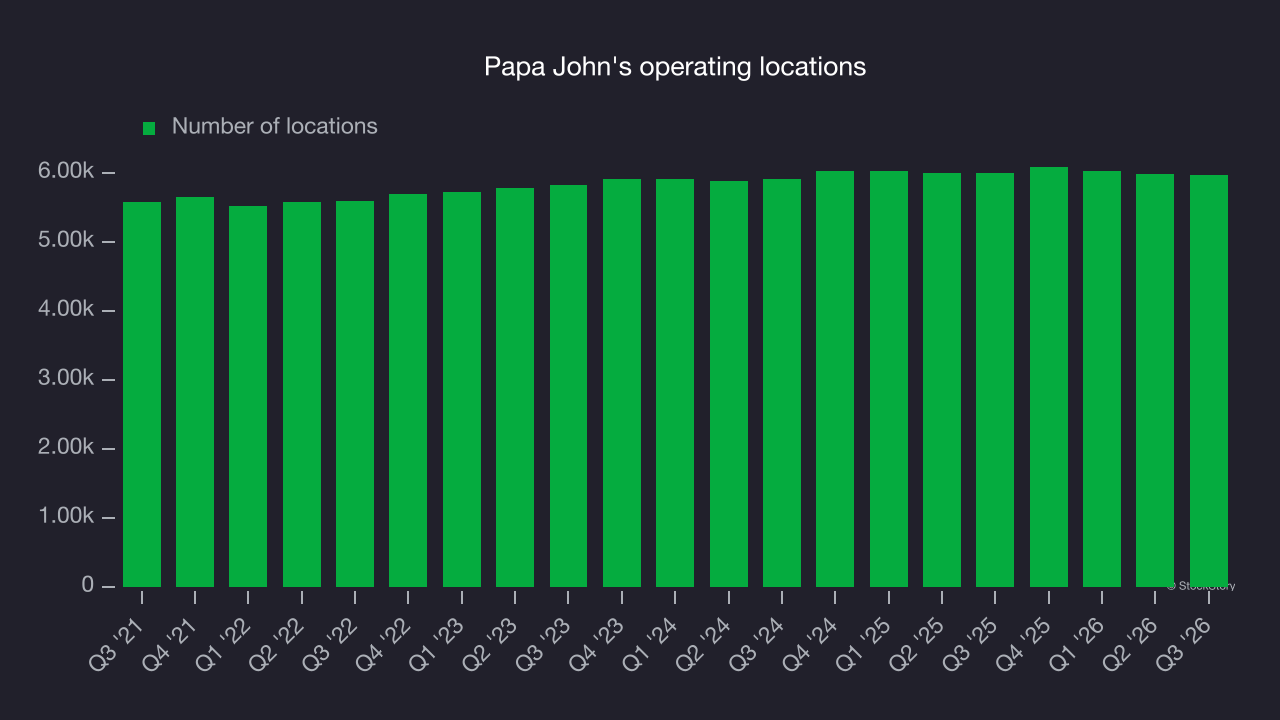
- Locations 5,969 at quarter end, down from 5,994 in the same quarter last year
- Same-store sales fell 6.5% year on year (-0.2% in the same quarter last year)
- Market capitalization $658.1 million
“At its core, Unbox Better is about turning our promise of ‘Better’ into something customers experience every time they interact with our brand, from our food and value proposition to restaurant execution and service. While our third-quarter results reflect continued pressure in a competitive operating environment, we have aligned our company and franchisees behind a clear strategy for growth, supported by a new marketing framework led by increased local marketing investment by our franchisees to complement our national marketing initiatives. This will be combined with core product improvements and operational actions to enhance competitiveness across our system. Together, these efforts are designed to strengthen our competitive position, drive sustainable growth and create long-term value for customers, franchisees and shareholders.”
Revenue growth
A company’s long-term revenue performance is one signal of its overall quality. Any business can have short-term success, but a top-tier one grows for years.
With $1.91 billion in revenue over the past 12 months, Papa John's is a mid-sized restaurant chain, which sometimes brings disadvantages compared to larger competitors benefiting from better brand awareness and economies of scale.
Papa John’s 2.8% annualized revenue growth over the last seven years was weak as it didn’t open many new restaurants.
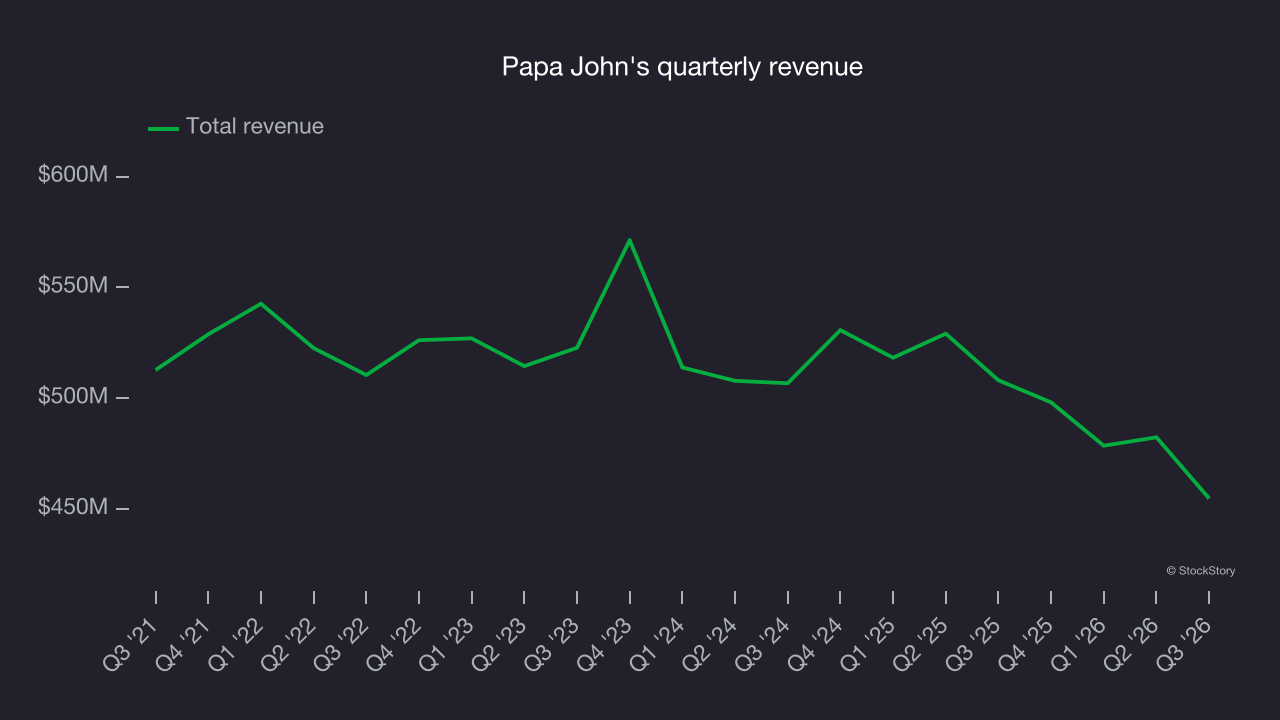
This quarter, Papa John's missed Wall Street’s consensus estimates and reported an uninspiring 10.5% year-on-year revenue decline, generating $454.8 million in revenue.
Looking ahead, sell-side analysts expect revenue to decline by 3.8% over the next 12 months, according to S&P, a deceleration versus the last seven years. This projection is underwhelming and implies its menu offerings will face some demand challenges.
Restaurant performance
Number of restaurants
The number of dining locations a restaurant chain operates is a critical driver of how quickly company-level revenue can grow.
Papa John's operated 5,969 locations in the latest quarter, and over the last two years, has kept its restaurant count flat while other restaurant businesses have opted for growth. Furthermore, the company’s franchise model makes expansion easier: franchisees are primarily responsible for opening new restaurants while Papa John's provides support.
When a chain doesn’t open many new restaurants, it usually means there’s stable demand for its meals and it’s focused on improving operational efficiency to increase profitability.
Same-store sales
A company’s restaurant base only paints one part of the picture. When demand is high, it makes sense to open more. But when demand is low, it’s prudent to close some locations and use the money in other ways. Same-store sales offer insight into this topic by measuring organic growth at restaurants open for at least a year.
Papa John’s demand has been shrinking over the last two years as its same-store sales have averaged 2.7% annual declines. This performance isn’t ideal, and it would be concerning if Papa John's started opening new restaurants to artificially boost revenue growth.
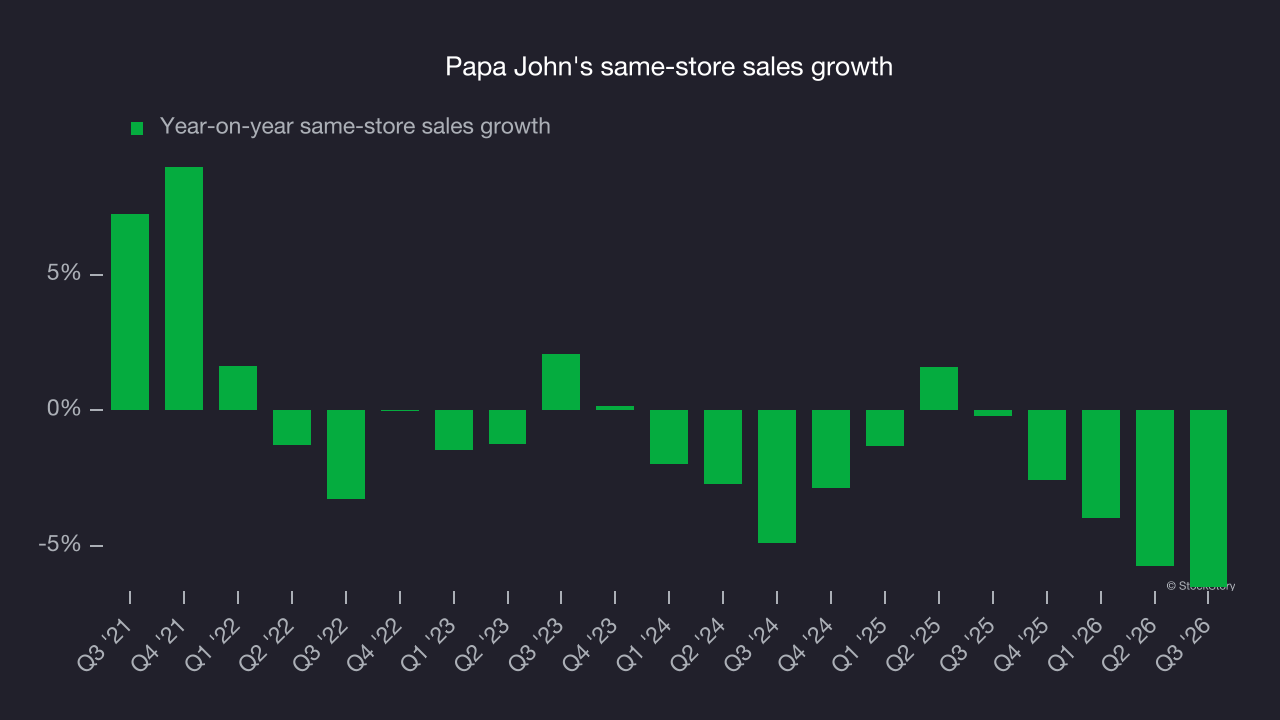
In the latest quarter, Papa John’s same-store sales fell by 6.5% year on year. This decrease represents a further deceleration from its historical levels.
Key takeaways from Papa John’s Q3 results
Papa John's full-year EBITDA guidance missed expectations, and same-store sales fell slightly short of Wall Street’s consensus estimates. EPS met analysts’ consensus estimates, but that was not enough to make this a better quarter overall. Shares tumbled 6.3% to $18.73 immediately after the results.
Papa John's may have had a tough quarter, but assessing whether it presents an investment opportunity requires a broader view. The latest quarter is only one piece of the longer-term business quality picture. Quality, when combined with valuation, can help determine if the stock is a buy. For more on Papa John’s, read our full research report here (it’s free).