Luxury fashion conglomerate Tapestry (NYSE: TPR) reported calendar Q3 2026 (fiscal Q1 2027) results exceeding the market’s revenue expectations, with revenue up 12.1% year on year to $1.89 billion. The company expects the full year’s revenue to be around $8.55 billion, close to analysts’ consensus estimates. Its non-GAAP profit of $1.82 per share was 16.4% above analysts’ consensus estimates.
For more on Tapestry, read our free full research report.
Tapestry (TPR) Q3 CY2026 highlights:
- Revenue $1.89 billion vs S&P analysts’ consensus estimates of $1.85 billion (12.1% year-on-year growth, 2.6% beat)
- Adjusted EPS $1.82 vs S&P analysts’ consensus estimates of $1.56 (16.4% beat)
- Adjusted EBITDA $524 million vs analysts’ consensus estimates of $428.5 million (27.7% margin, 22.3% beat)
- Revenue guidance The company lifted its revenue guidance for the full year to $8.55 billion at the midpoint from $8.45 billion, a 1.2% increase
- Adjusted EPS guidance Management raised its full-year adjusted EPS guidance to $8.30 at the midpoint, a 5.7% increase
- Operating margin 22.4%, up from 19.4% in the same quarter last year
- Free cash flow margin 7.9%, up from 4.7% in the same quarter last year
- Constant currency revenue rose 11% year on year (12% in the same quarter last year)
- Market capitalization $24.87 billion
Revenue growth
Examining a company’s long-term performance can provide clues about its quality. Even a poor business can perform well for one or two quarters, but a high-quality one grows for years. Over the last five years, Tapestry grew its revenue at a weak 6.2% compounded annual growth rate, falling short of the consumer discretionary sector standard.
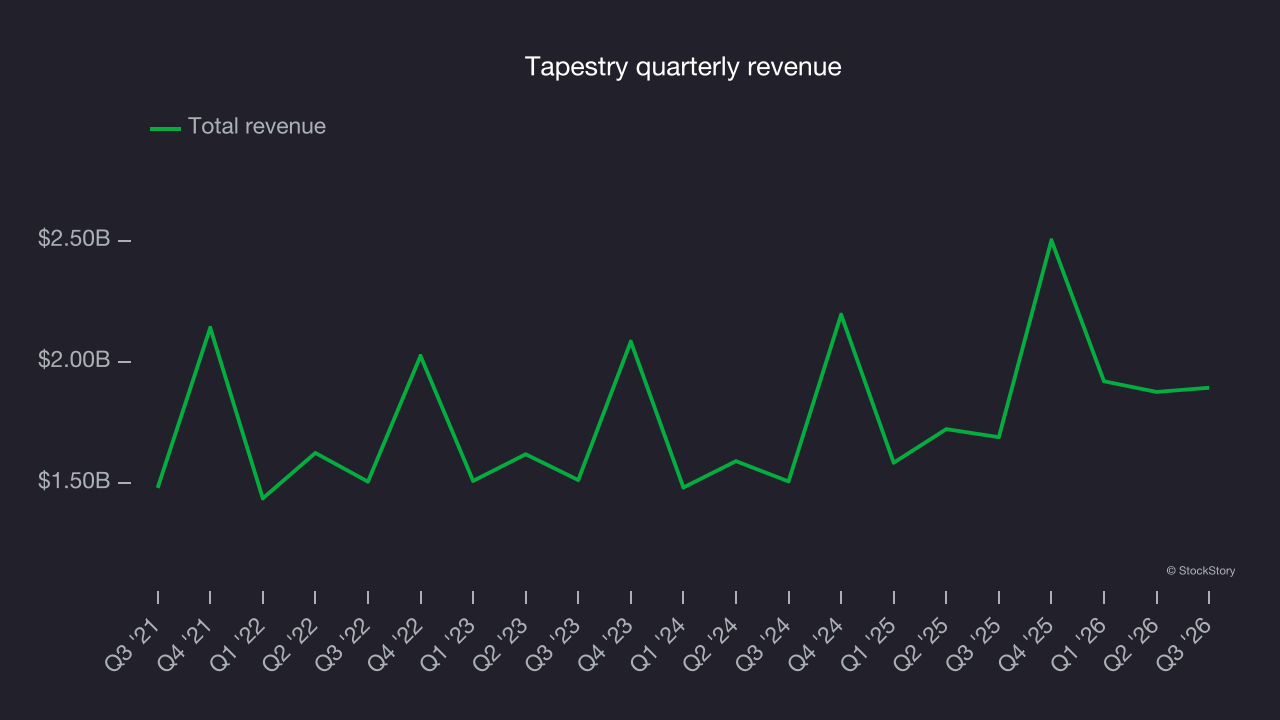
Long-term growth is the most important, but within consumer discretionary, product cycles are short and revenue can be hit-driven due to rapidly changing trends and consumer preferences. Tapestry’s annualized revenue growth of 10.9% over the last two years is above its five-year trend, a positive sign. 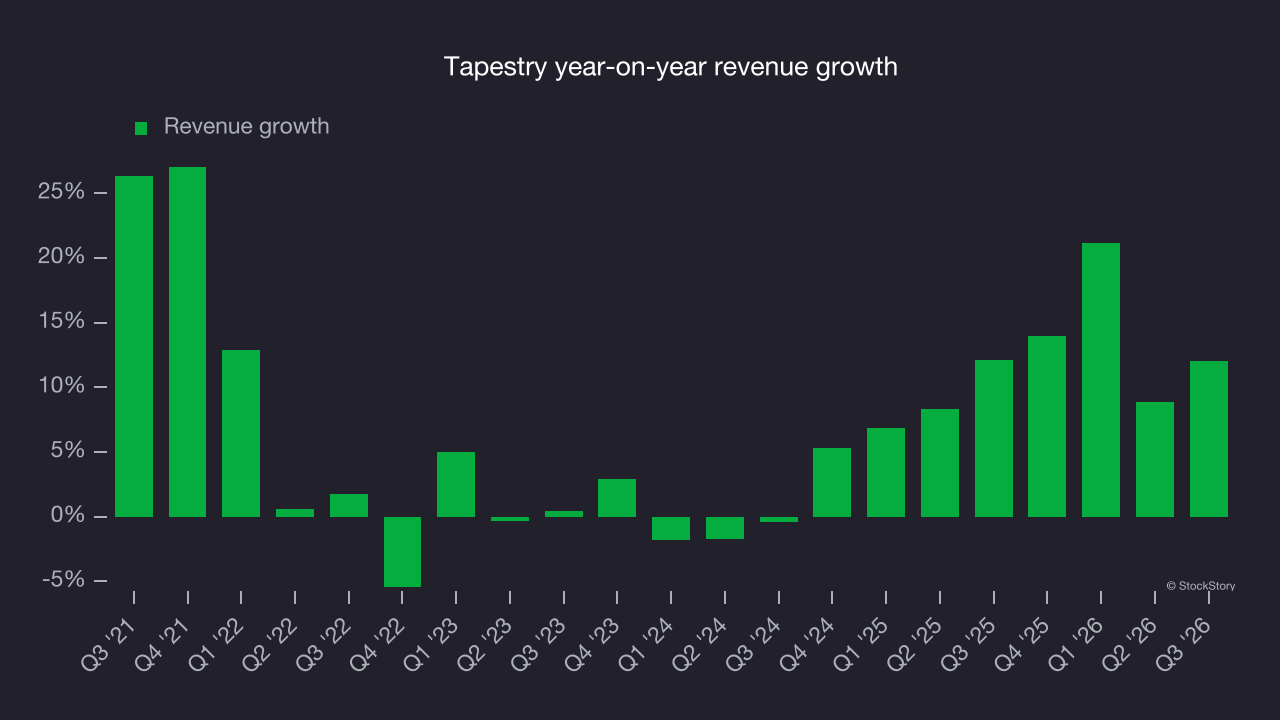
The company’s revenue dynamics become clearer by analyzing constant currency revenue, which excludes currency movements that are outside its control and not indicative of demand. Over the last two years, its constant currency revenue averaged 11.5% year-on-year growth. This was in line with reported revenue growth, indicating that foreign exchange has not had a meaningful impact on revenue. 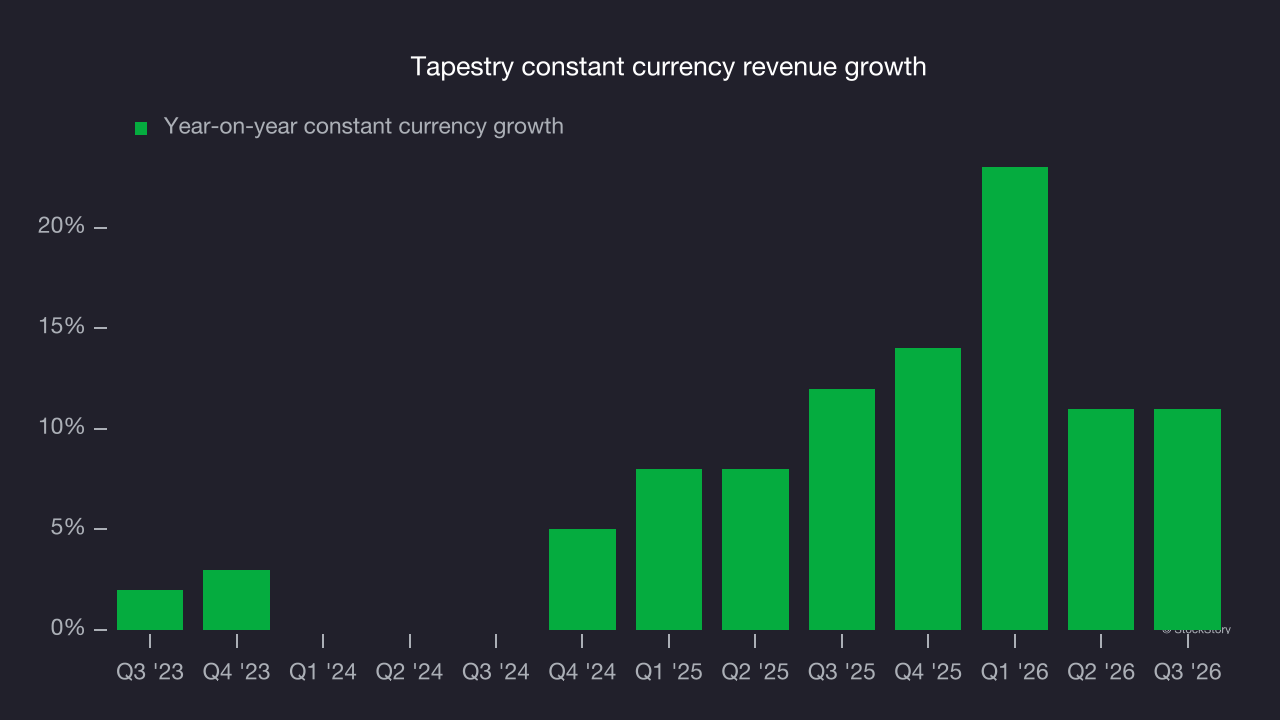
This quarter, Tapestry reported year-on-year revenue growth of 12.1%, and its $1.89 billion of revenue exceeded Wall Street’s consensus estimates by 2.6%.
Looking ahead, sell-side analysts expect revenue to grow 5.6% over the next 12 months, according to S&P, a deceleration versus the last two years. This underwhelming projection suggests its products and services will face some demand headwinds.
Operating margin
Tapestry’s operating margin has risen over the last 12 months and averaged 16.3% over the last two years. The company’s improved efficiency is a positive sign, but its suboptimal cost structure means it still has inadequate profitability for a consumer discretionary business.
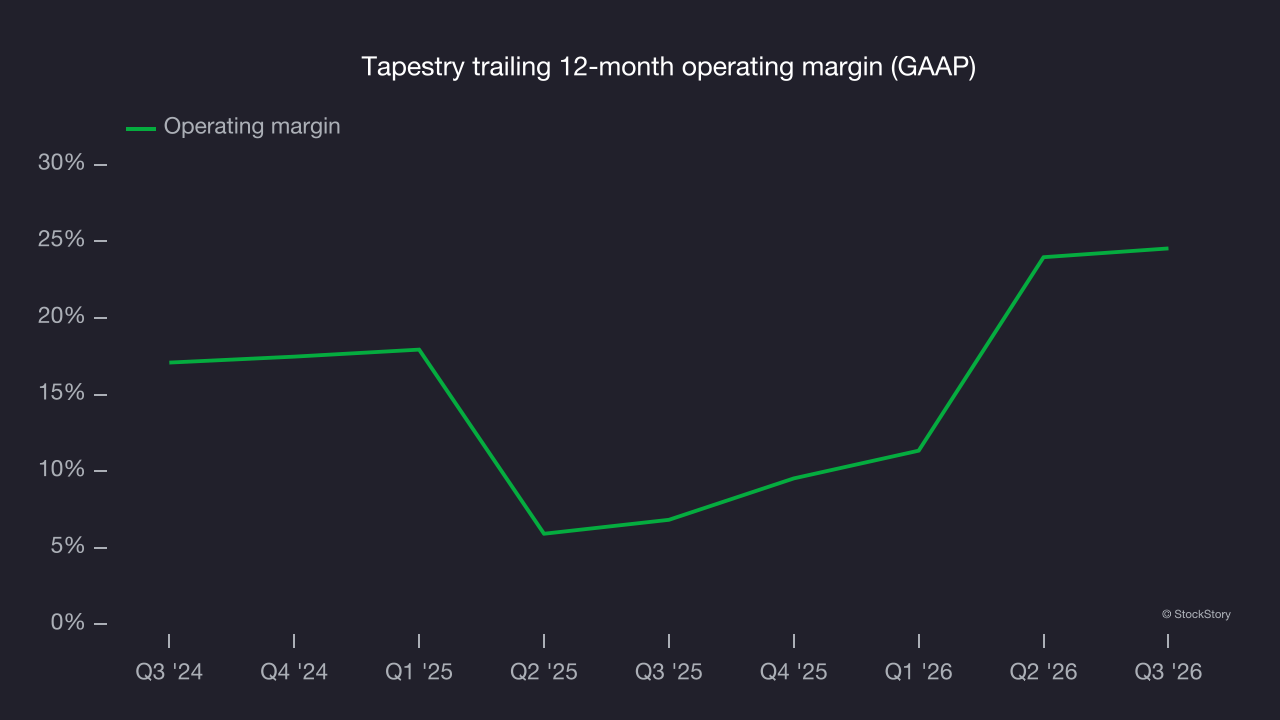
This quarter, Tapestry generated an operating margin of 22.4%, up 3 percentage points year on year. This increase was a positive development and shows it was more efficient.
Earnings per share
Long-term changes in earnings per share, or EPS, matter for the same reason as long-term revenue growth. Compared to revenue, however, EPS highlights whether a company’s growth is profitable.
Tapestry’s EPS grew at an 18.4% compounded annual growth rate over the last five years. On the positive side, this outpaced its 6.2% annualized revenue growth, indicating the company became more profitable on a per-share basis as it expanded.
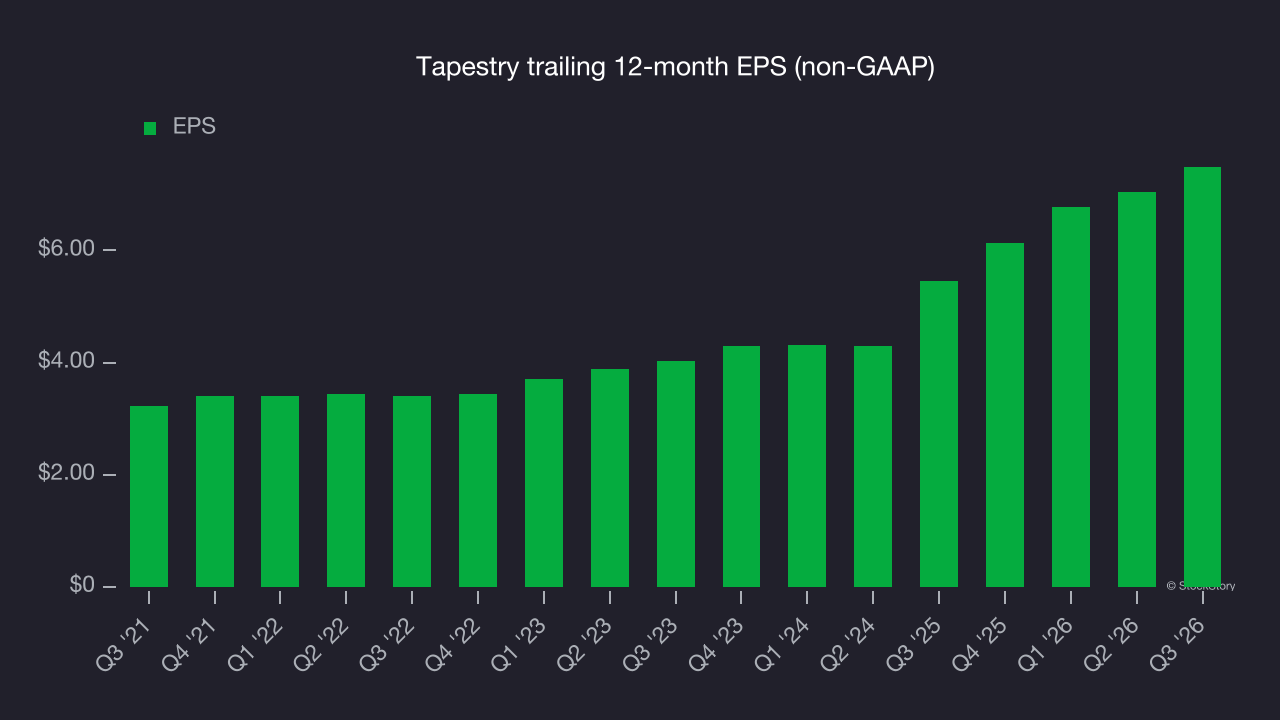
In Q3, Tapestry reported adjusted EPS of $1.82, up from $1.38 in the same quarter last year. This result comfortably beat analysts’ consensus estimates, a positive for shareholders. Over the next 12 months, Wall Street expects Tapestry’s full-year EPS to grow 7.9% from $7.49 to $8.08, according to S&P.
Key takeaways from Tapestry’s Q3 results
EBITDA and EPS both beat Wall Street’s consensus estimates, giving Tapestry a solid Q3 with key metrics above expectations. Shares soared 10.3% to $138.15 immediately after the results.
Tapestry had a good quarter, but that alone does not make the stock a good investment. The decision also depends on valuation and business quality, not just the latest earnings. For more on Tapestry, read the full research report here (it’s free).